Space is huge — full of planets, stars, galaxies, meteors, moons, cosmos, and more. Imagine seeing all that up close through a telescope!,So Far and Yet So Near,Space is huge — full of planets, stars, galaxies, meteors, moons, cosmos, and more. Imagine seeing all that up close through a telescope!
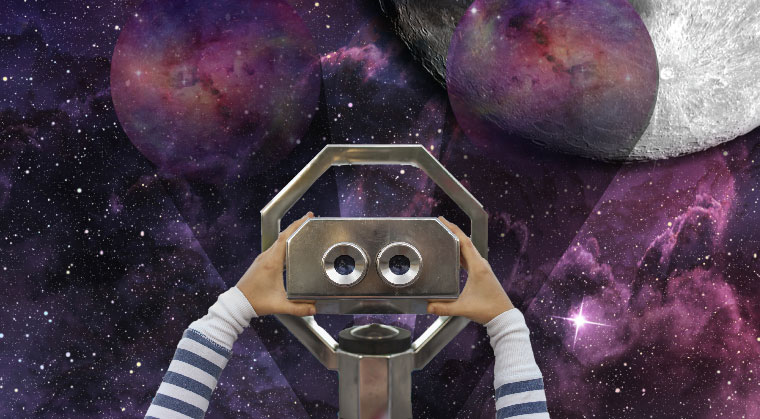
Photo: Shutterstock
Y our camera can zoom in to make faraway images look close. Something tiny under a microscope appears huge. Eyeglasses make images sharper and in focus.
To see the sky and beyond? For that we need the telescope.
Kids you can be inventors too! Rumor has it that the first telescope was invented by children. In Holland around the year 1608 two curious Dutch boys were fooling around in Hans Lippershey’s eyeglass shop. Hans really wanted to shoo them out the front door lest they break expensive lenses but they were too busy experimenting to pay him much heed. “Hans look!” they shouted gesticulating wildly “that weather vane looks so close to us!” Hans saw that they were looking through two lenses. He placed a tube around the lenses called it a kijker (Dutch for “looker”) and the telescope was born.
News of this fantastic new “looker” also called a spyglass reached the ears of Italian astronomer physicist mathematician inventor and philosopher Galileo Galilei (1564-1642). Galileo built his first telescope in 1609. While those early telescopes only magnified several times Galileo’s were much stronger. By 1610 his 30x telescope (sees things 30 times bigger) led him to discover that the moon isn’t quite as smooth as it looks when viewed with the naked eye but actually full of craters (bowl-shaped depressions). He saw four of Jupiter’s moons. He proved that the planets orbit the sun not the earth. His findings were revolutionary in two senses: they were new and incited arguments. The people of his era refused to believe him. The Catholic Church forbade him from publishing his writings. The Inquisition put him on trial. But he kept on observing studying and secretly writing. Way to go Galileo — never give up!
Create a free account to keep reading.