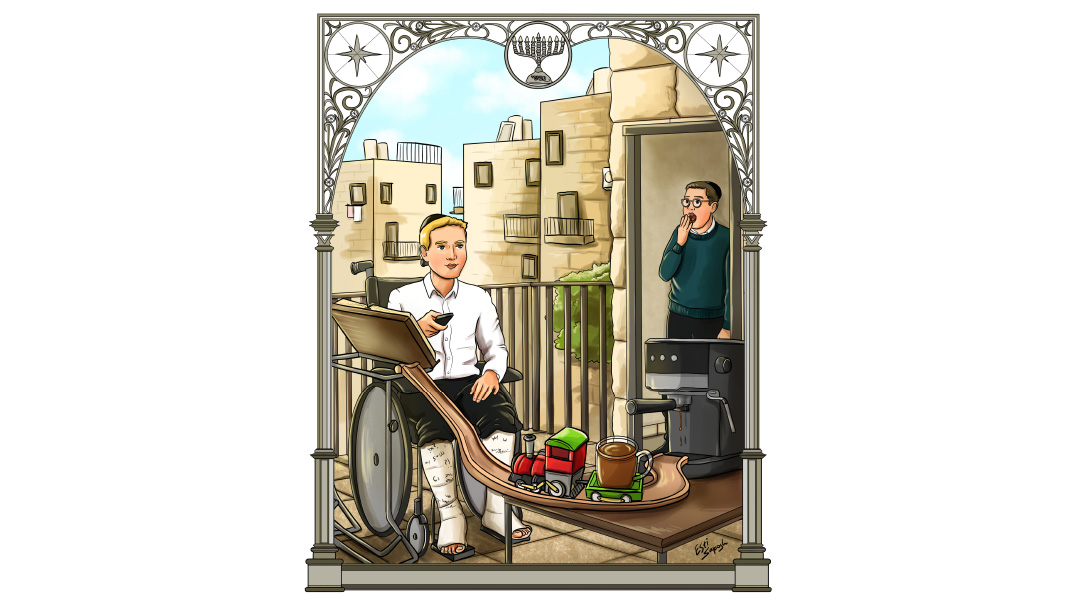
Shulchan Aruch rules that when one builds a home, he needs to leave a square amah (approx. 22 x 22 inches) in an unfinished state as a zeicher l’Churban


Prepared for print by Faigy Peritzman
Shulchan Aruch rules that when one builds a home, he needs to leave a square amah (approx. 22 x 22 inches) in an unfinished state as a zeicher l’Churban, a token reminder that the Beis Hamikdash is yet to be rebuilt. In the past, this halachah wasn’t widely observed, since most Jews didn’t build their homes from scratch, but purchased second-hand homes built by non-Jews. Nowadays, when there are many Jewish builders (especially in Eretz Yisrael), more and more people are observing this halachah in the way it’s supposed to be kept.
It’s neither a halachah nor a superstition, but advice from Rav Yehudah Hachasid, who warns homeowners not to completely close up any opening, since that will “block the sheidim from exiting” and may harm the people who live there. As with any advisory of Rav Yehudah Hachasid, which aren’t meant to be binding halachos but recommendations, some people follow them strictly, others follow them in part, and others don’t follow them at all. In your case, there’s an additional reason for leniency, since Rav Shlomo Zalman Auerbach is quoted as ruling (orally) that this applies only to an external door or window, not an internal one. Other poskim suggest that if you close up a window or door, but replace it with alternative exits, then the advice can be disregarded.
If the side posts of the arch are ten tafachim (about 35-38 inches) tall before they begin to arch, then the archway is considered a standard opening and requires a mezuzah.
Your son-in-law was quoting a ruling of the Chazon Ish, who maintained that a picture (or a clock) hanging on the wall is muktzeh and may not be moved on Shabbos for any reason. The Chazon Ish explains that since a picture hung on the wall is consigned to be in a designated place and isn’t meant to be moved, it’s considered a form of muktzeh to touch it, similar to muktzeh machmas chisaron kis (a class of muktzeh which includes fragile or delicate items which aren’t moved for fear of damaging them). Note, however, that many other poskim, including Rav Moshe Feinstein, disagree and don’t consider a picture or a clock hanging on a wall to be muktzeh. In their view, those items aren’t considered “consigned to a dedicated place,” but are hung on the wall for the purpose of displaying them.
Create a free account to keep reading.