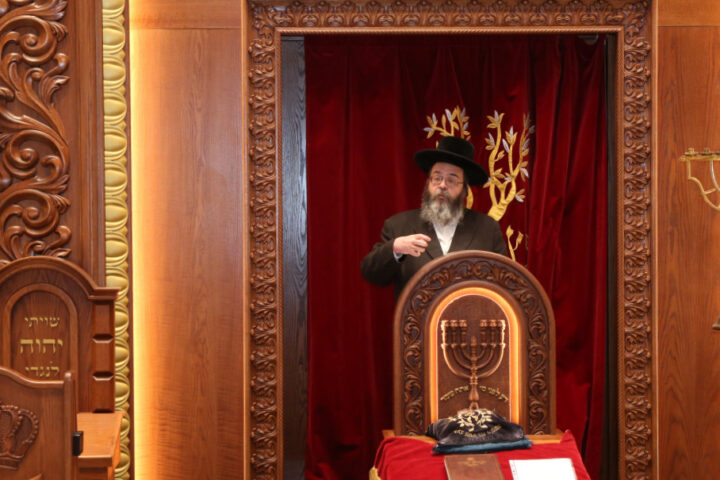
“If you have a good voice, it’s a gift from Hashem and a responsibility”

I’m the youngest of a very musical family. My father served as the chazzan in our town for Rosh Hashanah and Yom Kippur, and my mother trained as a singer. As you can imagine, our Shabbosim were filled with beautiful zemiros. When I was eight, I joined the Miami Boys Choir together with my older brother Duvie. This meant a two-hour drive into Brooklyn, a ride my mother undertook with dedication. It was meaningful to her for us to commit to music, and because of that, it became something meaningful to us as well.
Joining the Miami Boys Choir brought unforgettable moments and meaningful friendships into my life. We were a diverse group, all coming from different communities and backgrounds. Some boys were Modern Orthodox, some were chassidish, Litvish, Sephardi, and it honestly didn’t matter. We weren’t connected by who we were and what we did. We were connected over what we believed in, and that was the music of Hashem. I still keep in touch with some of those friends, even after 20+ years. We had incredible experiences together, like our trip to Mexico and Universal Studios in LA, that I can’t forget. That being said, it wasn’t always easy. My entire Sunday was reserved for choir practice since it took two hours to travel to Brooklyn, another two hours for the practice itself, and then two hours to get back. While my friends were enjoying Little League or birthday parties, I was either at choir practice or singing at a show.
I continued to create and sing songs on my keyboard as I aged out of the choir. I knew singing would be part of my future; I just didn’t know how or when. I was determined to do anything to give it a shot. After I got married, I started from the ground up, schlepping my equipment and singing at engagement parties and bar mitzvahs. I was pretty successful, but it wasn’t what I wanted to be doing long-term. I wanted to put out my own material. I started telling people I was a singer, and begged them to let me sing at weddings, but no one believed me. It wasn’t until after I stopped doing small gigs that anyone gave me a chance. Soon after, performing at weddings became my main parnassah. Motivated by that, I decided I wanted to put out an album. I took out a large loan, which was super risky at the time, but something I knew I had to do in order to have a chance at performing and inspiring. Baruch Hashem, my first album, Kol Haderech, became an instant hit and I was able to pay back the loan within the year. It was then that my journey as an artist really started.
I get up early to daven before sending my kids to school or camp. Afterwards, I dedicate some time to learning before heading to the studio. When I’m immersed in a music project, I can spend up to twelve hours there. On days when I’m not in the studio, I concentrate on exercising, creating new songs, and going to voice lessons. Often, my nights are busy with performing at weddings or concerts. Although my job doesn’t have a fixed schedule, I try to have some semblance of routine.
Create a free account to keep reading.