His experiences on this journey so impressed him that he committed himself to religious observance
—Dr. Samuel Schmidt, report for the Vaad Hatzalah on the state of refugee yeshivos in Lithuania, Spring 1940
Samuel Schmidt was born in Kovno in 1883 and immigrated with his family to the United States in 1896, settling in Boston. Following his graduation from MIT with a degree in engineering, he joined international relief efforts for his people when he was dispatched to the Holy Land by the Joint Distribution Committee’s Zionist Medical Unit for Palestine and assigned to deal with issues of sanitation, cholera, and malaria during World War I. In the early 1920s, he went to Poland as a representative for the Joint, to oversee medical relief efforts after the devastation of the First World War.
In 1926, having settled by this time in Cincinnati, he established a local Jewish newspaper called Every Friday, which he edited continuously until his passing almost four decades later. He rose to communal prominence with leadership positions in Bnai Brith, the American Jewish Congress, the Jewish National Fund, and the Poalei Zion faction of the Zionist movement. He held a traditional level of observance and was well known in the wider Jewish community, including to the titular leader of Cincinnati orthodoxy, Rav Eliezer Silver.
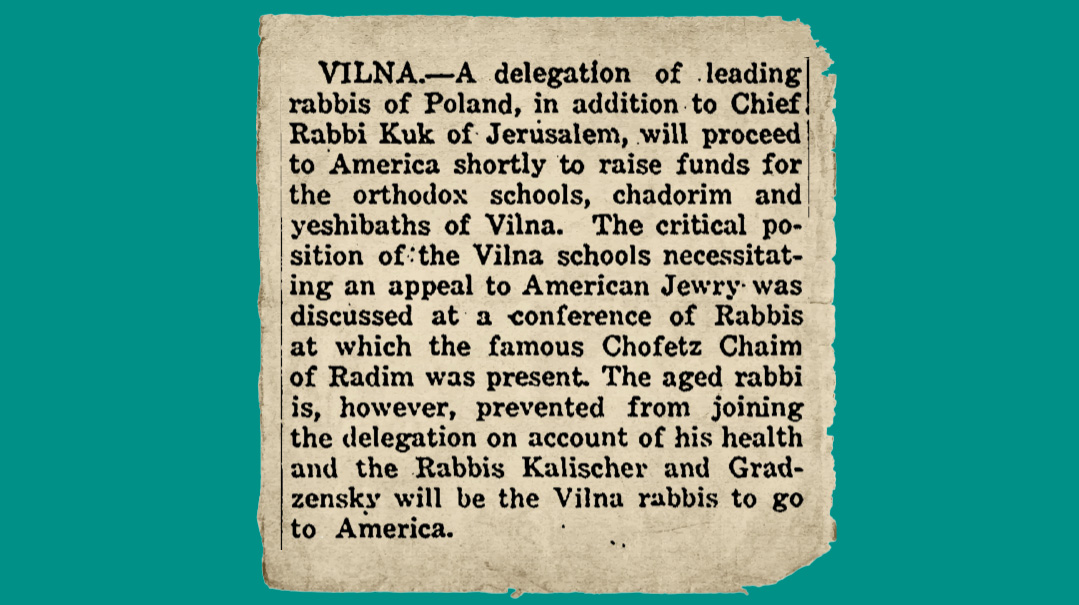
When World War II broke out in September 1939 and the Red Army occupied eastern Poland, the Soviet Union decided to return the Vilna region to independent Lithuania. When news of Vilna’s transfer from war-torn, Soviet-occupied Poland to independent and neutral Lithuania was publicized in October, it presented an incredible opportunity for Polish Jewish refugees. Among those who availed themselves of this venue of escape were the majority of the Lithuanian-style yeshivos in Soviet-occupied eastern Poland, heeding the call of the venerable leader of the Torah world, Rav Chaim Ozer Grodzenski, to escape the clutches of the anti-religious Communists.
Create a free account to keep reading.