TORAH → FOR THE RECORD Issue 1003 · March 13, 2024

Pockets of Poppy Seeds for Happy Holiday Hamantaschen

Hamantaschen have played a large role in Purim celebrations for centuries
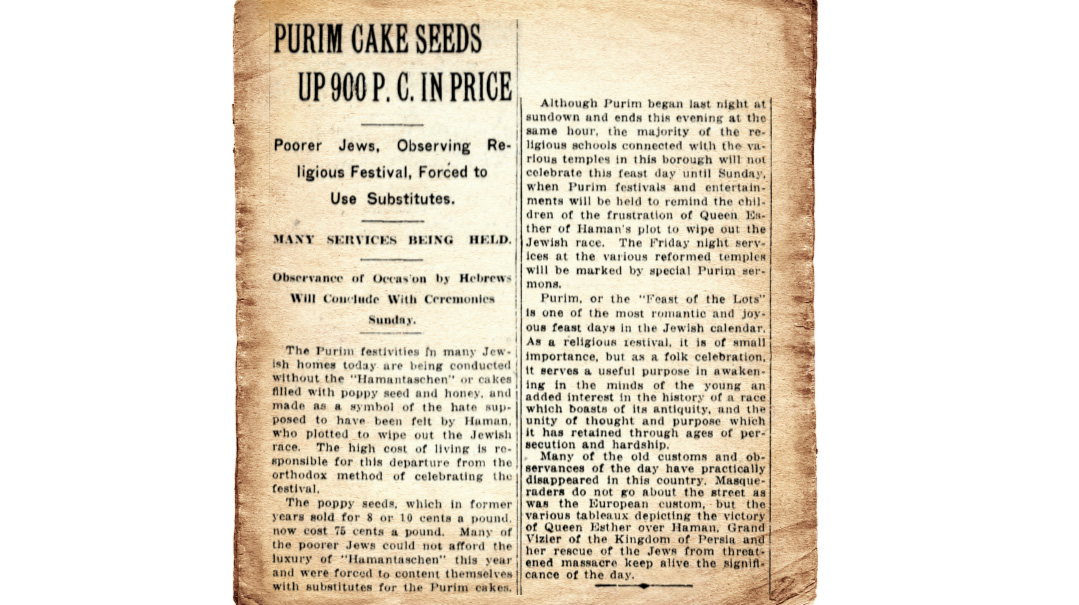
Pockets of Poppy Seeds for Happy Holiday Hamantaschen
Title: Pockets of Poppy Seeds for Happy Holiday Hamantaschen
Location: New York
Document: Brooklyn Daily Eagle
Time: 1917


Jewish studies scholars have unfortunately not given the topic of culinary history the attention it deserves. Very few scholars have researched this neglected subject.

—Mordecai Kosover, Yiddish author, 1965

In the early days of Adar one year, and my great-grandfather [Rav Yaakov Berlin] noticed on his way to shul that the baked goods vendors… weren’t selling any of the honey- and poppy-flavored pastries usually baked in honor of Purim. The custom had always been that from the beginning of Adar, the bakeries would sell these three-cornered Purim cakes referred to as “Haman-taschen.” The children’s excitement in purchasing them greatly fed into the Purim atmosphere.…
Upon inquiry, my great-grandfather discovered that due to the unusually high prices of wheat flour that season, the bakers had purchased enough flour for such necessities as bread, but not sufficient supplies for cakes and treats. Later that day, he summoned two of the main bakers in town and gave them each 30 gold coins to procure additional flour for the express purpose of baking and selling hamantaschen as was the yearly tradition. The community was happy, and this special minhag wasn’t lacking that year due to his efforts.

—Rav Baruch Epstein, Mekor Baruch, Volume 2

Though shapes and ingredients vary widely, hamantaschen in Yiddish (oznei Haman in Hebrew), have played a large role in Purim celebrations for centuries in Jewish communities around the world with diverse communal traditions.

Various explanations have been offered about the name. The Yiddish word for pocket, tasch, possibly refers to Haman’s pockets, which he emptied of contents to bribe King Achashveirosh to exterminate the Jews. Alternatively, it may refer to the Hebrew word tash, which means weaken, evoking the idea of weakening Haman through the miracle of Purim.

However, it’s much more likely that tasch derives its name from the dough pocket containing some sort of delicious filling. This is especially likely given the custom of preparing kreplach on various Jewish holidays; hamantaschen likely evolved from this dumpling-like food.

Unless tasch actually refers to his own pockets, the connection to Haman is somewhat mysterious. The most popular filling for centuries was poppy seed or mohn, so the pastry was given the German name mohntasche. German-Jewish bakers in the 19th century marketed them with an added ha– prefix to give it a Purim spin, and the name hamantaschen stuck. Although the poppy seed filling ’s popularity was due to the tastes of European Jews, a symbolic meaning grew around it, linking it to the seeds eaten either by Queen Esther or by the prophet Daniel in Nevuchadnetzar’s palace.

Continue reading with Mishpacha.

Create a free account to keep reading.

Everything you need to stay close to Mishpacha.
← Previous installment Bulwark of the Balkans Next installment → Purim Edition: Readers' Mailbag