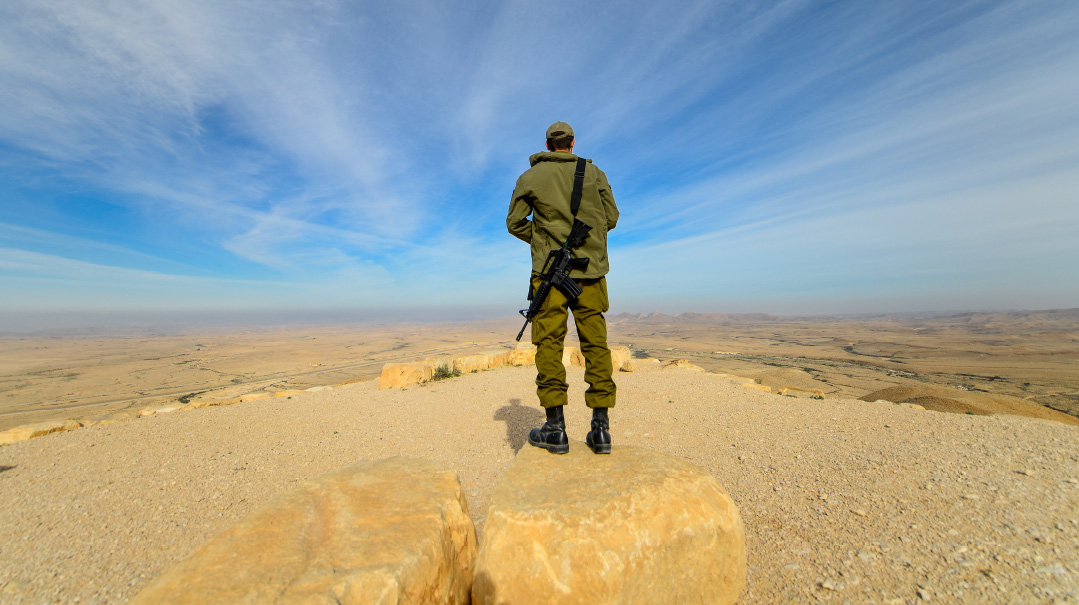
PHOTO: SHUTTERSTOCK / RAN ZISOVITCH
“These organizations don’t care whether IDF soldiers committed war crimes. For them, even an arrest is already a victory.”
The last-minute escape of an IDF soldier from potential arrest in Brazil for alleged participation in “war crimes” has set off alarms in Israel. It appears that young Israelis traveling abroad could face detention based on false accusations, despite having fulfilled their duty to defend their country in one of its most harrowing wars.
Yuval Vagdani, 21, was vacationing in Brazil with friends, taking a well-deserved break after serving several months in the Israel Defense Forces, when he received a warning from Israel’s Foreign Ministry: He had to leave Brazil immediately. If he stayed, he risked arrest.
The Brazilian judiciary was pursuing him in response to charges filed by the Hind Rajab Foundation (HRF), a pro-Palestinian organization whose goal is to prosecute anyone involved in the legitimate defense of the State of Israel. The HRF has systematically accused IDF soldiers of participating in what they label “genocide.” In Vagdani’s case, they alleged his involvement in the demolition of civilian homes in Gaza, using social media posts as evidence.
While Vagdani — himself a survivor of the Nova music festival attack — was fortunate enough to return to Israeli soil, more than 1,000 soldiers have been accused by the HRF and face the risk of arrest abroad.
To better understand the soldiers’ predicament and learn how they can avoid detention, we spoke with attorney Nitsana Darshan-Leitner, director of Shurat HaDin. The organization describes its mission as “defending against lawfare suits, fighting academic and economic boycotts, and challenging those who seek to delegitimize the Jewish state.”
Darshan-Leitner says, “Soldiers should delete content from their social media accounts.” She also says Israel must take a firm stand against countries that detain its soldiers.
In conversation with Mishpacha, Darshan-Leitner shed light on an issue that appears to be only at its inception.
How do you explain the near-detention of soldier Yuval Vagdani in Brazil?
Since the International Criminal Court [ICC] issued arrest warrants against Binyamin Netanyahu and Yoav Gallant, pro-Palestinian and anti-Israel organizations have been emboldened by the notion that Israel commits war crimes. They argue that the individuals actively responsible for these alleged crimes are not the prime minister or defense minister, but the soldiers themselves. As a result, they’ve begun gathering evidence — primarily from soldiers’ social media accounts — and presenting it to courts worldwide with international jurisdiction over war crimes.
When such a court holds the authority to prosecute war crimes, anyone can present a claim saying, “This IDF soldier committed war crimes, and here is the evidence.” The court then evaluates whether sufficient grounds exist to launch an investigation. To investigate, the court must issue an arrest warrant for the soldier in question. This is simply a procedural step and doesn’t mean the soldier has been found guilty.
You mentioned the arrest warrants against Netanyahu and Gallant. Are these attempts to detain soldiers part of the same investigation?
No, they are separate cases. The ICC only issued warrants against Gallant and Netanyahu for alleged war crimes committed by IDF soldiers, holding them responsible as top officials. They gave the orders and directed the strategy. While this investigation is independent, the warrants against Netanyahu and Gallant have emboldened other countries to detain Israeli soldiers.
It’s common knowledge that soldiers in war follow orders from above. How is this not a defense?
Their argument is that soldiers are the ones who carry out actions on the ground. While it’s clear they receive orders, that alone isn’t deemed a sufficient defense. They claim soldiers could have executed orders differently or defied them outright, especially if the orders involved war crimes, which they were prohibited from carrying out under any circumstances.