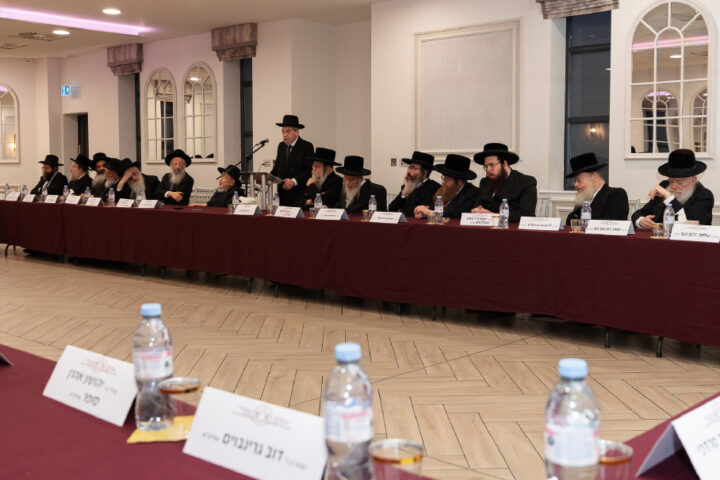
Clothes and head coverings define us, and clothes and head coverings divide us

Really, now! Threatening? Isn’t that verbal overkill? Perhaps the headline writer meant to write “worrying,” “upsetting,” “affecting,” or some such. When bread, milk, and vegetables prices soar — as they have — that is a threat, but if hat prices go up, say, from 150 to 200 dollars, that is painful, but not quite a threat to life and limb. Whereas one cannot eat last year’s veggies or drink sour milk, one can certainly wear an old hat.
Which leads to some random thoughts: Though the issue is not crucial, this headline illustrates the widespread carelessness with words. When we mean funny, we say “hysterical”; when we mean good, we say “fabulous”; when something is lovely, it is “awesome.” Soon enough, words lose all meaning and we run out of ways to express things, so that when something truly fills us with awe — the Kosel Hamaaravi, the Swiss Alps, the Grand Canyon, a once-in-a-century talmid chacham — we lack words. Thus, we have today’s verbal inflation; if every freshly ordained rabbi is a gaon, then the term becomes meaningless and so we use gaon amiti — “true gaon” ( implying that the adjective-less gaon is not amiti?). The dictum in Devarim 23:24, “Motza sefasecha tishmor, watch what emerges from thy lips,” while specifically referring to vows, might peripherally also be referring to careless speech.
All of which is forgivable, because of our natural desire to add verbal exclamation points to our words. The real problem occurs when such hyperbole is transferred to paper, to the written word. At that point, use of such hyperbole renders the entire text ludicrous and without meaning. The spoken word cannot simply be reduced to the written word without serious editing. The key to effective (and fabulous and fantastic…) writing is precision. That is why G-d gave mankind gifts like a thesaurus: to prevent folks from assuming that our carelessness with words reflects carelessness in our thinking.
Certainly, Torah-oriented Jews can appreciate this, for the Torah and Talmud are prime examples of this precision. There is not in the Torah a casual phrase, an unnecessary word. Every syllable contains subtle nuances that can be the catalyst for major teachings and halachic behaviors. Echoing this are the commentaries of Rashi and Rambam, who are Exhibit A of accurate and razor-sharp vocabulary which helps clarify otherwise difficult Biblical and Talmudic passages. The Bnei Torah who are threatened by soaring hat prices clearly understand this.
Create a free account to keep reading.