Senator Ted Cruz on why America needs to finish the job in Iran, supporting Israel, and the very Texan foreign policy of not letting terrorists get away with it
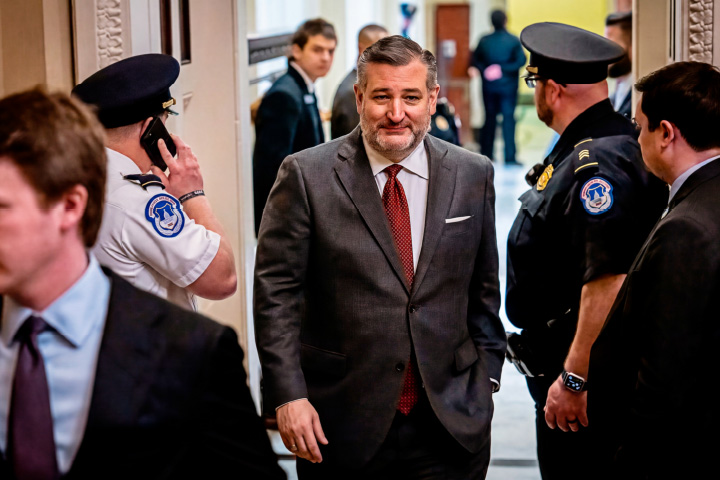
Photos: AP Images
Fourteen years when Ted Cruz was still trying to become Senator Ted Cruz, I interviewed him for the first time. This was back in 2012, when political candidates still had to kiss babies, shake hands, and pretend to enjoy county fair food. During that conversation, Cruz told me that one of the reasons he was running for Senate was to protect and defend Israel and the Jewish People.
At the time, while I did appreciate the assurance, I made sure to file it under: Things politicians say when speaking to a visibly Jewish reporter.
But 14 years later, the line hit different. As the world has come to realize, Cruz wasn’t just saying it. In fact, he’s built a Senate career around it. He said it before October 7, before the campus encampments, before the online right discovered that blaming the Jews garners more attention than minding your own business and reading a book, before Israel became the subject of daily moral lectures from countries whose idea of civil liberties is letting prisoners choose which wall to face, and before Jew-hatred achieved bipartisan participation.
I started the conversation by reminding him of what he had told me back then, and I asked what had given him the confidence and conviction to stand so firmly with the Jewish People through all the hostility Israel has faced since.
“Israel is America’s strongest and most reliable ally in the Middle East,” he declared. “We share common values. We’re both democratic societies that protect human rights.”
That answer could have gone sentimental. It did not. Cruz’s defense of Israel is not built primarily around ancient history, religious solidarity, or the emotional pull of the Jewish story, although he clearly understands all of that. His argument starts with something much simpler and harder for isolationists to dismiss without sounding like they lost an argument against a map.
“The enemies of Israel are the enemies of America,” Cruz said. “The United States’ friendship and alliance with Israel is overwhelmingly in the national security interests of America, and every time Israel takes out a Hezbollah terrorist, or a Hamas terrorist, or an IRGC terrorist, Israel is making America safer. We get enormous national security benefits from the Mossad, from the IDF, from the strong alliance we have between our two nations.”
Then his answer shifted from Israel’s enemies abroad to Israel’s enemies everywhere, including here.
“And right now, tragically, there are many forces in America and worldwide that are attacking Israel, that are attacking Jews,” Cruz said. “For more than a decade, we’ve seen antisemitism surging on the left, and disturbingly, in the past eighteen months, we’ve seen it surging on the right as well. I believe we need to stand up and defeat antisemitism, and I have resolved to lead the fight to defeat this poison, because I think it threatens to do irrevocable damage to America. Historically, antisemitism is the gateway drug to anti-capitalism and anti-Americanism, and you quickly go down that slippery slope.”
He then broke it down along party lines.
“Comrade Mamdani in New York City is a great example. Tucker Carlson is another. They start by hating Israel and hating the Jews, and they quickly move on to hating capitalism and embracing the enemies of America and hating America.”
Translated into Texas
I asked Senator Cruz where his conviction comes from. Because whatever one thinks of Cruz, this is not a new pose. He was defending Israel long before this war, before it became fashionable in some circles to treat Zionism like a felony. Cruz has clearly heard the question before.
“I get that question frequently,” he said. “How did a Cuban Texan Southern Baptist become the leading defender of Israel in the Senate?”
It is, admittedly, a fair question. On paper, “Cuban Texan Southern Baptist becomes one of Israel’s loudest defenders in Washington” sounds like the setup to a joke involving a rabbi, a rodeo, and a Senate Appropriations hearing.
Cruz’s answer came in two parts.
“Number one, a clear-eyed view of why standing resolutely alongside Israel is in America’s national security interest,” he said. “I think many in the pro-Israel community don’t focus enough on why it benefits America. Fundamentally, that is the core reason we should stand with Israel.”
That was the policy answer. Then came the childhood answer.
“I was a child when the Entebbe raid happened, but I remember it,” Cruz said. “And the Entebbe raid, to me — and this is through the eyes of a five-year-old — was Israel saying: If you take our citizens hostage, those citizens tragically may lose their lives, but you’re going to die.”
There are many ways to summarize Entebbe. Historians can discuss the operation, military analysts can study the rescue, Israeli families can speak about the trauma and heroism, and Prime Minister Netanyahu can speak about the brother he lost.
Ted Cruz, being Ted Cruz, took all of that and translated it into Texas.
“And I’ve got to say,” he added, “as a five-year-old in Texas, that seemed like a very Texan foreign policy to me. There is an absolute seriousness with which Israel conducts national security policy, because they are surrounded by nations who, if they could, would drive Israel into the sea. ‘From the river to the sea’ is not merely a slogan. It is a stated objective.
“And that clarity and strength and resolve and willingness to defend your national security interests, no matter what, I admire. And I think it is very much the same clear-eyed resolve America should have with defending our own national security interests.”
I asked whether he had ever discussed Entebbe with Prime Minister Netanyahu, who lost his brother Yonatan in the raid.
“Oh, I have,” Cruz said, “and we have discussed it at length. Hearing him tell it directly was powerful and meaningful.”
The Cost of Abandoning Israel
There is a question you can ask politicians that is usually more revealing than asking where they stand. Ask them what their position costs them. Anyone can stand for something when it polls well and anyone can deliver a nice Israel line at a donor dinner, especially if the salmon is good and the crowd already agrees. The question is what happens when the issue becomes uncomfortable, when the activists scream, when the podcasters rage, when the base gets confused, when the donors divide and when the easy applause gets replaced by political shrapnel?
So I asked Cruz whether there had ever been a point in the last 14 years when the cost of protecting Israel felt too steep.
“No,” he said. Then he explained. “I think the cost of abandoning Israel would be catastrophic.
“There is almost a perfect overlap. Those who chant ‘Death to America’ also chant ‘Death to Israel.’ Those who hate Jews also hate Christians. There is a reason the Ayatollah calls Israel the Little Satan and America the Great Satan. And I believe our interests are intertwined, and it would be a catastrophic mistake to cease to stand together as friends and allies.”
Then he pivoted to the danger he sees inside America.
“One of the reasons why I believe that antisemitism on the right is an existential threat is I don’t want to wake up in a country five years from now in which both major political parties are unequivocally anti-Israel and unapologetically antisemitic,” he said. “And I think that is a possibility.”
That is a heavy sentence, and he did not say it casually. Cruz’s point is that the Democratic Party already allowed antisemitism to metastasize by pretending it was little more than a rash.
“It was a decade ago that antisemitism rose in the Democrat Party, and Democrat leaders, by and large, looked the other way, hoped it would go away,” he said. “It has now consumed their party, and there is a very real pro-Hamas contingent in the Democrat Party.”
But his warning was not limited to Democrats. In fact, the right-wing part of the warning seemed to animate him even more, perhaps because it is happening inside his own political neighborhood. You get especially annoyed when the dumpster fire is on your side of the fence.
“On the right, it is much smaller. It is much more nascent,” Cruz said. “It is primarily a handful of podcasters and self-appointed influencers who are peddling their poison to young people, who are peddling their poison to teenagers and twenty-somethings.”
Then Cruz moved from analysis to declaration.
“And I’ve resolved I’m going to lead the fight to stop this,” he said. “I’m not going to see our party destroyed. I’m not going to see our country destroyed. And I’m not going to see these lies told to young people.”
Then he named Tucker Carlson.
“I think Tucker Carlson is the most dangerous demagogue in America,” Cruz said.
That is not the kind of sentence Republican elected officials usually say out loud. Many think it. Some whisper it. A few release vague statements about “voices on all sides” and then run away before anyone asks them to identify the voices, sides, or spine. Cruz did not do that.
“Virtually every elected Republican, other than President Trump, has been unwilling to call him out directly because he’s got a very big megaphone,” Cruz said. “I’m going to call him out directly because what he is saying every day — he is lying to people, and he is peddling a poison that is corrosive.”
Cruz argued that Tucker’s trajectory is not just anti-Israel or anti-Jewish.
“Not just attacking Israel, not just attacking Jews, but attacking President Trump almost on a daily basis, praising Mamdani, praising Islamists, having the president of Iran on his show and having a love fest, having Nick Fuentes, a self-avowed Nazi, on his show in a love fest, embracing sharia law, defending sharia law, defending Maduro.”
Then he summed it up.
“It is staggering.”
This is Cruz’s core argument: Antisemitism does not stay in its lane. It starts with Jews (because it always starts with Jews), but then it becomes a full conspiracy system, an ideological black hole into which every grievance gets sucked and from which no rational thought escapes.
“It is an object lesson in how antisemitism is a conspiracy theory and a poison that brings you down a rathole of hating everything about America,” Cruz said. “And Mamdani is a powerful illustration of the green-red intersection — how Islamists and Marxists very quickly overlap because they both hate the same people.”
This was the point in the interview when Cruz stopped sounding like he was discussing Israel policy and started sounding like he was describing a fire spreading through the walls of American politics. To him, antisemitism is neither a fringe fad, nor a cringe campus-crowd craze; it is the warning light that starts blinking before much larger systems begin to fail.
Tick Tuck
Since Cruz had just described antisemitism as a threat not only to Israel but to America, and since he had identified Tucker Carlson as one of its most dangerous carriers on the right, I asked what he wants President Trump to do about it.
“I think the president has been absolutely clear and unequivocal that [Carlson] has become an anti-Israel, pro-Iran apologist, an anti-American radical, and a very dangerous radical,” Cruz said. “I appreciate the president’s clarity on that.”
Then Cruz identifies Iran as the straw that broke the Tucker’s back.
“Look, it was President Trump’s decision to take military action against Iran that really broke Tucker Carlson,” Cruz said.
The theory goes that Tucker Carlson wasn’t just wrong about Trump and Iran, he may have been played. Tucker had met with Trump in the Oval Office, and apparently came away convinced that the president was bluffing about a strike, an assurance he passed along to Iranian upper echelons, directly or otherwise. Armed with that particular disinformation, the regime felt emboldened enough to call for a leadership-wide meeting in their not-so-secret lair. If true, that would explain why it seemed to break Tucker so personally. He got played and the world got to watch it play out in real time.
The conversation segues to Iran.
“I believe the decision to launch the military attack on Iran was the most consequential decision of Donald Trump’s second term,” he said. “I think he did exactly the right thing. I think taking out the Iranian military has made America significantly safer. And President Trump is a resolute commander in chief who is going to protect the American people, and that is his central job.”
Then Cruz disclosed how directly he has been pressing the president.
“I talk to President Trump — sometimes every week, sometimes every day,” he said. “And just a few days ago I spoke with him and urged him — on Iran, hold the line. Don’t listen to the voices urging him to take a bad deal. Instead, hold the line that President Trump has laid out many, many times: no nukes, absolutely zero enrichment, and Iran must hand over all of their enriched uranium.”
Cruz believes Trump has the position right and that the danger is not weakness from Trump but pressure around him, the eternal Washington surround-sound chorus of Take the Deal, Bank the Win, Declare Victory, and Schedule the Reception.
“President Trump is right on that,” Cruz said.
Then Cruz circled back to Carlson.
“And Tucker Carlson and his acolytes, who want Iran to win — and to be clear, Tucker has said that on air, that he thought it would be good if Iran prevailed,” Cruz said. “He also predicted Iran would defeat the United States and thousands of Americans would die.”
Cruz did not bother hiding his contempt for that prediction.
“So every prediction Tucker makes — virtually every prediction — comes out wrong,” he said. “President Trump is doing the right thing, and I urged him to stay the course.”
That raised the obvious next question. If Trump did the right thing militarily, what now? Destroying things is one kind of policy, and deciding what comes after the destruction is another. Washington is very good at confusing the two, which is how it sometimes ends up throwing a parade for Step One while Step Two is hiding in the bushes with a strongly worded statement.
So I asked Cruz whether he was concerned about how long the conflict had been taking, and especially about the president seeming bent on reaching a deal with the very regime whose military had just been smashed.
Thirty-Nine Days
Cruz rejected the concern by first giving me his scoreboard.
“This military conflict has lasted a couple of months,” he said. “If you look at what has been accomplished in that time period, it is extraordinary. The military success is extraordinary.”
Then he began listing what he said had been achieved.
“The president, at the outset, laid out specific objectives: their ballistic missiles are entirely destroyed, their drones are entirely destroyed, their manufacturing capacity to build more ballistic missiles and more drones are completely destroyed. Their air defense system is gone. Their air force is in rubble on the tarmacs. Their navy is sunk on the bottom of the ocean. The ayatollah is dead. Many of the mullahs are dead. Many of the IRGC leaders are dead.”
Cruz saying, that in essence, the military campaign worked. And yet, here we are.
“It took Iran 47 years to build this military,” he said. “It took the United States 39 days to utterly decimate it. In terms of military success, it is complete and total.”
But military victory, Cruz argued, should not be confused with the end goal. He then described what he sees as the economic phase of the campaign.
“Right now President Trump is carrying out a blockade of Iran, shutting down oil shipments,” he said. “That is imposing asymmetric costs of roughly five hundred million dollars a day on Iran as they are not able to export their oil. That is putting enormous pressure on them.”
Then Cruz stated plainly what he believes the objective should be.
“What I think the objective should be is regime collapse,” he said.
Not regime behavior modification; not a sternly supervised international compliance architecture; not a nuclear deal with footnotes, annexes, side letters, secret understandings, sunset clauses, and a European diplomat explaining why this time the mullahs definitely mean it.
“I think our objective should be removing from office radical Islamists who chant ‘Death to America’ and who fund terrorists who are actively murdering Americans,” Cruz said.
Then he added an important caveat.
“I don’t have a dog in the fight as to who the next leader of Iran is,” he said. “That’s for the people of Iran to decide.”
But he does want America to help the Iranian people create the conditions to make that decision.
“One of the things that I have urged President Trump to do, and I’ve also urged the State of Israel to do, is to arm the protesters,” Cruz said. “Let the Iranian people be their own boots on the ground. Let the Iranian people remove this regime. We’re not going to send American soldiers to do that. Early in this conflict we saw the regime murder somewhere between ten and forty thousand Iranians who rose up against them. It is not fair to expect protesters with rocks to be able to fight soldiers with machine guns.”
His solution is direct.
“If we arm the protesters so that the protesters can fight back and defend themselves, I think that is one of the ways we facilitate regime collapse,” Cruz said. “And a stable government in Iran that wants to be friends with America would be world-changing, and would make America much, much safer.”
That naturally led to the question of Crown Prince Reza Pahlavi, who has become one of the best-known opposition figures associated with the idea of a post-Islamist Iran.
Did Cruz have a relationship with him?
“I have met him several times,” Cruz said. “He is certainly working and working hard, and is one of the serious candidates to lead his nation.”
But again, Cruz was careful not to cast America as kingmaker.
“It’s not my role to tell the Iranian people whom they should choose,” he said. “It is America’s role, however, to say the choice should not be a radical Islamist who wants to murder us. That choice is unacceptable and harmful to the safety and security of America.”
Then Cruz emphasized that the current regime was never democratically elected by the Iranian people.
“And to be clear, that choice is not a choice of the Iranian people,” he said. “This regime is a dictatorship. They enforce their power with a gun and with a lash. And if the Iranian people are able to overthrow this tyranny, that would be better for the people of Iran and better for the people of America.”
In a nutshell, let the Iranian people decide, but America gets veto power over any decision seeking to establish another radical regime.
One More Iranian Proxy
The world is held together by narrow passages, shipping lanes, ports, cables, pipelines, and the collective assumption that goods will continue moving because nobody insane enough has gained enough power in the right place to stop them. Until recently.
That assumption has been taking a beating. The Houthis figured out that you don’t need an aircraft carrier, a professional navy, or even matching uniforms to terrorize global commerce. You just need backing from the Iranian regime and the rest simply falls into place. One fanatical militia, parked near the right stretch of water, can force reroutes, raise insurance rates, disrupt supply chains, and remind the entire civilized world that the route to globalization runs through some bad neighborhoods.
That is the lens through which Cruz looks at the Polisario Front.
To most Americans, Polisario sounds like either a recalled Italian scooter, or a discount airline that charges extra for oxygen. In reality, it is a long-running separatist movement in the Western Sahara, a stretch of territory on the northwest African coast occupied by Morocco, whom Polisario is fighting to establish an independent homeland. For decades, that made it sound like a regional issue — as in dusty, drawn-out and distant.
But Cruz argues that Polisario is no longer just a Western Sahara story. In his view, it is becoming part of Iran’s proxy strategy. Cruz’s fear is that Polisario is close enough to a strategic lane of traffic to make the world pay attention. And when a local conflict becomes a vehicle for Iranian reach, it stops being local.
I asked him what patterns or developments he was seeing that make him think this story deserves far more attention, and why we’re not hearing much about it in the media.
“Well, Iran’s strategy is to wage war on America through terror proxies,” Cruz said. “For forty-seven years Iran has been the world’s leading state sponsor of terrorism. The Polisario Front, likewise in Western Africa, is today an Iranian proxy. They are funded by Iran, they are funded by Hamas, they are receiving weapons from Hamas, they are carrying out terror attacks.”
That is why Cruz introduced legislation to designate the Polisario Front as a terrorist group. But Cruz’s concern is not only that Iran has another proxy. It is where that proxy sits and the leverage that comes along with. Iran, Cruz argued, understands that.
“Iran is doing this, number one, to sow discord and disorder,” he said. “But number two, they have focused on geopolitical choke points. With respect to the Polisario Front, Morocco is quite close to Gibraltar, which is yet another critical trade and shipping route. By expanding terror control on these chokepoints,” Cruz said, “it gives Iran the ability to hold the world hostage.”
Hold the world hostage is a phrase that sounds dramatic until one remembers that the world’s economy is essentially a giant game of Jenga played on water, and the pieces are named Hormuz, Suez, Bab el-Mandeb, Gibraltar, Panama, Taiwan, and Internet cables nobody thinks about until they stop working.
“America obviously should not acquiesce in Iranian religious zealots being able to hold the world hostage,” Cruz said. “And so we should designate the Polisario Front as a terrorist group and treat them accordingly.”
I asked where Algeria fits into all this, given sources who tell me that the Algerian government is funding Polisario. That question could have opened a second front in the conversation, but Cruz did not take the bait. Instead, he narrowed the answer to the American interest.
“Look, at the end of the day, the regional conflicts are precisely that, regional conflicts. And that needs to be resolved on the ground.”
That was a revealing answer, because Cruz had spent the previous several minutes describing Iran’s global proxy strategy in sweeping terms. Here, he stopped short of making America the referee of every dispute in the region, drawing a distinction between regional conflicts, which he said must be resolved on the ground, and Iranian proxy activity, which he believes directly implicates American interests.
“The United States’ interest,” he said, “is preventing Iranian proxy groups from waging war, carrying out acts of terror, and threatening American interests.”
In other words, Cruz’s argument is not that America must solve North Africa. His argument is that America cannot ignore Iran using North Africa.
It was a narrow answer, but not an evasive one. It was Cruz returning to the same framework he used on Iran: America does not need to choose every leader, settle every border, or manage every local conflict. But when radical Islamist proxies threaten American interests, global shipping, or allied security, America does not get to pretend the map is too confusing and go back to sleep.
Staying on Point
By this point, Cruz was already on his way to the next meeting, which meant I had time for one last question. Naturally, I asked about his ambitions for 2028, because in Washington, no conversation is truly over until someone has pretended not to be running for president. (This is why politicians love us, by the way.)
“Anything you want to tell us about 2028?” I asked.
Cruz did not nibble.
“My focus is 2026,” he said. “These midterms will be pivotal. The Democrats have gone to the extreme left. Tragically, candidates like Graham Platner are the new face of the Democrat Party.”
He described Platner in brutal terms.
“A self-described Communist with a Nazi tattoo on his chest,” Cruz said. “Not just a Nazi tattoo, a Totenkopf, the symbol of the SS they wore in the death camps.”
Cruz accused Senate Democrats of backing him anyway.
“Virtually every Senate Democrat is supporting him in Maine because they hate Donald Trump so much that they’re willing to support a figure like this.”
His conclusion was blunt.
“And yet for the Democrats, it’s all about power.”
Then he returned to 2026.
“These midterms are critical,” Cruz said. “And I am doing everything humanly possible to help Republicans keep and grow our majority in the House and keep and grow our majority in the Senate. I think if the Democrats succeed in flipping Congress, it would have enormously harmful consequences to the country. And so that is very much my focus.”
So much for 2028.
The answer to the presidential question was the midterm answer. Which is, of course, the most presidential answer a politician can give, because no one running for president ever admits they are running for president until the Iowa bus tour has been arranged.
I told him that at times like these, many of us are grateful to G-d that He put him into this position and gave him the courage to stand up and say what he has been saying. I told him we do not take his support for granted, and that we pray for his success, his strength, and his continued leadership.
“Thank you, my friend,” Cruz said. “G-d bless you.”
The world has changed, the politics have changed, the hostility has changed, and the coalitions have changed. The enemies have learned new language, new platforms, new slogans, and new ways to pretend the oldest hatred is really just a brave new critique of foreign policy.
In a political world where convictions are often treated like campaign rentals, Cruz’s answer has not changed much at all. Fourteen years ago, he vowed to back the Jewish people. He meant it, and then he’s kept meaning it.