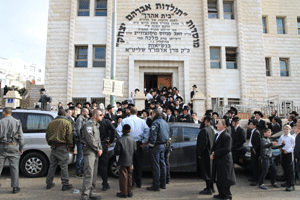
Throughout the world, images of a dusty, unremarkable Israeli city have been sparking debate and controversy. How did Beit Shemesh become a national tinderbox, and a symbol for secular-religious tensions?
Unlike the organic housing process familiar to Jews in the US where residents slowly and subtly leave their mark on an area the new neighborhoods in Beit Shemesh were planned and marketed to attract specific populations. The Sheinfeld neighborhood for example was earmarked as a national-religious neighborhood and marketed aggressively to potential immigrants in the United States beginning in 1992. The neighborhood known as Ramat Beit Shemesh Beit or Ramah Beit for short was planned as a chareidi area. This is typical of building trends in Israel today; contractors are charged with creating communities not just houses.
Considering that the Israel Lands Authority controls some 90 percent of Israel’s nearly five million nonforested acres land for residential development is scarce. Israel suffers from a chronic housing shortage and competition for land allocations between competing contractors or buyers’ groups representing different religious sectors is fierce.
That’s why many locals claimed there was an agenda fueling former Beit Shemesh mayor Daniel Vaknin’s decision to allocate land for the Orot girls’ school in Ramah Beit. Orot is a state religious school serving girls from the national-religious sector who reside in the Sheinfeld neighborhood which abuts Ramah Beit. Vaknin’s decision to situate the school past the border about 300 meters from Ramah Beit’s residential area was seen as an attempt to curb chareidi expansion.
According to Matti Rosenzweig a resident of Ramah Beit and spokesman for the municipality of Beit Shemesh this wasn’t the only time Vaknin utilized the tactic. Rosenzweig claims that the exact same scenario played out in Ramat Beit Shemesh Alef which was not officially declared a chareidi neighborhood; most of its residents are dati-leumi. At the time then-mayor Daniel Vaknin designated a plot of land in the center of Ramah Alef’s chareidi section for a “school for languages and culture ” with the express purpose in his own words of curbing the growth of the chareidi populace in the town. “The students in this school are bused in to the school from their homes in the Old City at the municipality’s expense ” Rosenzweig says. “The minister of education refuses to make any adjustments to this arrangement.”
Create a free account to keep reading.