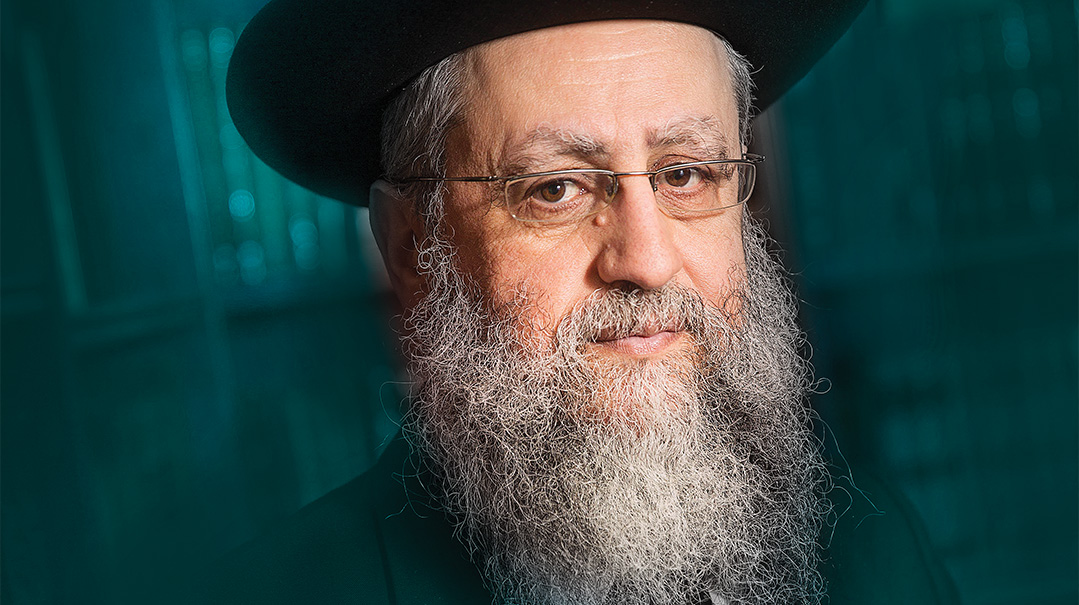
Rabbi Elazar Gelbstein says he's just following what's in his genes: for five generations his family has been in charge of Jerusalem's venerated Perushim Chevra Kadisha, and for the last 40 years, everyone knows to “call Gelbstein” whenever a burial or funeral complication arises. As 7 Adar approaches, the day when Chevra Kadisha members fast and say Tehillim for those who have passed away, Rabbi Gelbstein reminisces about the unknown dramas that sometimes accompany a niftar on his last journey.
Kehillas Yerushalayim Jerusalem’s government-sponsored chevra kadisha is no stranger to the horror of terror atrocities. Its dedicated people have developed a special protocol for modified taharos (in order to create a “storm” in the Heavens) and preparation for burial of these mutilated victims — including arranging the contours of the body so it looks intact under the tachrichim. But the quintuple funeral that took place last year on 7 Adar for the massacred Fogel family from Itamar was one of its most tragic funerals ever. And most difficult. While some 20 thousand Israelis converged on Har HaMenuchos to pay their last respects to the murdered family another drama was unfolding behind the scenes.
The eulogies were already in progress when the grandfather found out that the chevra kadisha intended to bury the family in what is known as high-density or multistory burials, a method used by some Jerusalem burial societies as a solution to combat dwindling burial space in the city. Not wanting his loved ones buried this way, he frantically contacted those who were in a position to change the burial plans, including Yaakov Margi, Israel’s minister of religious services. Margi immediately turned to “Perushim” burial society head Rabbi Elazar Gelbstein, a known adversary of the high-density burial method.
“We were already on the way back from Har HaMenuchos when I got the call,” Rabbi Gelbstein recalls. “I remember thinking, what does he want from me? The funeral was already in progress and the other chevra kadisha was in charge. Then he told me, ‘We need you to make five fresh graves’ and I understood; the family wanted five graves that were side by side, not stacked. But how was I going to do this? It was 7 Adar and our entire chevra kadisha staff was fasting. There wasn’t even access to Har HaMenuchos because of the throngs of mourners, and in the next few minutes the burial procession would begin.
“I told him, ‘Okay, get me two police cars to clear the traffic.’ I ordered all my staff to get back to Har HaMenuchos as fast as they could — some were there, some were on Har HaZeisim at the other end of the city. We quickly scoured the cemetery for a plot where we could dig five graves, in an area that has access to Kohanim [the Fogel family are Kohanim]. The hespedim were soon over, and I told the family, ‘walk slowly.’ By the time the procession arrived, all the graves were ready.”
Create a free account to keep reading.