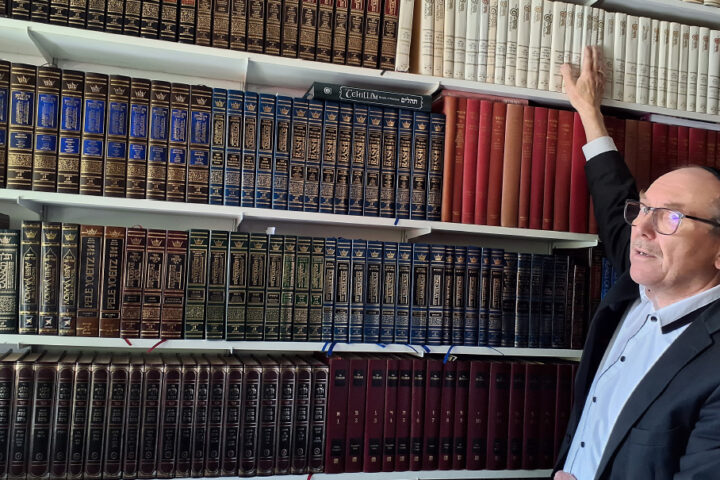
Hearing them live was the best consolation of all

My father and brother Yosef Chaim at the Lebanese border on the day we “lost” our precious tape recorder. We could either be sad or sing through it
For those of you who don’t even remember what a cassette looks like, the reel-to-reel tape recorder of the 1950s and ’60s probably sounds like ancient history. But back then, the lucky homes that had a Wollensak portable reel-to-reel tape recorder could actually record music or speech with a hand-held microphone. Then, in 1964, Philips/Norelco invented the first cassette player, which opened the door to prerecorded music on tape. But the sound wasn’t as high-quality as the vinyl record, and it took a few more years until tapes took over the industry (the short-lived eight-track cartridge, and then the compact cassette).
The first Jewish music cassette didn’t come out until the mid-1970s, so before then, if you wanted to listen to your favorite songs on a tape recorder, you had to place your tape recorder next to the record player, press record, and be very quiet. Any noise you made would be heard on the cassette.
If you were a lucky cassette owner, you probably became an expert at manual winding — like when your child or little brother thought it was adorable to pull out the thin tape from the cassette and tangle it beyond recognition. Then your job was to use your finger, or find a pencil, and slowly, tediously, untangle and rewind the hours of the cassette so that it could be used again. We became talented cassette surgeons when that thin plastic accidentally got twisted inside the cassette — we took out our tiny eyeglass tools or mini-screwdrivers to very carefully open the plastic cover and untwist the tape. If the tape was still usable, it was considered time well-spent.
Create a free account to keep reading.