As the maestro of Patient Relations at Brooklyn’s Maimonides Hospital, Douglas Jablon has cut through medical and bureaucratic red tape for thousands of patients — be they Haitian, Russian, Chinese, or native Brooklynites, rabbis, imams, or nuns. The name of Jablon’s game is respect for his fellow human beings, and a genuine desire to ease the pain and fear that accompany hospitalization. The mission and vision of a Brooklyn legend.
It took three staff members two outside connections and a dizzying round of phone-tag before we were finally able to pin him down for an interview. It may very well be easier to get an interview with the mayor of New York than with the man who’s been called “the Mayor of Maimonides Hospital” or more simply “Mr. Maimonides.” Of course once we meet him the reason for his unavailability becomes clear: there is scant time for Mishpacha because Jablon’s always available 24/7 for the people who really need him.
Jablon’s official title is executive vice president for patient relations at Brooklyn’s Maimonides Medical Center. He translates this into plain English for us as “everything from lifesaving to pillows for the patient.” What began as an effort to comply with new federal regulations for patient representation quickly mushroomed into a position that demands the diplomatic skills of a Talleyrand the patience of Hillel HaZakein and the ever-beaming countenance of a Nachum Ish Gamzu. Today at Maimonides should a glitch or snag arise the mantra has become “Ask Douglas.”
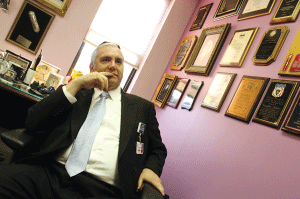
Douglas — he hates being addressed as Mr. Jablon — receives us in his office on the second floor of a modest brick converted brownstone on 48th Street in Boro Park. His height solid build and resonant baritone give him an imposing yet affable presence. After having so much trouble pinning him down for an interview I feared he might be abrupt begrudging us the time but instead he’s extremely welcoming and has set aside a generous chunk of the afternoon for us. Writer Julie Salomon’s book about Maimonides Hospital portrays Jablon as harried and beleaguered; today he seems relaxed and upbeat inviting us to have a seat in front of his expansive cluttered desk.
The back wall of the office painted an improbable shade of deep lavender is covered with dozens of photos plaques and commendations for public service. The photos show Jablon posing with all manner of people from nuns and bishops to Haitian councilmen and Pakistani imams.
Create a free account to keep reading.