“Give kids a good time and then they’ll learn” has been the proven formula for success for Rabbi Moshe Neuman, long-time educator who has just retired after nearly half a century as the principal of Bais Yaakov Academy of Queens. With the inspiration and confidence of his own rebbi, Rav Yitzchok Hutner, Rabbi Neuman has traversed the gamut of challenges facing Jewish educators. Reflections of a mechanech’s mechanech.
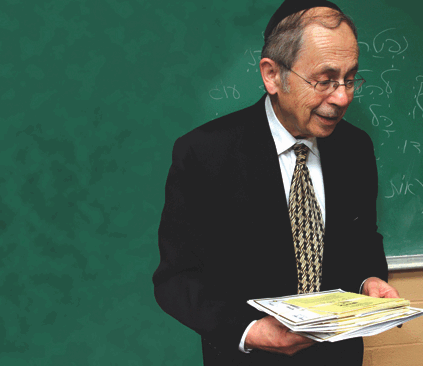
 There is something about the way Rabbi Moshe Neuman speaks a vitality and animation that makes conversation with him feel like much more than an interview. It is like I am a child again and he is the storyteller: all we’re missing is the campfire and popcorn. He weaves a narrative so rich and colorful that one can almost miss the fact that there are insights and lessons in chinuch hidden under every stone.
Rabbi Neuman has just retired after forty-nine years at the helm of Bais Yaakov Academy of Queens taking it from a fledgling operation with twenty-seven students to a prominent institution with close to 700. Before that he distinguished himself as a menahel in Allentown Pennsylvania and a rebbi in Detroit.
And before that … he just wanted to be a lawyer.
Appropriately the farewell gift he received from the school is a magnificent painting of the likeness of his rosh yeshivah Rav Yitzchok Hutner. Indeed it was the rosh yeshivah who revealed to him that he was destined to be so much more….
A Place for Keeping Shabbos
One of the first things I heard about Rabbi Neuman even before meeting him was that the has a high tolerance level for mischievous students. He understands that they too need breaks down time space; a student relaxing in the hallway during class might even earn a smile from him.
I hear his story and I understand. “I too was a rebel of sorts ” he grins endearingly “and I also had to find my place.”
Young Moshe Neuman was precocious but he was also determined to make his father happy.
His father Reb Yehuda Yitzchok arrived in America after a string of miracles saved him from the inferno that was Eastern Europe. The family settled in Washington Heights.
“My mother had two sisters there so she was comfortable. I was sent to the local public school and I sustained daily beatings at the hands of the locals. Eventually I befriended an African-American boy in the apartment building by giving him apples and bananas from my house and in exchange he was my protector in school. Things got a little better after that but my father couldn’t come to terms with the religious climate in the neighborhood. We davened in a local shtiebel filled with heimishe Yidden but he was stunned when he saw them hurrying through davening that first Shabbos morning anxious to be finished by eight-fifteen in the morning. ‘This is not Poland Reb Yehuda Yitzchok and here you have to work on Shabbos ’ they told him.
“He refused to accept that and eventually he learned that in Williamsburg there was a yeshivah for me and shuls with people who kept Shabbos. But how was he to convince my mother? So my father who had nothing went and rented the largest most spacious apartment he could find and one Sunday he took my mother to Williamsburg to see it. She liked it of course she did. It was much nicer than the dump where we lived in the Heights. So we moved.”
The young boy was sent to Torah Vodaas but things didn’t go so smoothly. Some of the rebbeim were themselves new to the country and still bearing the scars of war. They would often grow frustrated and would resort to corporal punishment — and Moshe Neuman found himself a frequent target of his rebbi.
In desperation he told his father who spoke to an acquaintance Rabbi Lieberman who ran the junior high school of Torah Vodaas. Rabbi Lieberman met the fifth-grade boy and seeing how miserable he was he welcomed him to the junior high allowing him to skip two grades.
This isn’t mere history; it’s valuable because so much of Rabbi Neuman’s philosophy was shaped by the negative experience. “My father always told me that I could learn from everyone and anything: from that difficult encounter I learned many things as well.”
Besides the yeshivah there was another place that proved a seminal influence on him. “We davened on Shabbos at the famous Zeirei Minyan at 616 Bedford Avenue and the passion and warmth in that place could change anyone. The davening of Dave Maryles the speeches and conversations of Mike Tress and the leadership of Rav Gedalia Schorr combined to give us an experience each Shabbos that was me’ein olam haba. It was a room filled with people who were burning with a sense of achrayus for Klal Yisrael and you got swept into it.”
One of the outstanding figures in that chaburah was Mike Tress’s young assistant a brilliant German refugee names Gershon Kranzler. “He would type up Mike’s correspondence but even though he only typed with two fingers he was much faster than those who could type with two full hands and often while Mike was still dictating he had already completed the entire letter. Mike would be amazed at his eloquence and how he had understood his thought process.”
Gershon Kranzler married Moshe Neuman’s sister Trude and the dynamics of the family changed.
“My father wasn’t much of a conversationalist but once Gershon joined the family he was so personable and interesting that my father became more expressive as well. When Gershon and Trude had their first child Chaim my father would go straight from work even before coming home to play with his einekel. He was no youngster at the time and he worked long hours in a factory — but he just needed to stop off there before going home.”
From Torah Vodaas Moshe traveled to Ner Israel in Baltimore one of the two great out-of-town yeshivos as the time where as a serious and dedicated masmid he excelled.
“The rosh yeshivah Rav Ruderman taught me a valuable chinuch lesson. He was somewhat timid not so forthcoming but he had his way of expressing respect for a talmid. One Shabbos afternoon when everyone was sleeping in the dormitory I sat alone in the beis medrash learning. The rosh yeshivah entered and walked up and down the deserted aisles stopping by my seat. “Why aren’t you resting?” he asked. “I have to chazzer to review ” I replied. He was delighted. “Come let’s walk together ” and we walked up and down speaking in learning — a sublime experience.
“At that point my father who wasn’t feeling that well asked me to consider learning closer to home back in New York.
“At the time I was attending courses at Johns Hopkins University in order to become a tax lawyer. I had grown up in poverty and was determined to have a source of parnassah with which to support my own family.
“When I went to take leave of the rosh yeshivah Rav Ruderman he asked me what I intended to do with my life. ‘I want to go to be a lawyer ’ I said.
“No” he said “du darfst veren a rabbi you ought to be a rabbi.”
“I told the rosh yeshivah that I didn’t want to be a rabbi.”
“He looked at me. ‘Chotch a principal at least a principal ’ he said.”
He Knew My Strengths
Upon returning to New York Moshe looked for the right yeshivah. It was Chol HaMoed Succos and his brother-in-law Gershon suggested that he join him at the Simchas Beis Hashoeivah of Rav Hutner in the rooftop succah of Yeshivas Chaim Berlin in Brownsville. There was an immense crowd there and the atmosphere was like that of the tisch of a chassidic rebbe with all eyes upon the rosh yeshivah.
“But Gershon had a personal connection with Rav Hutner and after the maamar was complete he brought me over to give him shalom. Rav Hutner looked at me and we spoke in learning for a few minutes. He asked me what yeshivah I attended and I told him that I had been in Ner Israel but was now returning to New York and had not yet registered in a yeshivah. The rosh yeshivah broke out in a smile and said ‘The problem is solved. You’ll come to our yeshivah after Yom Tov.’ ”
Rabbi Neuman’s eyes involuntarily rest on the picture in the corner of the room and he continues if a tad more emotionally. “What can I say? He knew my kochos better than I knew them. He saw things in me of which I had no idea. I owe him everything.
“I was a cynical boy but I was overawed by him his knowledge his wisdom the force of his personality all of it.”
Moshe Neuman was learning well in Chaim Berlin and one day he received a message that the rosh yeshivah wished to speak with him. He hurried in to the office.
“Moishe listen ” said Rav Hutner “I need a favor from you.”
“Hineini ” replied the talmid “whatever the rosh yeshivah wants.”
“The eighth-grade rebbi is ill and he won’t be here for the next two weeks. The class is a difficult one and I want you to substitute for him.”
“I was stunned at the request but the rosh yeshivah couldn’t be dissuaded so a few days later without benefit of teacher training or curriculum I walked in to a classroom for the first time.”
The novice rebbi was greeted with indifference. The boys were playing and chatting among themselves and one of them looked in his direction. “We don’t want to learn ” he stated unequivocally and went back to his friends.
It was then that Moshe Neuman first applied the theory that would carry him through six decades in education.
“Listen fellas ” he said “the rosh yeshivah sent me here for two weeks to teach you boys. Has anyone ever heard the Gemara term ‘chatzi l’Hashem and chatzi lachem?’”
One or two boys hesitantly answered that it was a reference to the mandate to “split” Yom Tov half for spiritual pursuits such as learning and davening and half for physical indulgence such as eating and resting.
“Right” said the new rebbi “and that’s the deal I’m offering you here. We’re going to learn for two hours and then we’re going to go to the playground on Pitkin Avenue and play basketball.”
“How will we get out of the building without getting stopped by the menahel?” asked the boys.
“Don’t worry I’ve got it all worked out. There’s a fire escape right near the class and we’re going to sneak out quietly. You’ll see we won’t get caught.”
They were partners in crime rebbi and talmidim and they started to learn.
Rabbi Neuman smiles proudly.
“They were good boys. We started to learn one asked a good question I showed him that it was a Tosafos and another made a comment that was in the Maharsha. It was a pleasant two hours for them as well and sure enough at the two-hour mark I closed the Gemara and motioned for them to follow me.”
The group snuck out of the building and had a grand time on Pitkin Avenue with the rebbi — really just a few years older than them — joining in a spirited basketball game. When two hours passed the rebbi told them how to go back in to the yeshivah for lunch. “You’ll go in like by the teivah two by two and no one will notice a thing.”
The next day the rebbi came in with the same formula; chatzi l’Hashem and chatzi lachem.
On the third day Rabbi Neuman said “Listen fellas: chatzi lachem is only on Yom Tov not every single day. We’re up to two-thirds learning and an hour of fun and I promise that’s the way it will stay.”
He reflects. “They trusted me they knew we were on the same page and they had also seen that learning wasn’t as boring as they had thought so they went along with it for the entire two weeks.”
On Thursday the substitute invited the eighth-graders to come learn in the yeshivah at night during mishmar and to feel free to ask him questions on what they had learned during the week. A fair number of them showed up.
The regular rebbi returned and the bochur Moshe Neuman went back to his seat in the beis medrash. Once again he was summoned to the rosh yeshivah’s office. “Moshe I hear that you learned with them and they even came to mishmar. What did you do? Hust zei farkisheft did you hypnotize them?” asked Rav Hutner. Moshe hesitated but the rosh yeshivah prodded him. “Tell me everything.”
Moshe told the entire story without leaving out a detail. The rosh yeshivah listened in silence and then began to laugh. Then he once again turned serious and said “Moishe Moishe; America is America nisht Slabodka uhn nisht Kletzk uhn nisht Mir uhn nisht Telz. It works with basketball and Pitkin Avenue and that’s how you got them. Remember that.”
Moshe Neuman’s theory had been tried tested and now approved by his rebbi.
Destined To Be a Rabbi
The rosh yeshivah wanted Moshe Neuman in his office. “Moishe I want you to learn for smichah ” said Rav Hutner.
“But Rebbi I want to be a lawyer” said Moshe.
That night Moshe told his father of his conversation with the rosh yeshivah. “My father looked at me and said ‘You know Moshe I never made demands of you in this way but I always harbored a secret dream of your becoming a rabbi. The Ribono shel Olam saved us for what?’” Rabbi Neuman reflects. “He didn’t need me to be a rabbi so that he could say ‘my son the rabbi.’ He just thought that smichah would be a worthy attainment.”
Moshe returned to the rosh yeshivah the next day and said he wished to join the chaburah learning Chullin and Yoreh Deiah. The rosh yeshiva gave him a chavrusa and they set out to conquer the material. When the summer came the rosh yeshivah instructed the pair to go to Camp Morris and learn there. Moshe told him that he had no money for camp.
“Hub ich dir gebetten gelt? Did I ask you for money?” the rosh yeshivah asked him. “I want you two to learn over there with menuchas hanefesh and enjoy the break from the city.”
Rabbi Neuman pauses to comment on the chinuch lesson. “Do you know what that did for us that kind of encouragement singling us out like that?”
After a time Moshe Neuman indeed became a rabbi earning smichah from Rav Nissan Telushkin and from the rosh yeshivah himself.
Create a free account to keep reading.