Another glimpse at how certified products get to your table from the corners of the world
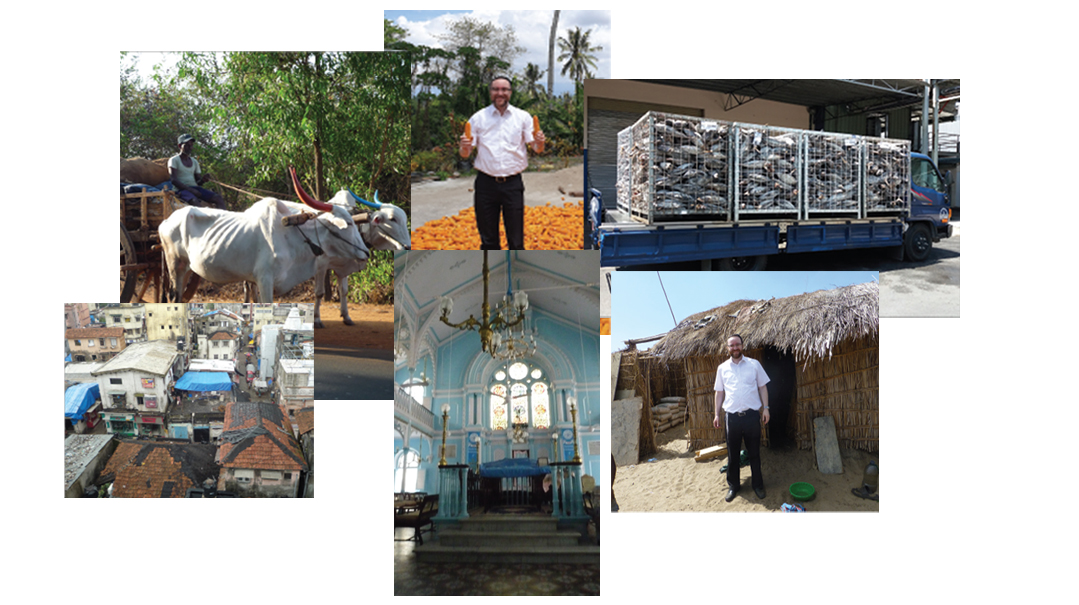
Meticulous attention to detail, a cool head, and high tolerance for long, uncomfortable journeys are all part of Rabbi Danny Moore’s work in international kashrus. From his very first job supervising an early-morning milking as a favor to a friend, Rabbi Moore was drawn into a world where one sharp glance — and a dose of Heavenly help — is the difference between kosher and treif. More than two decades and 51 countries later, he’s the kashrus director of Badatz Igud Harabbonim, the Manchester-based hechsher famously led by Dayan Osher Yaakov Westheim ztz”l, who was niftar earlier this year. The hechsher now continues under the supervision of the Dayan’s son-in-law, Rav Shulem Landau.
Last year, Mishpacha presented some of Rabbi Moore’s more interesting kashrus adventures, but after 22 years in the field, the stories don’t stop.
Stewing in Their Own Juice
Where: Kayseri, Turkey
I was once asked by two different mehadrin hechsherim, one based in the UK and one in the US, to represent them in supervising a production of orange and apple juices in Turkey.
The fruit juice factory, owned by a big Turkish entrepreneur, was situated next to the main mountain road that runs from the city of Kayseri to the city of Adana in the South. I flew from Manchester to Istanbul and then took an hour-and-a-half domestic flight to Kayseri airport, where I was met and driven to the plant. When I got there, I saw that the owner had built a gas station with his own gas pumps, a restaurant and service area, and a guest house right next to his factory. This attracted a lot of the truck drivers who stopped for a break on their way down to Adana.
He was obviously a capitalist and a shrewd businessman.
Like all mashgichim and visitors to his factory, I was put up in the guest house. In order to get to my room, I had to walk through the restaurant, and I noticed that the fridge of cold drinks there carried no Coke, Pepsi, or Schweppes — only the company’s own fruit juices.
Of course, I had done plenty research before I came. When you kasher a factory, you have to know exactly what you are koshering it from. Has it been used for dairy? For treif products? Or is it only used for non-problematic foods, in which case you are basically koshering “l’chumrah”?
There is a certain piece of filtration equipment that is extremely delicate and difficult to kasher, and our main concern was grape juice. In all our discussions with this company, they had told us that while they made apple, orange, apricot, and pomegranate juices, they haven’t produced grape juice for the last 20 years. And in fact, our online checks didn’t turn up any grape juices under their label. They did tell us that they had done a recent run of a kosher grape juice for a certain hechsher, but other than that, no grapes came into the factory.
The production began and all was going well.
A few days later, one of the managers asked me if I would be able to help them out by sending a sample of the recently produced kosher grape juice to the hechsher in question.
I explained that I would like to help them, but couldn’t, because I was not authorized to open the seals on that kosher product unless asked to do so by their rabbi.
Soon enough, I got a call from the rabbinical authority on that hechsher asking me to supervise the sample-taking of their product. And so, we went to the 50,000-liter tank of kosher grape juice, I unsealed the tape, took off a small sample, closed it and sealed it again. Then I was shown into the laboratory to pasteurize the grape juice and pour it into small sample bottles. I was required to do this for them, to prevent a problem of “stam yeinam,” which would make the grape juice forbidden.
I was about to close the sample bottles, when the non-Jew said to me, “Can I just add something?”
He was holding a small bottle of grape flavor.
I said, “You can’t add that, it’s not kosher. And, if you do, the end product won’t match this sample.”
He said, “Don’t worry about that, rabbi.”
I told him that I would only seal it as it is, and I would not add anything. Okay, it got sent off as it was. But I realized that I was dealing with cheaters.
My antennae were up. I looked all over the factory for evidence of grape juice production, which would mean that the machinery was used for “stam yeinam.” But I couldn’t find anything, and I had to be very careful lest they realize I was suspicious. I spoke to the fellows lower down on the line, the factory workers, but I wasn’t able to ferret out any information.
The industrial boiler in this factory ran on coal. During the winter, they sometimes had stoppages due to the coal getting wet, and that happened one day while I was there. The manager let me know that we would have to wait a couple of hours, as production would be halted while the boiler was cleaned out.
Most of the staff went home, and it seemed like a good opportunity to poke around. I decided to check out the warehouse to see the pallets that had been prepared for shipment. The warehouse was a huge underground storage area, the size of the entire factory. Security was fairly tight, few people were allowed in, but my excuse was that I wanted to see how many pallets of juice we had already produced. I asked Mehmed, the production manager, he agreed to get the key from someone, and we went down the steps and through a heavy metal door.
He showed me our product. I counted them, checked them, sealed them, and marked them, then I started walking through the other dozens of aisles.
“Do you need to see something?” he asked me.
“No, I’m just looking around.”
“Okay.”
Then, a minute later, Mehmed said he needed to go upstairs for something.
Even better, I thought. But two minutes after the production manager left me, the lights throughout the warehouse suddenly went off. It was pitch black, a cavernous underground room, and the aisles all looked the same.
I had my phone with me for a little light, and I suddenly saw a light coming from the far end of the warehouse. Walking toward it, I saw it was an office, where a guy sat alone working on his computer. He obligingly stood up to help me, leading the way to a big switchboard, but nothing happened when he flipped the switches. The mains had been switched off.
I made my way upstairs and found Mehmed, telling him that the lights had suddenly fused. He feigned total surprise. “Really?”
We walked back down the staircase, and the metal door was locked.
“Can we get the key again?” I asked.
“No, the guy who has the key has just gone home. It’s impossible to open it without him.”
“If he’s just left, maybe you can call him on his cell phone to return. It was open just minutes ago.”
“We can’t do that, no. He’ll be in tomorrow.”
By that point, I had a pretty strong feeling that they were hiding something. But I needed to catch them without confronting them.
Suddenly, the image of the fridge in the restaurant, with all the company’s juices, crossed my mind. I told Mehmed I was going over to have a rest in my room, since they anyway weren’t working. He was quite happy for me to leave him alone.
By that time, it was dark outside too. We were in quite a lonely spot in the Turkish mountains, and as I opened the door, I heard the loud barking of several wild mountain dogs. They ran at me, but I ran back to the factory and managed to close the door on them. I don’t love dogs at the best of times, but these wild creatures were something fearsome.
I found Mehmed again and told him there was a pack of wild dogs just outside the door. He came out with a big stick and beat away the huge dog that was sitting at the door. It scarpered. I would have preferred him to accompany me the whole way across the yard, but he left me with an assurance that “you’ll be okay, they won’t touch you now.”
I ran across the yard, through the service area with the gas pumps, and arrived out of breath at the restaurant.
“Ah, good evening, Rabbi, help yourself to a drink.” The Turk manning the restaurant was always very friendly, constantly offering to heat my double-wrapped meals or serve me drinks. I greeted him and went across to the fridge. I scanned the shelves, peach and apricot and orange, and there, unmistakably, was a small box of grape juice. I took it and slipped it into my pocket, without him noticing, and then I took an apricot juice and showed it to him with a big smile and a wave.
I went back to my room, shaking. These people had been lying to us for months. I took a few photos of the little box drink and called the rabbanim of both hechsherim right away. But I could not let the Turks suspect anything. I made sure to tell them I was very happy with the production. After all, I needed them to drive me a couple hundred miles to the nearest airport, and I would not have put it past them to leave me on the side of the road, or induce customs officials to detain me.
I went straight from the airport to the rav’s house and showed him the grape juice box. He was so shocked that he dropped it on the floor. Then I emailed the Turkish export manager with whom I had dealt one more time.
“Do you make any grape juice under your label at this plant or any other?”
“No grape juice, no. We don’t make such a thing.”
https://temp.abovedemo.com/the-amazing-adventures-of-a-globe-trotting-treif-spotting-kashrus-supervisor/
Where: Bangkok, Thailand
I was on a trip to Thailand for kosher production of everyone’s favorite canned fish, skipjack tuna. The job was to supervise a huge cannery in Bangkok, a massive operation with a workforce of thousands.
Skipjack tuna is caught by fishing vessels in the Maluku Sea. The method used by these boats, called purse seiners, is to hang a vast fishing net vertically in the sea. Once an entire school of tuna is located, they encircle it with the net, and then pull in a line that purses the net closed on the bottom, so the fish can’t escape downward. The massive raw tunas are immediately frozen, then they’re sawed apart, gutted, and precooked in big steam ovens. After that, there are huge teams of ladies and girls in the factory who remove all the skin and bones, and place the good parts of the fish into trays ready for canning.
This vast factory is active around the clock. Because fish has the same halachah as meat, that it always has to be within sight of the mashgiach (it cannot be “misaleim min ha’ayin — hidden from sight”), we use a team of two mashgichim working in shifts. I’d work for ten or twelve hours, then go for a rest while my partner took over.
The job involves switching on the ovens for bishul Yisrael, and checking every single fish for scales (if it has scales, it automatically also has fins). As the frozen fish come into the factory, we know how to position the fish so each one can be checked for scales after it defrosts, before being precooked.
The factory provides mashgichim with a little air-conditioned office, table, and chair, which we can use for davening, eating, or making phone calls during our stay. As hosts, they also like to provide us with refreshments, although they know that we can’t eat anything. On the first day that I was working in this specific cannery, the director of marketing came in to make sure I was comfortable with the office provided, and she brought some refreshments.
Just to give some background, Thailand is a Buddhist country. On almost every street corner in Bangkok, you’ll see temples filled with idols and images. Buddhist monks in orange minimalist robes are all over the street. Every taxi has a little Buddha hanging, which I ask the driver to remove for the duration of my trip. Even in the workplace, every management office has their own plug-in electric Buddha. It sits there, lit up in the corner, and there are little cups of wine and oil which are poured before it — a real live example of avodah zarah and yayin nesech — as well as burning sticks of incense. I would politely explain that I was very sensitive to smells and ask them to switch off the Buddha and not burn the incense when I was in the room.
So here I was in this little office, and the export manager brought in a beautiful tray of exotic fruits. She explained that they were aware I couldn’t eat any non-kosher processed food, but fresh fruit was surely all right.
I asked if it was local fruit or possibly imported from Israel, and she said it was locally grown. I looked at the tempting tray again. It seemed very high-quality, better than what I had seen sold around the city, so I asked, “Where did you get such nice fruits?”
“Oh, these are top quality. They were eaten by our Buddha.”
Alarm bells were going off in my mind as she continued to explain.
“When you drove in to our plant, I am sure you noticed that we have a temple for our workers’ use in the corner of the yard. We serve choice fruits and libations to be eaten by the Buddhas. Well, they don’t actually eat it, but we call it eaten… and the next day we remove it. So I thought I would give some of this holy fruit to the holy people.”
I said, “That’s very kind of you, I’m truly honored. But I actually can’t eat the fruit if it has been served in the temple.”
“Rabbi, I think you’re making a mistake. Last month we did another kosher production, and the rabbis ate this fruit every day of their stay.”
“Well, uh, did you tell them where it came from?”
“Oh, no. They didn’t ask.”
I followed it up and got the details of the mashigichim of that kashrus agency. They were pretty upset, but thanked me profusely for the information, because they had another booking to go back and produce more skipjack tuna from Bangkok for the kosher public.
Create a free account to keep reading.