This is not the beginning of a joke. Three Russians, one Frenchman, one Spaniard, and one Chinese man cut themselves off from the world for a period of a year and a half. They lived in a room the size of a bus, breathed artificial air, subsisted on cans of preserves and recycled water, and spent their time performing futile tasks — all in the context of a mock flight to Mars. Russia is already seeking candidates for the next “flight.” Would you volunteer?
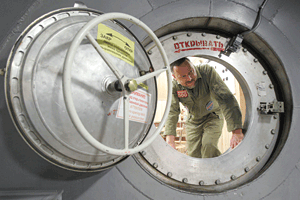
Two months after Chinese astronaut trainer Wang Yue and his five associates emerged from a 520-day lockup to simulate a flight to Mars and back he’s broken the silence of that self-imposed captivity with the release of the book Mars 500:Back from the Field — which his countrymen have grabbed off the shelves in the past week. It took a while for Yue his country’s newest hero to get back to himself after not seeing daylight for a year and a half eating spaceship rations and losing 20 pounds and much of his hair but Yue’s mother has been nursing him back to health with sesame milk and walnut powder.
Yue a 27-year-old graduate of China’s Astronaut Training Center was one of six men who defeated 6000 rivals from 42 countries with the honor of being confined to a capsule the size of a bus for a year and a half. The multinational crew emerged from Moscow’s Mars-500 isolation module blinking and a little shaky on November 4. Mars-500 is one of several experiments being staged around the world in preparation for a trip to Mars that Russia hopes to try in about 25 years.
What could possibly have caused six ordinary healthy sane human beings to voluntarily confine themselves to a series of interconnected metal tubes set up in the parking lot behind a Moscow research facility? What convinced the members of this group to spend 16 consecutive months together without visits from family members without a daily outdoor stroll without a weekend off without even a reduction of their “sentence” for good behavior? As the bleary-eyed crew emerged from their lockup the $15 million Mars-500 project was about to answer one of the big unknowns of deep-space travel: can people stay healthy and sane during a flight to Mars?
What can explain their readiness to survive for 520 consecutive days on a monotonous diet of granola bars canned preserves and recycled water? Throughout this time they breathed recycled air slept on thin foam mattresses washed themselves once a week in a makeshift shower and maintained a daily schedule that consisted of a series of rigorous exhausting physical exercises and an endless list of tasks with no apparent meaning or purpose. Why?
Create a free account to keep reading.