Towns north of the Arctic Circle have their own “plague of darkness” every year. As residents watch the final autumn sunset, they bid farewell to daylight and prepare for months of winter darkness, when morning and night are indistinguishable. What does a Shabbos observer do when there is no sunrise or sunset to guide him? As Jews find themselves in every corner of the world, some find themselves grappling with the unusual considerations of seasonal extremes.
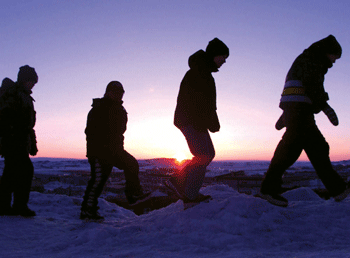
Until you hit the Arctic Circle.
Here at the parallel of latitude that circles the globe 66.5º north of the equator there is one day a year that is completely daylight during which the sun doesn’t set at all. And in winter one day is completely dark — not one ray of sunlight appears. The farther north one travels above this parallel the more days like this there will be. (In the Southern Hemisphere below the parallel of latitude of 53º south of the equator there is no human habitation.) At the poles themselves the most extreme phenomena occur: the sun shines for six continuous months followed by a long night that only ends half a year later.
So in Longyearbyen residents experience four months without sunlight followed by one long day that lasts for months.
The Jews of the North
While Svalbard doesn’t yet have a Jewish community the Jews in the northern Scandinavian countries of Norway Finland and Sweden and in Russia at St. Petersburg grapple with the seasonal extremes of white nights and dark days.
“The earliest Shabbos in Oslo starts at 2:45 p.m. and ends at 4:30” says Rabbi Shaul Wilhelm director of Lubavitch of Norway. “That’s still relatively bearable. But in summer there are about seven weeks when there isn’t any tzeis hakochavim no appearance of three stars indicating nightfall. Only the sunset gives some indication of the end of the continual daytime. In such a case as several rabbanim I consulted with have determined the end of Shabbos should be reckoned as midnight.”
Create a free account to keep reading.