As a victim of polio handicapped from an early age, Zusha Frumin could have been forgiven for sinking into apathy or self-pity. Instead his life has been a colorful journey that has taken him from the beaches of California to the sidewalks of Jerusalem, where he is known — by yeshivah bochurim in the know — as “the flower man.”
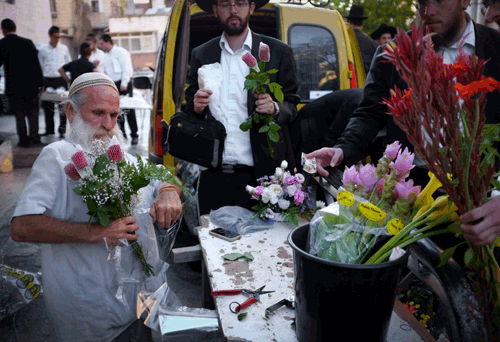
Zusha Frumin’s makeshift flower stand is located in front of a barbershop directly across from the main building of Yeshivas Mir. A narrow rickety wooden table holds the handful of items he needs to run his business: a plastic bag full of rubber bands a pile of clear plastic sheaths for the bouquets a pair of clippers for snipping the stems of flowers and a worn plastic bowl full of spare change. A series of buckets are arrayed around the table with bundles of tall flowers standing at attention in each. Zusha doesn’t sell ready-made bouquets; he supplies the flowers and allows the customers to assemble their own. But if a customer feels he lacks the artistic flair necessary to fashion his own bouquet Zusha is more than happy to do it for him. While he works he finds the time to exchange a few words with his customers many of whom are regulars and his cheerful mood is even brighter than some of the vibrant colors peeking out of the buckets.
That cheerfulness becomes even more striking when Zusha walks over to his car where he keeps additional supplies. It is a distance of only a few paces but his gait is awkward; Zusha walks with a distinct limp and his movements are labored. He also stands significantly shorter than the average adult. Yet instead of complaining about his disability when Zusha begins to speak about his past he begins by expressing his hakaras hatov to “the woman who saved my life.”
Despite the numerous Hebrew words that pepper his speech Zusha’s American accent gives away his true origins. He was born in California in the year 1950 and grew up in a town named Encinitas located on the beach between Los Angeles and San Diego. His family had absolutely no affiliation with Judaism and he was not even given a Hebrew name at birth; he was called Bob throughout his youth and personally selected his current moniker many years later when he became Torah-observant. He was one of four siblings including a twin brother and he remarks ruefully “I never even saw the inside of a beit knesset until I was in my twenties.”
Zusha’s slight stature and pronounced limp reflect the devastating results of an illness that he contracted in his infancy. At the age of eleven weeks he became sick with polio one of many to fall victim to an epidemic that was sweeping through America at the time. He lay in the hospital for months his muscles weakened and unable to move. The doctors despaired not knowing how to rehabilitate him.
Create a free account to keep reading.