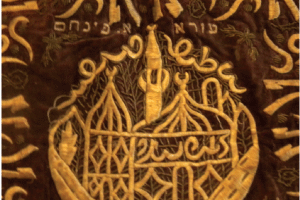
Their paper has aged and their ink has faded, but Holocaust-era cards and letters still have the power to awaken deep emotions — and tell a story. Chicago optometrist and stamp collector Dr. Justin Gordon reads between the lines of postal history to decipher the wrenching personal stories behind letters from Gehinnom.
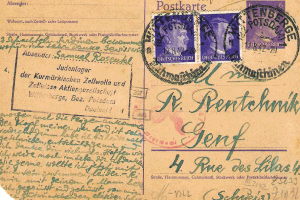
The year was 1942. Samuel Rosental a prisoner at a Judenlager (Jewish slave labor camp) located at Wittenberge eagerly took up his pen. There was so much to write but so little space on the small card. There was also the problem of the censors. So how could he tell his in-laws in Geneva Switzerland — whom he had never met — what was in his heart? How could he tell them about his fears for his wife and small child whom he had last seen before he was deported from Warsaw? He hadn’t heard from his wife for so long. Where was she? Where was his child? Why didn’t his wife write to him? Didn’t she realize he was nearly sick to death with worry?
And not just with worry. Somehow he had to make his in-laws understand the desperateness of his situation. The prisoners were worked mercilessly at this camp. Their job was to build a chemicals factory for the Germans and they had to do it on starvation rations. If they didn’t work fast enough they were fiercely beaten by their slave drivers. People were dying practically every day. He didn’t know how much longer he would be able to hold on. He was so sick and so very tired. His in-laws had to help him get out of Germany. Fast. They had to.
The year was 1982. Dr. Justin Gordon a Chicago optometrist and collector of postal documents pertaining to the Holocaust couldn’t believe his eyes. He had run across many postcards from non-Jewish prisoners incarcerated at Nazi slave labor camps but he had never before seen a postcard like this one — a postcard hand-stamped with the word Judenlager.
As he held the postcard from Samuel Rosental in his hands he knew that he was holding more than a rare collector’s item. This desperate plea from a Judenlager had a story to tell — the story of the Holocaust. And so as Gordon’s collection grew an idea began to form in his mind: tell a new generation the story of the Holocaust through the era’s postal history. Because through that uniquely personal lens — the cards and letters written by those who lived during that tragic time — one can follow each step of European Jewry’s tragic journey from the Nazis’ rise to power to the deportations that led to the Final Solution.
Create a free account to keep reading.