LONG READS Issue 946 · January 25, 2023

Horror through the Prism of Faith  

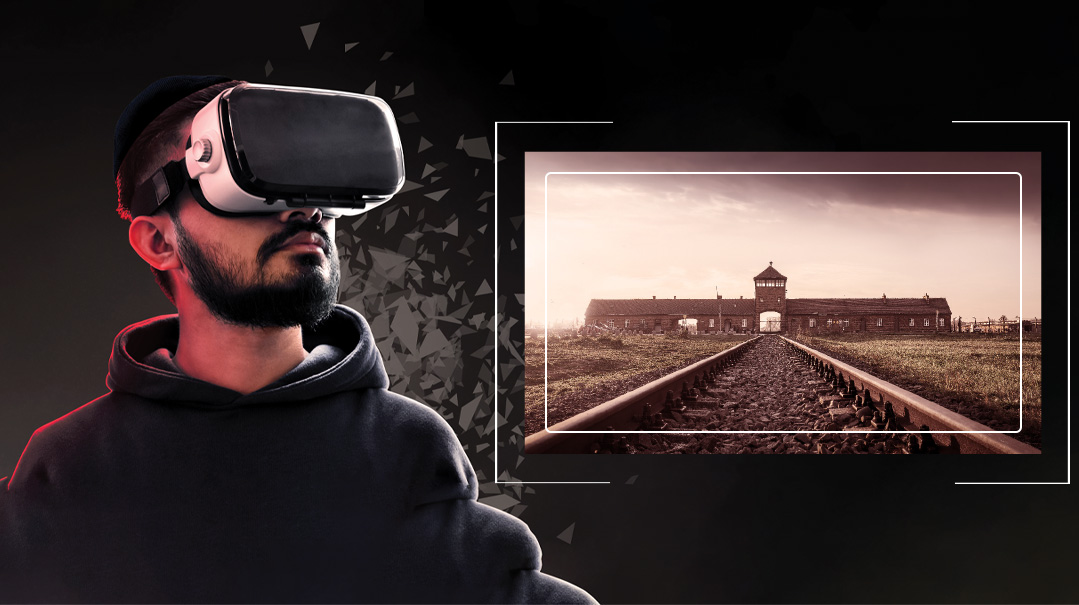
Three chareidi women create a virtual reality film in the heart of Auschwitz
Horror through the Prism of Faith  
Photos: JVR360
“What will become of all the memories, are they to scatter with the dust in the breeze / Who will stand before the world, knowing what to say / when the very last survivor fades away”
(Journeys II, Abie Rotenberg)


It is 5:30 a.m. After four flights and a five-hour drive, we are finally entering the infamous gates of Auschwitz-Birkenau, treading the same path that millions have taken before us, never to return. My heart is beating a staccato, and the gates are locked behind us. They promised we’d be alone, and indeed, we are alone.
The drone lifts off and the monitor displays an aerial view of this Gehinnom spread out before us in all its diabolical horror. As if to highlight the irony, the spring weather brings placid blue skies, bright green grass, and deer with fawns, who would otherwise be frightened by the many tourists, leaping over the train tracks.
Exhausted and overcome with emotion, I want nothing more than to break down and weep, but we are struck by the responsibility we bear toward the martyrs whose memories we’ve committed to commemorating. We have three days, two filming teams, and a drone. I gather myself together, pack away my emotions, and spring into action.
Once we start filming, all doors open, figuratively, but also literally. Various clauses of the strict contract that we’d signed with the Auschwitz directorate are waived, and rooms that have always been locked are magically opened for us. We feel so clearly that Hashem is here with us, His Pillar of Cloud guiding us and smoothing out our path.
—from the diary of film producer  Chani Kopolowitz


When chareidi film producers Miriam Cohen, Chani Kopolowitz, and Yuti Neiman decided to embark on a groundbreaking project to portray Auschwitz in virtual reality with 360-degree, 3D viewing, they encountered opposition from all the naysayers in the industry.

“Everyone discouraged us,” recalls Kopolowitz, whose team creates films for women and for schools. “Since VR is used mainly for gaming, apps, and simulations, we were advised that at the most, we could create an Auschwitz model in 3D that allows the viewer to explore the camp. But we wanted to do more than that, and in the end we decided to move forward with this tool that engages all the senses and that we knew had the power to convey the Holocaust narrative in all its horrifying reality.”

It was a question that had been bothering the women since they began creating kosher entertainment for the chareidi public over a decade ago: How to connect — on a deep and meaningful level — a new generation who’s used to seeing everything experientially, instantly, and in all its morbidity, with one of history’s most unthinkable atrocities?

Today, 78 years after Auschwitz was liberated, there aren’t many survivors left, and most young people have never even met a Holocaust survivor. The subject is taught in schools, but lacking a context, it often becomes distant and difficult to personally identify with, even for young people whose own family members perished.

Continue reading with Mishpacha.

Create a free account to keep reading.

Everything you need to stay close to Mishpacha.
← Previous installment Seeing Triple Next installment → Zoom into Your Soul