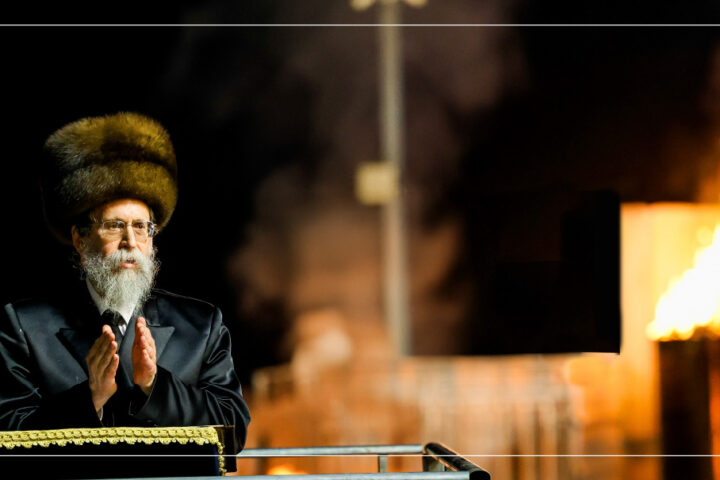
Rav Leuchter explains what drove him to write a commentary on the Haggadah— the feeling that “we have lost the forest for the trees.”

Photos: Lior Mizrachi
Rav Reuven Leuchter, one of the generation’s leading baalei mussar and original Torah thinkers, added his own Haggadah to the plethora of Seder literature in order for us to develop a consciousness of ourselves as an integral part of Klal Yisrael, each of us finding a seat at the table.
T
Though it’s still nearly two weeks before Pesach, I’m feeling better prepared for the Seder than I can ever remember. The reason: I’ve been learning Rav Reuven Leuchter’s newly released English-language translation of his popular Haggadah Living Our History, in preparation for our conversation.
Every year as I approach the Seder, I feel that the dozens of vertlach in my hands are only tangentially related to the Seder night mitzvah of sippur yetzias Mitzrayim — more talking about the telling than the telling itself. Rav Leuchter’s major achievement is, more than anything else, to have presented the Haggadah as Chazal’s concise and powerful relating of the story of galus and geulah.
The ability to be mechadesh even in a text as familiar as the Haggadah undoubtedly derives in part from Rav Leuchter’s long tutelage under Rav Shlomo Wolbe ztz”l. When Rav Wolbe was leaving his position as menahel ruchani of Yeshivas Beer Yaakov to move to Jerusalem in 1981, he received a call from a Swiss-born yungerman named Reuven Leuchter asking Rav Wolbe if he would be willing to continue their rebbi–talmid relationship as chavrusas.
Create a free account to keep reading.