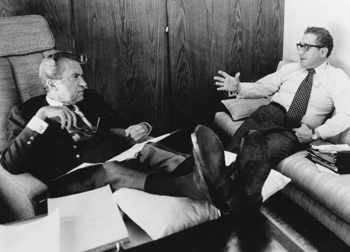
“And if they put Jews into gas chambers in the Soviet Union it is not an American concern. Maybe a humanitarian concern.”
The most appalling thing about former secretary of state Henry Kissinger’s by-now familiar comment to President Richard Nixon is how gratuitous it was. A case could perhaps be made for the proposition that Jewish emigration did not justify upsetting Kissinger’s grand design for détente with the Soviet Union. But why add the next sentence conjuring up new gas chambers? How could a Jew who had himself barely escaped Nazi Germany and who had lost nineteen close family members to the Nazis have so coldly contemplated a repeat of the Nazi extermination camps? For all his evident anti-Semitism Nixon never came close to such a cold-blooded statement.
Jewish groups who have honored Kissinger over the years scurried for cover in the wake of the newly released Nixon-Kissinger tape. Had they set themselves a simple rule — no awards to intermarried Jews — they could have saved themselves a lot of embarrassment. Kissinger himself seems to have recognized that. At the funeral of his Orthodox father he declined to recite Kaddish on the grounds that he did not wish to embarrass his father.
As it turned out the Kissinger-Nixon strategy of not pressuring the Soviet Union on internal issues in order to preserve détente and forestall major power confrontation failed on its own terms. Though the 1975 Helsinki Accords recognizing the borders of postwar Europe were the ultimate expression of détente Article 7 in which signatories committed to human rights and basic freedoms proved to be the chink in the Soviet armor. Dissidents behind the Iron Curtain exploited the provision to hold their governments to account. Natan Sharansky who was imprisoned in the Soviet Gulag for his work monitoring compliance with the Accords records that when he heard in prison that President Reagan had called the Soviet Union an “evil empire ” he knew the USSR’s days were numbered. Ultimately confronting the Soviet Union as Reagan did proved far more effective than détente in removing the nuclear threat posed by the Soviets.
Create a free account to keep reading.