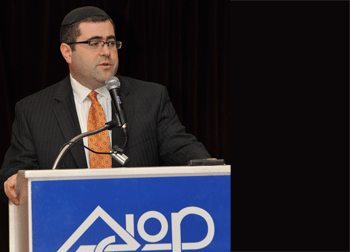
This year’s Association of Jewish Outreach Professionals (AJOP) convention included a broader-than-usual spectrum of kiruv workers from across Orthodox Jewry. For instance Hart Levine a recent graduate of the University of Pennsylvania described in one session a project he initiated while an undergraduate at the University of Pennsylvania in which Orthodox students on the Penn campus invited fellow Jewish students for Shabbos meals Sedarim and Hebrew and text learning. Since graduating Levine has worked to spread this initiative on nine other campuses with a significant cohort of modern Orthodox students with day school backgrounds and often one or two years of post–high school learning in Israel. As campus kiruv becomes an ever larger slice of the overall kiruv budget Levine’s initiative raises the question of whether and how the student efforts could be combined with those of full-time kiruv workers on campus.
One of the featured speakers at the AJOP convention was Rabbi Steven Burg the national director of NCSY. He told a story of tracking down a blogger who was consistently posting highly critical remarks about Orthodox kiruv. The young man was thrilled that anyone had taken note of his complaints and told Rabbi Burg that he had been a student in a baal teshuvah yeshivah. As long as he learned in the yeshivah he related all he heard from his rabbis was how great he was. But when he decided to leave because he was not yet prepared to take on a life of full observance he was dropped like a sack of potatoes (or at least that’s how he perceived it).
When someone in whom one has invested much effort and with whom one has developed a relationship does not become fully observant disappointment is natural. But it is a mistake to make a great show of that disappointment. For one thing it may be premature. One never knows what the impact of one’s efforts will prove to be years later. In addition just because someone does not become fully observant does not mean that one’s efforts had no impact. NCSY for instance works primarily with Jewish public school students from nonobservant homes. Historically no more than 40 percent of those students will become shomrei Torah u’mitzvos. But it is a mistake to feel that nothing was achieved with respect to the other 60 percent. As Rabbi Burg pointed out NCSY graduates will rarely be found among those Jewish students leading campus coalitions against Israel.
Most importantly showing too much disappointment may impair the future religious development of the nonobservant Jew whom one is trying to be mekarev as it places the focus on the one doing the kiruv not the beneficiary of his efforts. As far as the young man in Rabbi Burg’s story was concerned the message was: You are only of interest as long as you seem headed in the desired direction. The effect of such an attitude is to turn the would-be baal teshuvah into the chafetz shel mitzvah (the object with which the mitzvah is performed) of the one who seeks to draw him close to Torah. No one wants to feel like someone else’s chafetz shel mitzvah.
Create a free account to keep reading.