Mishpacha visits with Reb Shloime Biegeleisen, Boro Park’s Legendary Bookseller
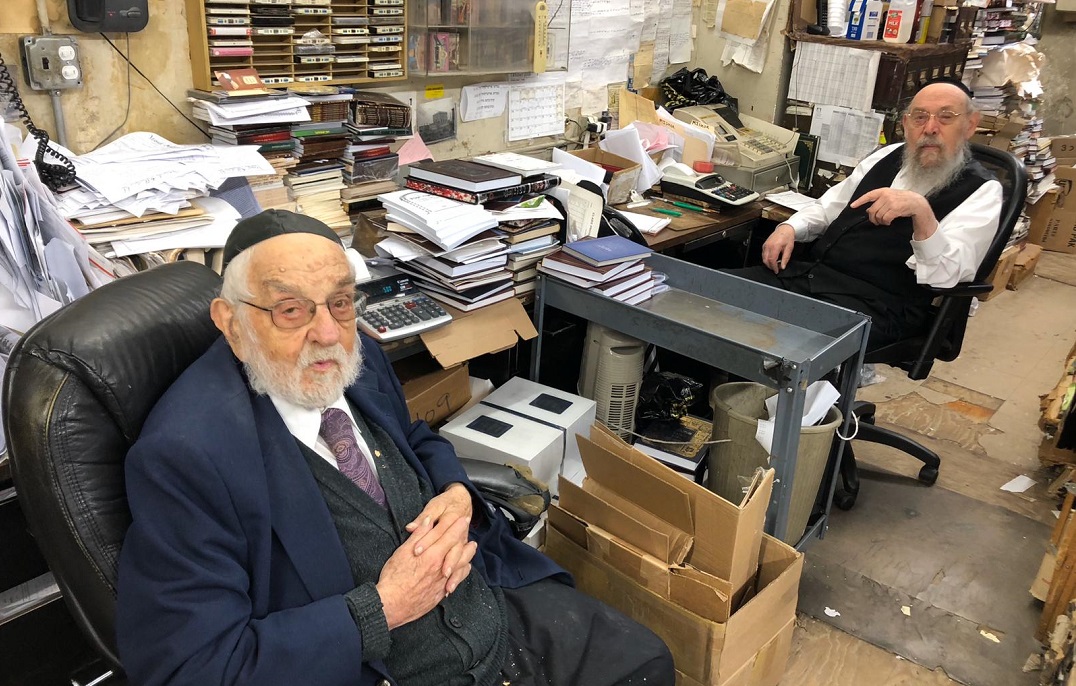
In a nondescript Boro Park store, a legend has been operating for decades. It’s a magnet for Jews of all sorts who are united by their common love for the holy volumes that transcend their differences. Welcome to J. Biegeleisen Hebrew Books, the first stop and last word for seforim lovers everywhere
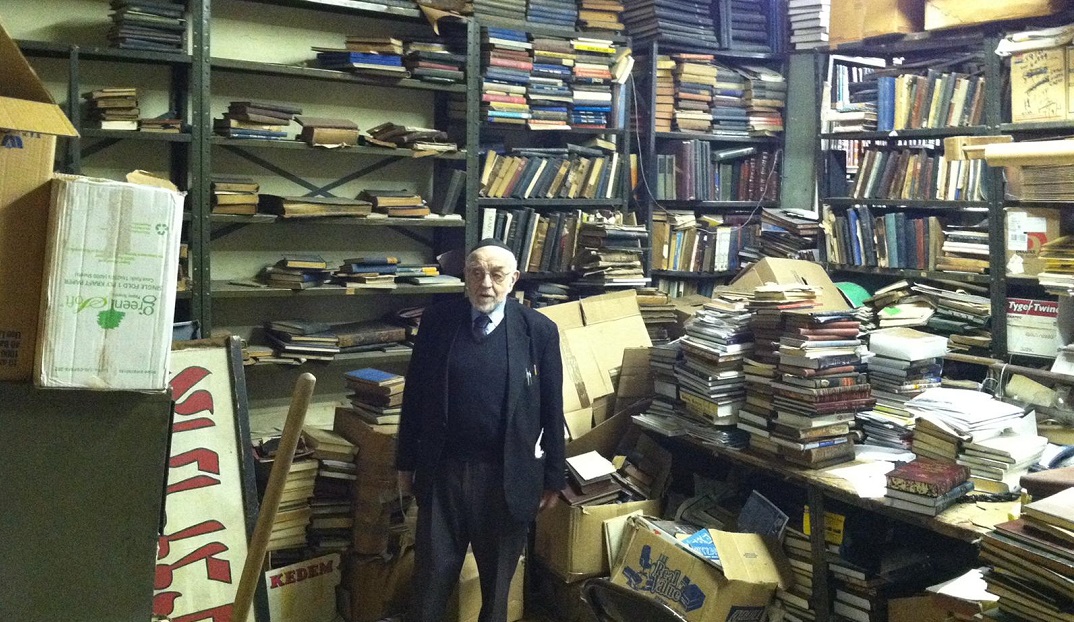
In a society plagued by many negative trends and needs, all too often, the writer must put words to a troubling problem. What a joy, then, to write about this most beautiful of addictions: the People of the Book’s insatiable love of seforim. And what better way to do it than by traveling to the undisputed seforim headquarters, the supplier’s supplier, the dealer whose phone number is stored in the speed-dial of serious customers everywhere. It’s a store so nondescript, without any sign or identifying feature, that it seems to fade into a line of other shops that stretches on for blocks and blocks in Boro Park’s commercial district.
Yet even without a marketing budget, the name Biegeleisen (or J. Biegeleisen Hebrew Books, for the sake of accuracy) has become singularly identified with the industry, the definitive “if they don’t have it, it doesn’t exist” locus for seforim collectors, lovers, and purchasers.
Like the vast range of the seforim inside, the store isn’t limited to any one type of customer. It’s not just a destination for serious seforim aficionados; on any given day one can find here a bar mitzvah bochur fingering the books gingerly, a shul shamash looking to augment his congregation’s library, and an accomplished talmid chacham looking for an obscure treatise on the Yerushalmi. There’s a mystique here, enough to create an aura.
Besides the mix of people, another unique Biegeleisen feature is the fact that price is not indicated anywhere on the sefer. Instead, there is an obscure coding system so that the owners — rather than the would-be purchasers — know the price. Many customers, however, relate with no small degree of pride that they have “cracked” the code.
When I enter, I meet one of the “addicts,” a well-dressed businessman who visits the store “if not every day, then every second day, just to see what came in.” I ask why. “Because this is my thing, I am sick,” he answers, and it’s clear from his smile that he is quite content with his “sickness.”
The proprietor of this empire, Reb Shloime Beigeleisen, leads me to a small alcove in the back of the store, where we sit on chairs with no backs. His air is noncommittal and matter-of-fact. He thinks I’m wasting my time with the interview; he is a regular person, and the store is a regular store, and he doesn’t know why I think it’s newsworthy, and he says as much. As he begins to speak, however, it becomes clear that the store’s mystique has deep and fascinating roots.
Reb Shloime is, bli ayin hara, over eighty years old, and most of his life has been spent here, between the books, boxes, and rope. He answers my questions politely, but with the detached air of someone who really doesn’t understand what I want.
Biegeleisen’s is likely the oldest seforim store in New York, certainly the oldest one in Boro Park, having opened close to a hundred years ago in the neighborhood. Reb Shloime’s father, Reb Yakir Biegeleisen, arrived in the United States from Galicia along with his own father. Lovers of seforim, these Belzer chassidim began to buy, trade and sell their own seforim out of the family home, which was located in Boro Park of the twenties. Of course, all seforim at the time were printed in Europe, and thus harder to come by. Soon enough, word spread. Even if the man of the street had no need for a Rashba or a Teshuvos Rabi Akiva Eiger, there were European-born and trained rabbanim across the country who found their only solace in the timeless words of the seforim.
“Often, these rabbanim lived in cities where they had no one with whom to ‘speak in learning,’ and their seforim were quite literally their best friends. My father created a catalog which he would send to all of these rabbanim.”
By establishing their niche in this way, the Biegeleisens soon had a steady business. Then, in the forties, the stream of immigrants from Eastern Europe became a flood, and the business entered its glory era. The new arrivals looked at seforim not as synagogue décor, but as staples for a vibrant, functional Jewish home. They knew that Yakir Biegeleisen — a bookseller of the old school — would provide them with a mix of honesty, unsurpassed yedios, and appreciation for the contents of each individual sefer.
Reb Shloime indicates a letter written by one the greatest geonim of that era, Reb Michoel Forshlager.
“He was something special, a talmid of the Avnei Nezer of Sochatchov, and someone who was in constant contact with my father,” Reb Shloime recounts. “He left over a priceless seforim collection, in addition to volumes of his own chiddushim, which have yet to be printed.”
In a postscript to a shtickel Torah, Rav Forschlager writes to someone looking to establish contact with rabbanim in America: “To my knowledge, Mr. Biegeleisen would be ideal for this, as he communicates with all the rabbanim in America, and also the balabatim that purchase seforim, and everyone is pleased with him. He conducts his business honestly, and knows and appreciates his merchandise; he is a Belzer chassid …”
That letter is far from the only piece of history here. There are little fragments of times gone by all around the store, starting with the sign — J. Biegeleisen Hebrew Books — that originally graced the old store on the East Side. Today it sits in the store window, facing the interior. One relic that I personally find touching is a brittle receipt taped to the wall, dated in the early fifties, confirming the payment of Pinchas Hirschprung of Montreal for the seforim he received. It’s poignant because, as anyone from Montreal knows, Rav Hirschprung — chief rabbi of the city — spent hour after hour, day after day, year after year, fully immersed in his seforim. The yellowed scrap is more than just nostalgia; it’s part of a paper trail of eternity.
The talmidei chachamim of his era invested more than their trust in Reb Yakir Biegeleisen; he was indispensable to them in another way as well. With his connections and expertise, he helped many institutions establish their seforim libraries.
Reb Shloime remembers one of the earliest such incidents:
“There was a seforim collector, a very wealthy man, who was moving to Eretz Yisrael. He asked my father how to arrange the shipping logistics for his library. ‘Why go through the expense and bother?’ my father said. ‘Instead, you can leave them all here where people will learn from them, and you can start a new collection there.’ The fellow accepted my father’s logic and with that, the otzar haseforim of Yeshivah Torah Vodaath was started.”
The story of the Chaim Berlin library, as Reb Shloime tells it, is especially fascinating.
“There was a professor at Harvard, a brilliant scholar named Nathan Isaacs, who had a great love of seforim, particularly seforim of sheilos and teshuvos. He discovered my father and basically made him responsible for assembling the seforim that formed his collection. My father would send him seforim along with index cards which noted where the interesting teshuvos were. In time, he put together quite a collection.”
In 1941, the professor passed away. Reb Yakir Biegeleisen realized that the family had little interest in the collection, and he made them an offer, hoping to purchase it in its entirety for Yeshivas Chaim Berlin. Along with Rav Hutner and Rav Shlomo Freifeld, the bookseller traveled to Boston to see the collection. Reportedly, there were just two beds at their accommodations. Rav Hutner told the other men to sleep while he sat up through the night with a sefer Teshuvos Maharash Engel.
“The trip was successful, Baruch Hashem, and the library was established at Chaim Berlin.”
Reb Yakir invested much of his energy and resources assembling the seforim collection in Boro Park’s first Belzer shtiebel. “It had everything,” Reb Shloime remembers, “the new, the old, the hard-to-get. But over the years, many of those seforim have gone missing. People ‘borrow’ and don’t return.”
I’m amazed. “People steal seforim?” I ask.
He gives me a long look, as if marveling at my naïveté. “Of course they do. I’m sure they have all kinds of heteirim for it also.” He lifts a sefer from the table and slips it under his jacket. “It’s fairly easy, too.”
Create a free account to keep reading.