This was no ordinary will, for the unique individual who promulgated it had sparked a worldwide kosher textile revolution
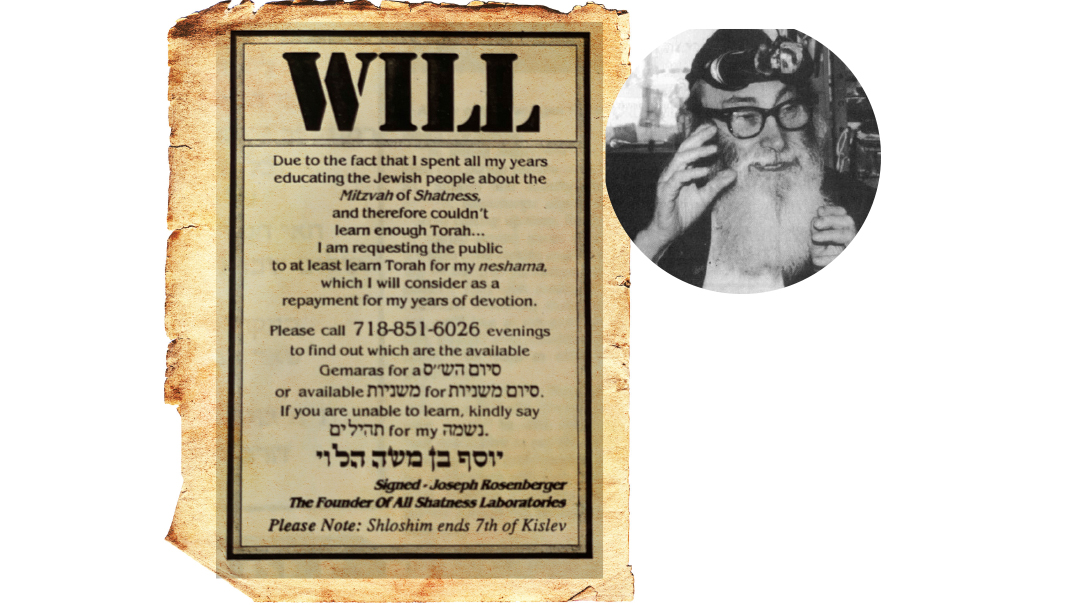
Wills aren’t generally published in the local papers anymore, nor do they call on the general public to study Shas on behalf of the deceased while apologizing for his not becoming a talmid chacham. Yet this was no ordinary will, for the unique individual who promulgated it had sparked a worldwide kosher textile revolution.
Joseph Rosenberger (1911–1996) had been raised in an Oberlander home on the outskirts of Vienna. Following the Anschluss with Nazi Germany on March 12, 1938, he spent a torturous year in the Dachau concentration camp before making his way to the US.
Discovering that technological advances and mass marketing had made traditional methods of shatnez checking obsolete in his new home, Mr. Rosenberger set out on twin crusades: research new methods for shatnez detection, and raise awareness and enthusiasm among the public for what had become a lost mitzvah. Under the aegis of the nascent Agudas Yisrael, and with the encouragement of its tireless leader Mike Tress, Mr. Rosenberger opened the first shatnez lab in 1941.
Finding customers would prove to be quite a challenge. Making his rounds between Minchah and Maariv to the various Williamsburg shtiblach, he unabashedly promoted shatnez checking. Though he was targeting American Orthodoxy in the 1940s, he still faced ambivalence (perhaps ignorance?) at best, scorn at worst.
Create a free account to keep reading.