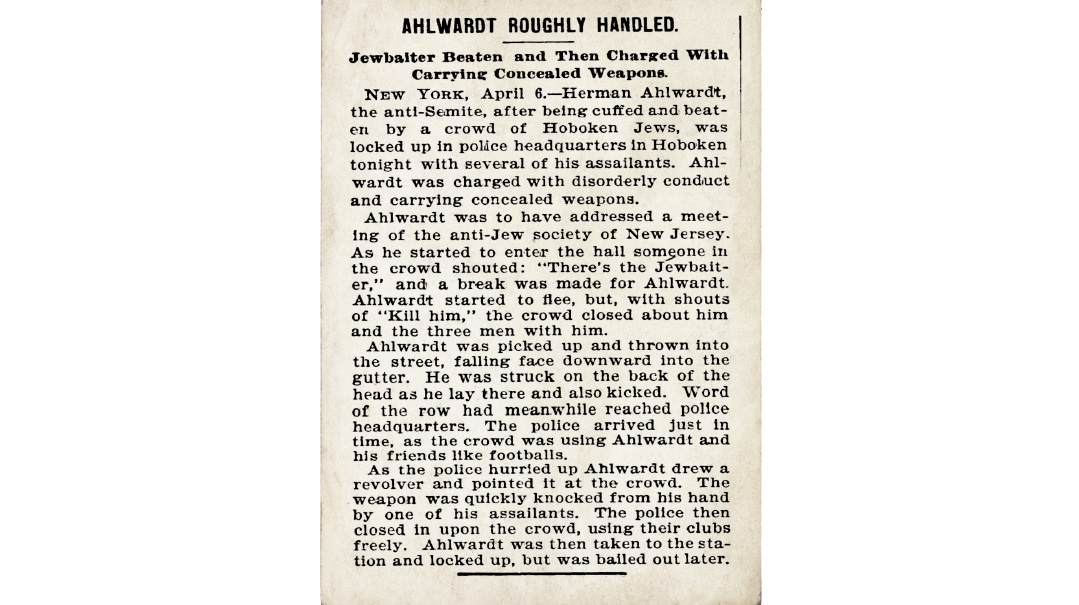
In 1895 Ahlwardt arrived in America on a speaking tour, hoping to exploit free speech laws to inflame anti-Semitic sentiment
Medieval anti-Semitism against the Jewish religion was supplanted in the 19th century by modern anti-Semitism against the Jewish People. Emancipation brought equal rights to Western European Jewry, but the rise of romantic nationalism, combined with modern media propaganda and political parties, led to a manifestation of a new and ugly form of Jew hatred. Though it was particularly insidious in late 19th-century France, culminating in the Dreyfus affair, and in Czarist Russia, culminating in the May Laws, pogroms, and the Protocols of the Elders of Zion forgery, it was in Germany that the term anti-Semitism was brought into wide use by Wilhelm Marr in 1879.
Marr published a pamphlet describing the threat that Jews posed to the future of Germany, and to advance his ideas, he founded the League of Anti-Semites. Anti-Semitic expression wasn’t limited to the fringes of society; German statesman Heinrich von Treitschke coined the phrase “Die Juden sind unser Unglück” (the Jews are our misfortune), adumbrating its daily use by the Nazi Der Stürmer a half century later. Anti-Semitic candidate Hermann Ahlwardt was elected to a seat in the Reichstag by running on a platform that Jews were at fault for the recent decreases in agriculture revenue, openly describing Jews as “predators” and “cholera bacilli” that should be exterminated.
In 1895 Ahlwardt arrived in America on a speaking tour, hoping to exploit free speech laws to inflame anti-Semitic sentiment. While his hateful messages were largely scorned by the American people, he found an ally in the nascent Anti-Semitic Society of America, which hosted several speaking engagements. He also utilized the freedom of the press to found a short-lived newspaper called the Gentile News.
Future American president Theodore Roosevelt was serving a brief stint as New York City’s police commissioner at the time. He hit upon a creative solution to allow Ahlwardt to exercise his free speech rights while making him a laughingstock. Roosevelt recorded in his autobiography how he was approached by concerned Jewish citizens of New York regarding the anti-Semitic agitator:
Create a free account to keep reading.