The House of Chernobyl was founded by Rav Menachem Nochum Twersky, a talmid of the Baal Shem Tov
AS the chassidic movement’s center of gravity shifted west to Galicia and Poland over the 19th century, the dominant dynasty remaining in Ukraine was the House of Chernobyl, founded by Rav Menachem Nochum Twersky, a talmid of the Baal Shem Tov and author of Meor Einayim. His son and successor, Rav Mordechai Twersky, known as the Chernobyler Maggid, had eight sons who would establish courts across central Ukraine, among them Tolna, Rachmistrivka, Skver, Cherkassy, Hornosteipel, Trisk, Makarov, and Korostyshev.
With the Bolshevik Revolution in 1917 and the subsequent establishment of the Soviet Union, religious leaders were persecuted and often had to flee or go into hiding. Some leaders of Chernobyl hunkered down and stayed, their small communities operating underground in the ensuing decades. Most were ultimately exiled to Siberia or killed by the Nazis during the Holocaust. Some escaped to Poland, while the Rachmistrivka branch made it to Eretz Yisrael.
Others were able to escape the Soviet Union, ultimately reaching the United States and becoming some of the earliest chassidic leaders to establish themselves there.
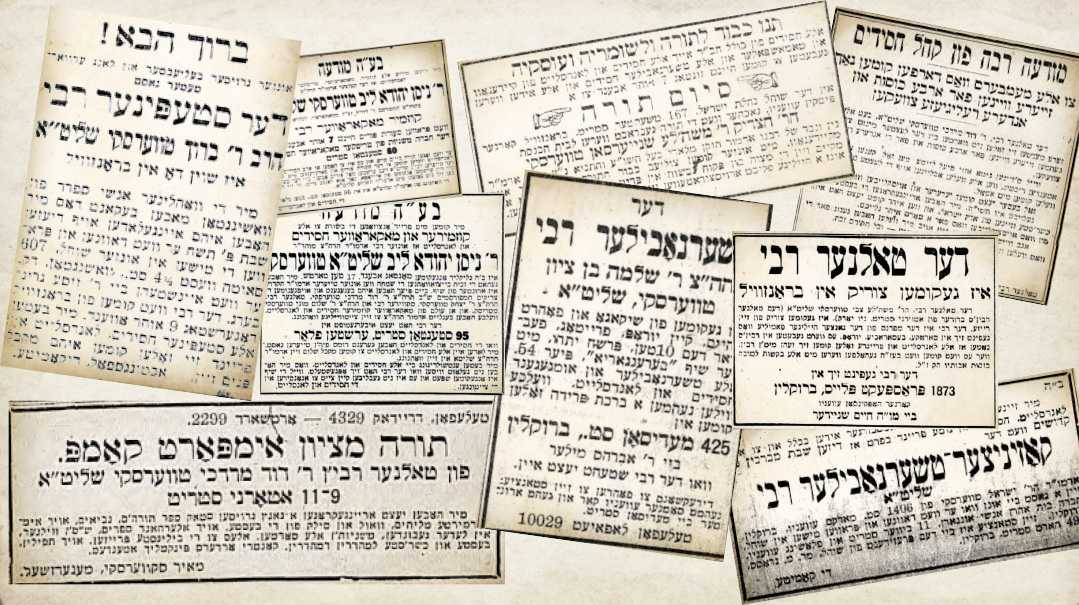
Tolna was the first branch of Chernobyl to arrive in the New World. Rav Dovid Mordechai Twersky immigrated to New York in 1913, where he established a Tolna shtibel on the Lower East Side. An ad in a Jewish newspaper stated that he had “hundreds of members who were Sabbath-observant and proper Jews at his synagogue at 9 Attorney Street.” His brothers fled the Soviet Union during the 1920s, with Rav Moshe Tzvi arriving in Philadelphia in 1924, and Rav Meshulam Zusya immigrating to Massachusetts in 1927. Eventually settling in Boston, he was succeeded by his son Rav Yitzchak Asher (Professor Isadore) Twersky, who served as Tolna Rebbe while also a professor at Harvard.
Create a free account to keep reading.