"Reb Chaim clearly proved the baselessness and falsity of the imbecile creature known as Bible criticism"
From Rav David Tzvi Hoffman to Rav Mordechai Breuer, over the course of the 20th century, many Orthodox scholars defended the Divine authorship of the Torah against the onslaughts of Biblical criticism. A product of the 18th-century Enlightenment, Biblical criticism purported to critically reexamine the Hebrew scriptures from a scientific perspective, reconstruct Biblical historical events, and analyze the text itself and how it developed. With the gradual academic acceptance of this heresy in the early 1900s, there emerged a pressing need for an educated, authentic response from within the Torah world. A brilliant young scholar known as the “Warsaw Illui” resolved to shoulder that responsibility.
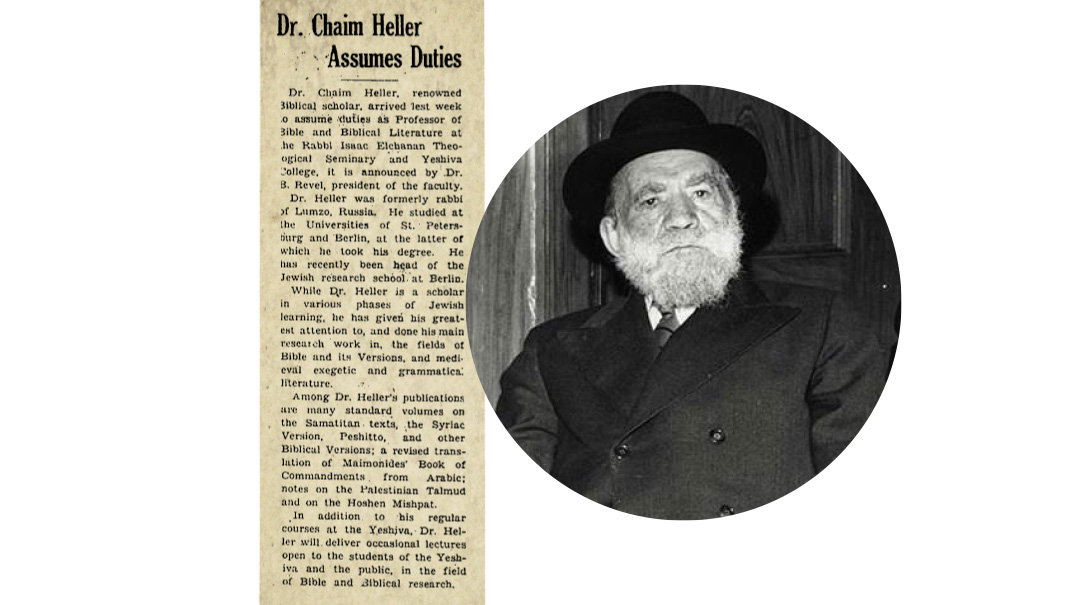
Rav Chaim Heller (1879–1960) was born in Bialystok and raised in Warsaw. He never studied in a traditional yeshivah setting, but in the home of his rich uncle, the young genius was exposed to some of the greatest Torah scholars of the day, including Rav Yitzchok Elchonon Spektor of Kovno; the Beis HaLevi, Rav Yosef Dov Soloveitchik; and the Netziv of Volozhin. Among his friends were Rav Chaim Brisker, Rav Eliyahu Chaim Maizel of Lodz, and Rav Elya Feinstein of Pruzhan. In addition to his Torah accomplishments, Rav Chaim received a doctorate from Wurzburg University.
When the renowned rabbi of Lomza, Rav Malkiel Tzvi Tannenbaum, passed away in 1910, Rav Chaim Heller was appointed in his stead. Just a couple of months later, Rav Heller left Lomza, not wishing to serve in the rabbinate. He later moved to Berlin, where he opened a unique Torah institution named Beis Medrash Ha’elyon. Perceiving the threat that Biblical criticism posed toward the traditional understanding of Tanach, he endeavored to create an elite institution where young brilliant scholars would receive the tools to refute critics.
Rav Chaim felt that what was missing was a background knowledge in ancient Semitic languages — Biblical Hebrew, Arabic, Aramaic, Syriac — coupled with a broad and in-depth knowledge of Tanach and Shas. This combination would enable one to disprove any theory advanced in the field of Biblical criticism.
Create a free account to keep reading.