Jewish tombstones in the middle of a Chinese cabbage field? Hebrew inscriptions on slabs of stone used as sewer covers? Israeli photojournalist Dvir Bar-Gal discovered Shanghai’s graveyard secret: hundreds, maybe thousands of Jewish tombstones, are scattered around Shanghai’s outlying villages, used for everything from building beams to washboards.
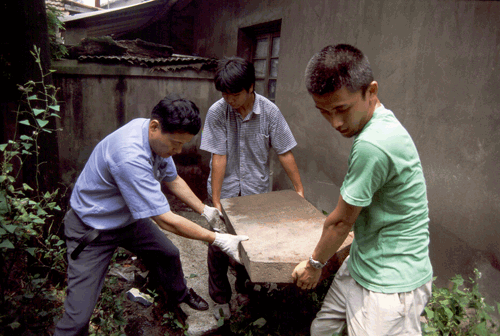
 As the old dilapidated villages around Shanghai are being redeveloped into upscale neighborhoods Israeli photojournalist Dvir Bar-Gal is racing the clock scouring swamps construction sites riverbeds and cabbage fields for the slabs of stone that mark the city’s Jewish past.
What turned into his mission of the decade began by accident when he discovered a Hebrew tombstone in a Shanghai antique shop in 2001. Since then he’s become Shanghai’s “gravestone sleuth” unearthing burial markers in the most obscure places around the bustling Chinese metropolis.
Bar-Gal a photojournalist from Tel Aviv was in Shanghai to learn more about the city that served as a refuge for Jews for a century when he hooked up with a tour led by fellow Israeli expatriate and Shanghai resident Georgia Noy. When the tour ended Noy sent the journalist what she thought might be a story lead for him: a photograph of two Jewish gravestones adding that she had found the stones in an antique shop in the city where they were up for sale. The name Yachne bas Reb Shmuel Poliak was engraved on one stone; the other stone bore the name Raizel bas Reb Moshe Abramowitz written in both Hebrew and Russian.
“At first I wanted to ignore the pictures” Bar-Gal told Mishpacha. “Who is interested in graves today? But Georgia told me she received many inquiries from Jews looking for their ancestors’ burial places and although Shanghai had a large Jewish community there was a big mystery. There was not a grave to be found. I smelled a good story and decided to check it out.”
Create a free account to keep reading.