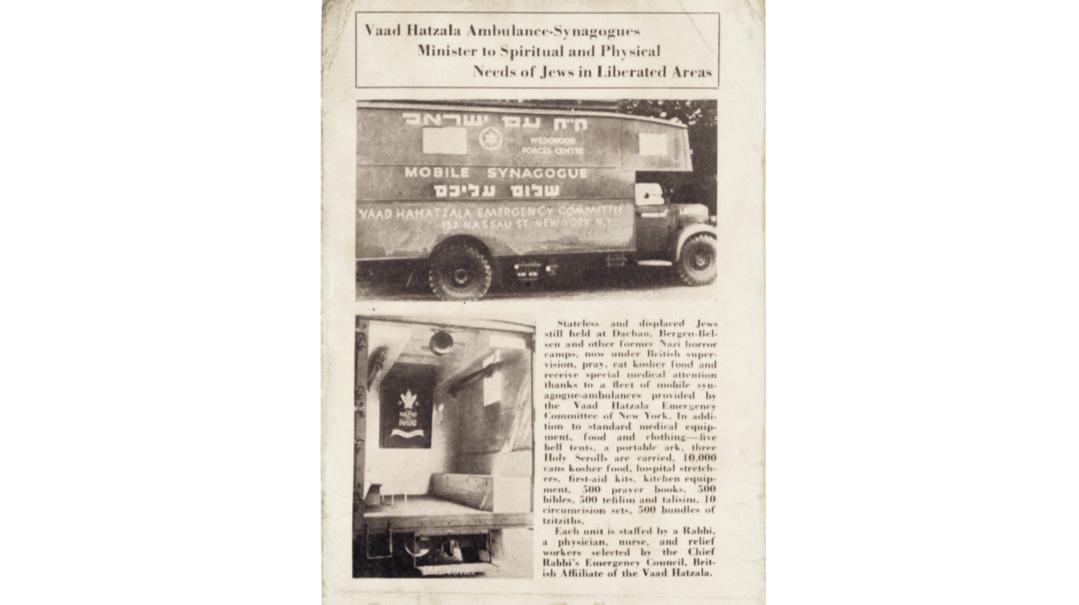
One of the Vaad Hatzalah’s innovations was the “ambulance synagogue”
When General Alfred Jodl signed the German Instrument of Surrender in Reims, France, on May 7, 1945, and Field Marshal Wilhelm Keitel did so the next day in Berlin, the guns finally fell silent on the European continent after nearly six years of devastating bloodshed. While the world celebrated V-E Day on May 8 and 9 and servicemen began returning home, the few Jewish survivors of the Holocaust only began to internalize the full scope of the tragedy they had experienced.
A period of physical rehabilitation was soon followed by searches for relatives, attempts to return home, and the dawning realization for many that they were alone in the world with nowhere to return to. The Allied militaries established Displaced Persons (DP) camps, which were administered by UNRRA. As attested by the Harrison Report in the summer of 1945, the survivors were kept in horrid conditions, and it was up to Jewish American philanthropic organizations — primarily the Joint — to provide for the physical needs of the survivors.
The Vaad Hatzalah was an American organization established by the Agudas Harabbonim in November 1939 to assist refugee rabbis and yeshivah students. In late 1943, the Vaad expanded its activities to include Holocaust rescue. With the war over, the Vaad focused its activities on physical and spiritual rehabilitation for the survivors in the DP camps. This would later come to include provision of religious articles, kosher food, Jewish educational facilities, printing of seforim, and more.
In its initial stage, however, it was imperative to expedite relief and reach those who needed it most. One of the Vaad Hatzalah’s innovations was the “ambulance synagogue” — a standard ambulance stocked with standard medical equipment and staffed by physicians and nurses, augmented with supplies of sifrei Torah, siddurim, talleisim, tefillin, tzitzis, and kosher food, with a rabbi attached to the staff for good measure. These mobile synagogues were able to reach a wide number of survivors, providing critical relief during the early months after liberation.
Create a free account to keep reading.