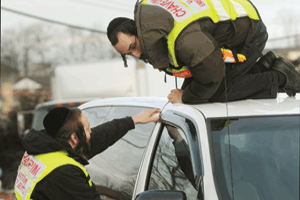
When Rabbi Shaya Erps first thought of creating a cadre of volunteers who would respond to nonemergency dilemmas, his friends were less than encouraging: “Nice idea, but it will never work.” But Rabbi Erps didn’t give up so fast, and it worked. So if you’re stuck with a flat tire on your way to catch a plane, or you’re locked out of your house as it begins to snow, you can thank Rabbi Erps when a Chaverim volunteer comes to the rescue.
Since he was a child Rabbi Erps who grew up in Monsey where his parents still live watched them selflessly helping others around them. Though his parents lived in a small house and owned few possessions their hearts were big enough to include all those who crossed their path. His father would send him together with his brother to build the succah of an elderly neighbor before erecting their own. His mother filled her tiny home with shopping bags of clothing as she helped run a used-clothing gmach. Neither preached about the importance of chesed but Rabbi Erps learned to be a giver by osmosis.
Rabbi Erps joined Hatzolah of Rockland County in September 1993. After working the territory for some time he observed that Hatzolah dispatchers regularly received nonemergency calls from people who required help but didn’t know where else to turn. For example Hatzolah members occasionally transported handicapped individuals up or down steps and once even chased away rowdy neighborhood kids who had injured a child. But because emergencies took precedence they were not always available to respond to such calls. Not one to sit idly by after recognizing a community need Rabbi Erps soon conceived the idea of forming a Code Two Squad.
“Medical emergencies are known as Code One” he explains “so I thought that my volunteers could be known as Code Two members.”
At first Rabbi Erps envisioned this Code Two Squad as an offshoot of Hatzolah even using the same dispatching system. However after some discussion with Hatzolah directors it became clear that there were too many technical complexities involved. It was decided that it would be best to form an organization that operated independently.
Create a free account to keep reading.