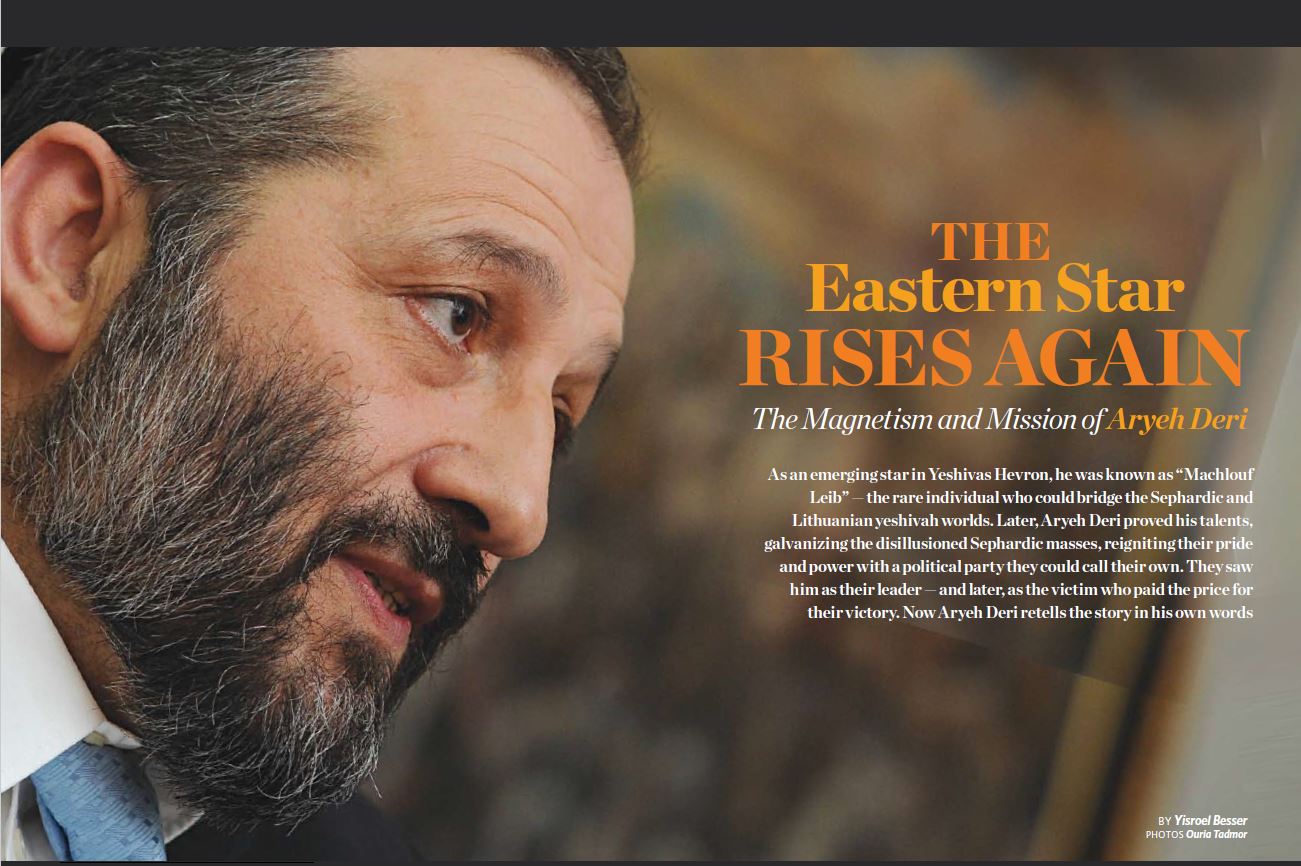
As an emerging star in Yeshivah Hevron, he was known as “Machlouf Leib” — the rare individual who could bridge the Sephardic and Lithuanian yeshivah worlds. Later, Aryeh Deri proved his talents, galvanizing the disillusioned Sephardic masses, reigniting their pride and power with a political party they could call their own. They saw him as their leader — and later, as the victim who paid the price for their victory. Now Aryeh Deri retells the story in his own words
The small barbershop in Jerusalem’s Shmuel HaNavi neighborhood was a mixture of smells: talc and tonic, shampoo and the faintest hint of cigarettes — officially prohibited but evident nonetheless by butts piled up in a small tray in the corner. The day I happened in there, the smell was something deeper, muskier, heavier. It was the smell of discontent and restlessness.
The owner, a young, immaculately dressed Sephardi, had enough customers waiting for him that it seemed to require protzektzia to merit a glance from him. Several young men worked assiduously all around him, but as I stood there — a young American waiting patiently for a seat, trying to figure out my place in line — I soon realized that there was no line. People were coming in from the street to join the conversation, jumping in with a familiarity that suggested that they came in often, and that the topics rarely varied. Many entered, sat, chatted, and then left, dispensing with the formality of a haircut altogether. There were bigger things going on there.
Eventually, someone took pity on me and cut my hair. (Maybe they tried out new barbers on unsuspecting Americans?) Of course, it became my barbershop of choice, and throughout the years that I lived in the Holy City, I looked forward to my trips there. Left out as I was, there was something in the atmosphere: passion, conviction and a youthful zeal, suggesting that the small storefront was a hotbed of political activity. The conversations centered around one person, essentially, and one cause. Their praise was reserved for him and his people, their most venomous criticism for his detractors and enemies. Every surface in the store boasted his picture, or slogans proclaiming his righteousness. They were the troops, and he was the one they would rally around.
Create a free account to keep reading.