“The Jews had forgotten how to do shechitah for lamb and cows, so they ate only chicken,” Geula says. “They kept many traditions, but no longer remembered why.”
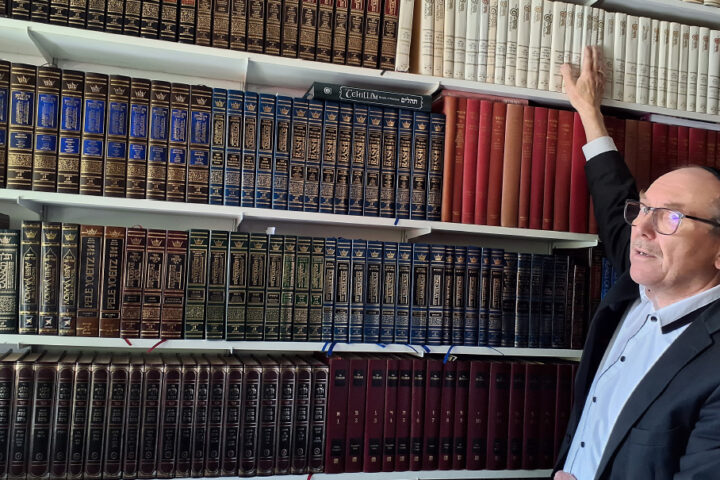
N eat and modest on the outside Geula Sabet’s home in Forest Hills is filled with striking Persian rugs elegant drapes and glass cases displaying fine china bibelots she has collected on her world travels.
These days, Geula, 72, and her husband travel for pleasure and to visit their children in Eretz Yisrael. But several generations ago, Geula’s family embarked on a journey to save their lives. Her mother’s family fled Bukhara in the late 1930s, arriving in Eretz Yisrael via Afghanistan and Iran. There, her grandfather served as chief rabbi of the Bukharian community. In the 1950s her parents moved to New York.
In a casual skirt and shirt, Geula still looks young and fresh. There’s a touch of polite shyness to her manner, but Geula’s desire to share her heritage quickly overcomes her hesitation, and she spills out a wealth of stories. She has prepared for our meeting: hand-dyed silk caftans and embroidered, beaded Bukharian caps cover one couch, and the coffee table has been laid with fragrant green jasmine tea and a tray of dried fruit and nuts.
Geula’s life has been a journey. As a young child of immigrants in New York, Geula kept the house running while her parents worked long days. After her marriage at age 16, Geula resolved to get an education. “I hadn’t finished high school,” she tells me. “I had to get my GED, then convince Queens College to take me.” The entire process, accomplished while raising four children, took 14 years, including master’s work in Sephardic studies.
Upon graduation, Geula went into Jewish education, working in kiruv with Iranian, Russian, and Bukharian immigrants, and speaking to groups about Bukharian culture. Fluent in Bukharian, Farsi, and Hebrew, she also worked as a translator in hospitals and for NYANA, a Jewish organization that helps settle new immigrants. Her greatest passion, however, is sharing her Bukharian heritage.
“Jews are the oldest inhabitants of Bukhara, which is bordered by China, Russia, and Iran,” Geula says. “There are tombstones there with Hebrew inscriptions dating back to the second century.”
Some say Bukharians made their way there via Iraq after the fall of the First Temple. They may have migrated during the reign of King Cyrus, when Iran had a large Jewish population. Others claim the Bukharians are the lost tribes of Yissachar and Naftali.
“My family had a yichusin book, tracing our lineage,” Geula explains. “It shows that we descend from Ezra Hasofer. The yichusin book was written on parchment, and when my grandfather left Bukhara, he took it with him. Somehow it ended up in the library in Leningrad [today St. Petersburg]. My son and my cousin are trying to arrange to see it there.”
While Bukhara is on the Silk Road, a trade route, the Jewish community remained isolated from the rest of the Jewish world and pressured to assimilate to the Islam of their neighbors. By the 18th century, they had lost many customs; per legend, they retained only two out of five Chumashim. “The Jews had forgotten how to do shechitah for lamb and cows, so they ate only chicken,” Geula says. “They kept many traditions, but no longer remembered why.”
But Hashem sent a shaliach, a rav originally from Tetouan in Morocco who’d studied Kabbalah in Tzfas. Rav Yosef Maimon arrived in 1793 and, finding the community’s religious level woefully lacking, took it upon himself to stay and teach. Rav Maimon married a local woman, and Geula’s family tree on her mother’s side includes him among her ancestors.
The Bukharian community made their living through silk, crafts, and furs, and by trading. “Dyeing silk was a Jewish occupation, with its own trade secrets,” Geula says, displaying a colorful rose-colored silk caftan patterned with lozenges of green, blue, and gold. “This caftan was dyed by hand. This dress”—she holds up a salmon-colored dress with tufted roses—“is pure silk. My mother wore it for chagim.”
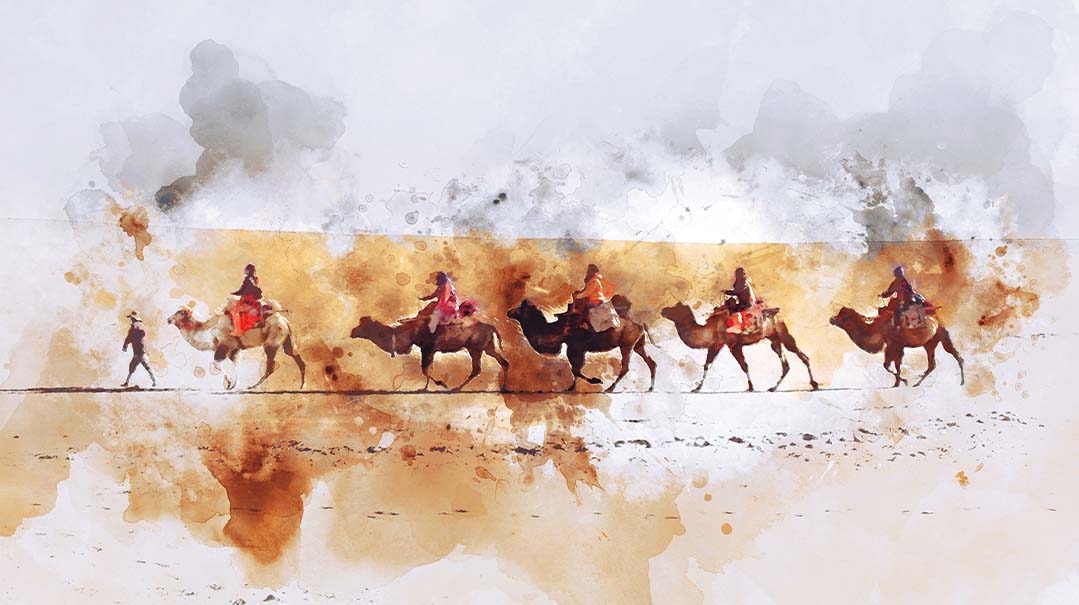
Jewish traders would buy and sell silk, spices, cotton, leather, and artisanal goods; along the route, they delivered mail and maintained communications. In order to observe kashrut and Shabbat, they set up a system of Jewish homes at six-day intervals, so travelers could stop for Shabbat. “Every bar mitzvah boy was taught to shecht chickens, so that when he started traveling, he’d be able to eat meat,” Geula says. “The men would buy bread, fruits, vegetables, and eggs along the way. They traveled with a sefer Torah.”
The routes were difficult, unpaved roads through deserts and steep mountains. Guides called rohdahns, who knew the terrain, would lead them and help them avoid robbers and other dangers. They slept in caves at night, constantly on alert for snakes and scorpions. Given these dangers, women almost never went along.
“The exception was a prospective mother-in-law traveling to check out a bride,” Geula says. “Many matches were arranged on these trips.”
While their Muslim neighbors revered those who’d made the hadj, or pilgrimage to Mecca, the Jews of Bukhara had the custom to make a pilgrimage to Jerusalem (and would call such returned pilgrims “hadji”).
“They would leave after Pesach, arriving in time for Shavuot,” Geula says. “Many Bukharians would buy second homes in Israel and send boys to yeshivah there.”
By the middle of the 19th century, a settlement called Shechunat HaBucharim had been established in Jerusalem, near Meah Shearim, and around the same time, the Russians took over Bukhara and granted the Jews more religious freedom.