The Boyaner dynasty, and its historic chazakah over the hadlakah, almost didn’t survive
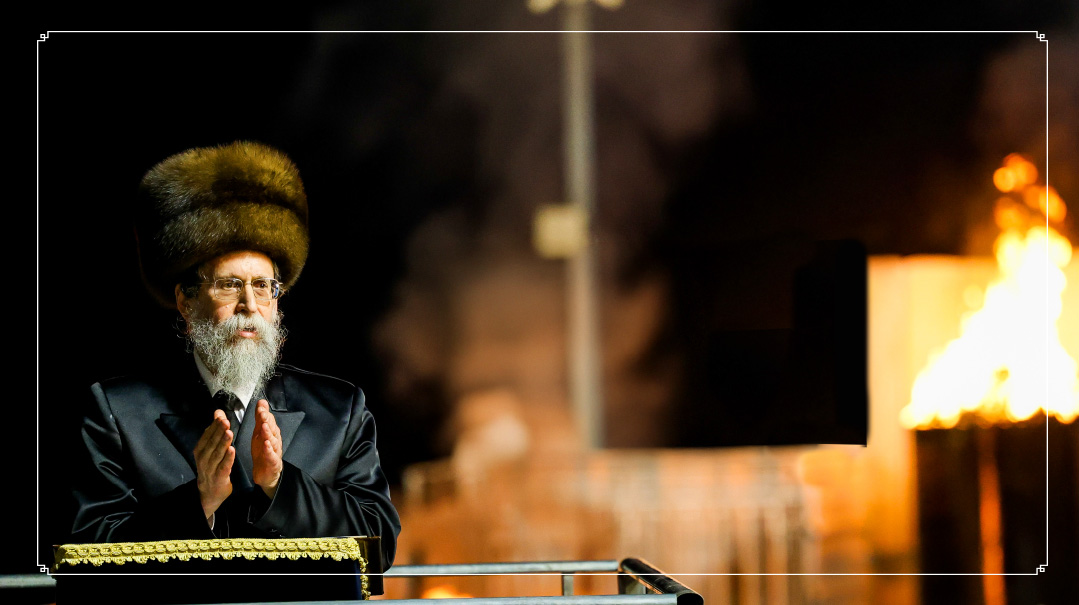
As the music shifts from haunting niggunim to jubilant song, the Boyaner Rebbe lifts the torch in hand, and as the flame catches the bundle of oil-soaked cotton, all of Meron seems to erupt in sacred joy. Yet the Boyaner dynasty, and its historic chazakah over the hadlakah, almost didn’t survive — until a remarkable chain of events restored the crown and returned the tradition to the famed rooftop bonfire
It was Zos Chanukah, 1984.
I was a young boy when my father a”h told my brothers and me that we would be attending a tish that evening. The announcement surprised us, because although my father had deep chassidic roots through his father and grandfather, our family had not taken part in such gatherings since immigrating to Israel. In the United States, we had regularly davened in the beis medrash of Rebbe Moshe Mordechai Heschel of Kopyczynitz in Boro Park — he even served as sandek at my bris. But after his sudden passing in 1975 at the young age of 47, my father stopped attending tishen.
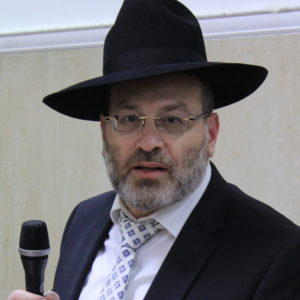
When we arrived at Yeshivas Tiferes Yisrael (the Boyaner yeshivah) on Malchei Yisrael Street in Jerusalem’s Geula neighborhood, the excitement in the packed hall was palpable. For my father, the moment was deeply personal: The young, newly-coronated Boyaner Rebbe — 25-year-old Rav Nachum Dov Breyer, a grandson of the previous Rebbe who passed away in 1971, was married to the granddaughter of Rebbe Avraham Yehoshua Heschel of Kopyczynitz (a close friend and distant cousin of the previous Boyaner Rebbe and father of Rebbe Moshe Mordechai). And now, after much rabbinic pressure, this young, quiet talmid chacham had finally agreed to take on the leadership of the Boyaner chassidus. For the chassidim, it was a long-awaited moment of renewal, a turning point they had yearned for for over a decade.
Only years later did I fully grasp the magnitude of that night, and the extraordinary chain of events that culminated in the rebirth of the dynasty with the crowning of the present Boyaner Rebbe.
And every Lag B’omer, I think about it again.
That’s because one of the most sacred traditions of the House of Ruzhin, rooted in the time of Rebbe Yisrael of Ruzhin and continued to this day by the Boyaner Rebbe, is the annual Lag B’omer lighting in Meron. Even when the mass celebrations were halted over the last six years due to Covid, the aftermath of the Meron disaster and war on the northern front, the Boyaner Rebbe was still there lighting the main fire, his audience of thousands relegated to live hookup. And he’ll iy”H be there again next Monday night, even as the authorities have pretty much decided that — barring any last-minute developments — Meron will not be open for mass crowds due to the current war.
On “regular” years, thousands converge toward the rooftop of the tziyun of Rabi Shimon bar Yochai, filling every inch of space in anticipation of the moment when the Rebbe lights the flame. (Only about 400 people can fit on the rooftop itself, while giant screens broadcast the lighting all across the mountain.)
They wait as the Rebbe ascends the platform with his trademark regal composure, lighting the flame with measured, deliberate motion. Every gesture is restrained, yet filled with profound inner fire.
At the signal, the musicians begin with the haunting “Arba Bavos” niggun of the Baal HaTanya as preparation for the lighting. Then the choir of Boyaner chassidim sings “Vehi Noam” in the traditional Ruzhiner tune. Suddenly, the tone shifts entirely, as the orchestra breaks into the lively “Lekavod HaTanna haEloki, Rabi Shimon bar Yochai” as the Rebbe approaches the lighting post, torch in hand. He ascends the steps slowly, and when the flame catches into a prepared bundle of cotton and cloth soaked in pure olive oil, it’s as if all of Meron erupts in sacred joy, and the Rebbe, almost imperceptibly, claps his hands. He then moves on to the second nearby flame and lights it as well. A wave spreads through the mountain: The rooftop flames have been lit; the hilula has begun.
He then removes a silk necktie from his pocket and casts it into the fire — a gesture of ancestral tradition.
“The holy Ruzhiner, my great-great-great grandfather, said that tens of thousands of souls achieve their rectification through this lighting,” the Rebbe tells the crowd. “So one must prepare spiritually.” Who knows, he’s hinting, if it’s your own soul that’s among those being elevated?
“I still become emotional when I think about it — the first lighting of the current Boyaner Rebbe at the site,” says Rabbi Yisrael Rabinowitz, a Bohusher chassid [Bohush is one of the branches of Ruzhin] known as the “lighting gabbai” — a title he earned for preparing the central Meron bonfire of the Bohusher Rebbe for many years. Rabbi Rabinowitz had his own upsheren in Meron on Lag B’omer of 1960, and has been there every year since. “It was the year of his hachtarah, Lag B’omer of 1985. Until then, the first lighting was performed by the rabbanim of Tzfas, who served as Boyaner emissaries. In some years, Ruzhiner rebbes would come to Meron, such as the Husiatyn Rebbe and the Boshusher Rebbe, together with the Tzfas rabbanim. That year, Rav Avraham Simcha HaKohein Kaplan, the chief rabbi of Tzfas, asked that the new Rebbe light in order to renew the tradition. The Rebbe initially refused, but in the end agreed that they would light together. Until Rav Kaplan’s passing a few years later, he lit alongside the Rebbe.”
Rav Kaplan passed away in 1989, but for over four decades, he faithfully fulfilled the shlichus of the Boyaner Rebbes, who commissioned him to light the first flame.
The Privilege
How the “chazakah” of the Meron lighting remained within the descendants of Rebbe Yisrael Friedman of Ruzhin (known as the “Heilige Ruzhiner”) goes back to the 1860s when the Rebbe’s son Rav Avraham Yaakov Friedman of Sadigura purchased the privilege of lighting the fire at Meron — a practice traditionally associated with the Arizal — from the Sephardi administrators of Meron and Tzfas. When the structure above the tomb was once in danger of collapse, the Rebbe Avraham Yaakov sent funds to reinforce it, and in return received the privilege of the lighting. While this first Sadigura Rebbe nor his sons merited to come to Eretz Yisrael, they sent personal emissaries to carry out the privilege annually.
So, how did the privilege wind up with Boyan? Noting that the Ruzhiner dynasty can be quite confusing because of its many branches and descendants (all six of the Ruzhiner Rebbe’s sons and some sons-in-law established their own chassidic courts), the line that goes through Boyan began with the abovementioned Rav Avraham Yaakov Friedman, second son of the Heilige Ruzhiner and the first Rebbe of Sadigura. (The Ruzhiner’s oldest son, Sholom Yosef, led his father’s chassidim, together with his brothers, for only a year after the Ruzhiner’s petirah in 1850 until his own passing in 1851; his son became the first Bohusher Rebbe.)
Although all of the Heilige Ruzhiner’s sons established their own courts across Eastern Europe, they all accepted the authority of the Sadigura Rebbe as the undisputed leader of the entire Ruzhin dynasty. Many — Jews and non-Jews alike — viewed him as the leader of Eastern European Jewry.
The first split in the Sadigura court began in 1883 after Rebbe Avraham Yaakov’s passing. As his oldest son and then his son-in-law passed away in his lifetime, there were two sons remaining who were worthy of leadership: The older of them was Rav Yitzchak, and the younger one was Rav Yisrael. As both were qualified to lead, they agreed to draw lots. Rav Yitzchak (known as the Pachad Yitzchak) left Sadigura for nearby Boyan, and Rav Yisrael (the Ohr Yisrael) became the second rebbe of Sadigura.
When it came to dividing up their father’s inheritance, Rav Yitzchak — the Pachad Yitzchak of Boyan — renounced all material possessions but retained the sacred rights connected to Eretz Yisrael: the Tiferes Yisrael Synagogue in the Old City whose construction was sponsored by the Heilige Ruzhiner, communal institutions, and the Meron lighting, all of which he bequeathed to his progeny.
Until that time, Boyan was far from a major Jewish center — official records indicate that only a handful of Jewish families lived there. But once the Pachad Yitzchak settled there, Boyan became a major chassidic hub, attracting thousands of followers. The town flourished until World War I, when the Russian army destroyed the town’s Jewish quarter.
Before the war, the Pachad Yitzchak intended to settle in Eretz Yisrael, but with the ensuing destruction, he fled to Vienna. And as to the suggestion to rebuild elsewhere, he declared, “No, no — only in Eretz Yisrael.”
Into the Desert
After the passing of the Pachad Yitzchak of Boyan, his three sons established their respective courts: Rav Menachem Nachum in Chernowitz, Rav Yisrael in Leipzig, and Rav Avraham Yaakov in Lemberg. Rav Menachem Nachum traveled to Eretz Yisrael in 1927 to light the Meron flame himself, and in subsequent years, his brothers did as well.
The Pachad Yitzchak had one more son, a ben zekunim named Mordechai Shlomo, born as a gift after a special blessing (see sidebar). He had not set up a court in Europe, but instead was sent on a mission that would prove to be the salvation of the Boyaner line.
It happened when he received a surprising proposal from a cousin, Rebbe Yisrael of Chortkov, one of the senior rebbes of the Ruzhin dynasty.
A deep concern weighed on Rebbe Yisrael’s heart: The masses of Jews who had emigrated from Eastern Europe to the United States were facing grave spiritual danger. He believed the path to preserving Judaism in America lay in establishing educational institutions and yeshivos — but that required the presence of rebbes who would be willing to live in what was then a spiritual desert.
As so, Rebbe Yisrael selected two talented young relatives for the mission: Rebbe Yitzchak of Sadigura-Rimanov and Rav Mordechai Shlomo of Boyan. They were to travel together, initially for a trial period of several months, so they could support one another in the unfamiliar environment.
But then, Rebbe Yitzchak of Sadigura-Rimanov passed away at the young age of 39. Still, Rav Mordechai Shlomo continued on the mission alone and emigrated to the United States. At first, he devoted himself primarily to Torah study in relative seclusion, although he eventually established his own court.
In the years following World War II, many chassidic rebbes arrived in the United States, and Rebbe Mordechai Shlomo of Boyan understood that to exert meaningful influence on American Jewry, these leaders would need a unified framework. He therefore helped establish Agudas HaAdmorim, an association to bring the rebbes together. He also worked together with Rav Eliezer Silver of Cincinnati to create what would become Agudath Israel of America.
But Rebbe Mordechai Shlomo’s impact extended well beyond organizational leadership. He offered practical and financial support to emerging chassidic courts, including providing initial financial assistance to Rebbe Yoel of Satmar upon his arrival in the United States. And while he exuded the spiritual loftiness characteristic of rebbes of Boyan, his warmth and sensitivity attracted many American youth — both yeshivah bochurim and secular Jewish boys — who had never seen a chassidic rebbe.
During the Holocaust years, another scion of the Ruzhin dynasty reached America: Rebbe Avraham Yehoshua Heschel of Kopyzcynitz, a great-grandson of Rebbe Yisrael of Ruzhin through his mother. He joined Rebbe Mordechai Shlomo in strengthening Jewish life and served alongside him on the Moetzes Gedolei HaTorah of the Agudah, and like Rebbe Mordechai Shlomo, he devoted himself less to building a personal court and more to outreach and chesed. (In time, the Boyan and Kopyczynitz dynasties would unite when Rebbe Mordechai Shlomo’s grandson — the present Boyaner Rebbe — married Rebbe Avraham Yehoshua Heschel’s granddaughter.)
Rebbe Yisrael of Chortkov’s original vision helped lay the groundwork for the organized Orthodox revival in America, yet for Boyaner chassidus in particular, it proved both physically and spiritually lifesaving.
The Holocaust devastated the direct line of the Pachad Yitzchak. The children and grandchildren of Rebbe Menachem Nachum of Boyan-Chernowitz were murdered, as were Rebbe Avraham Yaakov of Lemberg and his family. Rebbe Yisrael of Leipzig, who escaped at the last moment and eventually made his way to Eretz Yisrael, left behind two daughters with no surviving offspring. He passed away in 1951.
Rebbe Mordechai Shlomo established his base in New York, although most of the Boyaner chassidim lived in Eretz Yisrael. From the time of his brother Rebbe Yisrael of Leipzig’s passing in 1951, he effectively became their rebbe as well.
Two years before, in 1949, the Boyaner Rebbe arrived from America to reclaim the ancestral Meron lighting privilege, as after a bit of negotiations, the Religious Affairs Ministry and the Chief Rabbinate upheld the longstanding tradition and ruled that the chazakah indeed belonged to the Boyaner dynasty.
His visits to Eretz Yisrael stirred tremendous excitement among the chassidim. Following his brother’s passing, he visited another three times: Chanukah 1953, Chanukah 1958, and Lag B’omer 1960. One of his most significant achievements during this period was the founding of Yeshivas Tiferes Yisrael–Ruzhin in Jerusalem, an institution that would later play a key role in the revival of the dynasty.
The Last Hope
When Rebbe Mordechai Shlomo passed away in Adar 1971, it seemed that no successor had been left to lead the community. Although he was survived by two sons, neither felt qualified to take on the position. The elder son, Rabbi Yisrael Shalom Yosef, devoted himself for over six decades to the Tiferes Yisrael institutions in Jerusalem, until his passing in 2010 at age 95. He worked in the New York Department of Welfare and didn’t see himself as suited to lead a chassidic court, especially one centered mainly in Jerusalem.
His younger brother, Yitzchak, a successful businessman, took upon himself the financial support of the institutions in the United States and greatly assisted the yeshivah in Jerusalem, but he, too, didn’t see himself as fit for leadership.
The last remaining hope of the chassidus lay in the family of the Rebbe’s son-in-law, Rabbi Dr. Menachem Mendel Breyer, son of the Gaa’vad of Stefanesht. Rabbi Dr. Breyer was a talmid chacham and man of letters, a respected professor and academic researcher, student psychologist, and both a maggid shiur and lecturer at Yeshiva University.
Rabbi Dr. Breyer and his wife Malka had a daughter and two sons — Yigal Yisrael Avraham and Nachum Dov. Though they were still young, the senior chassidic leadership in Israel understood that this was their last hope to continue the line.
But the Breyer family had grown up in the United States, far removed — both physically and culturally — from the chassidic world of Jerusalem. The present Rebbe once said that as a child, he wasn’t even aware that his zeide was a revered rebbe with thousands of followers overseas. Once, he asked his older sister, “Is Zeide a tzaddik?” To which the Rebbe later remarked, “It’s not so bad if children think I’m a tzaddik. The problem is if adults start believing it…”
Although Rabbi Dr. Breyer provided his sons with a strong Torah education, it was not a classic chassidic upbringing. The present Rebbe himself originally studied in Yeshiva Rabbi Samson Raphael Hirsch in Washington Heights and Yeshiva Chasan Sofer in Brooklyn before moving over to Yeshivas Tiferes Yisrael in Jerusalem, where he was paired with prominent chassidic scholars in order to prepare him for hoped-for future leadership. His older brother Yigal was first sent to Eretz Yisrael, but it soon became clear that the change wasn’t for him, and he returned to the US, where he studied aerospace engineering and eventually secured a position with NASA. Yigal once remarked, “We both chose to deal with heavenly matters.”
Despite his different path, he remained emotionally connected to Boyan chassidus and is regarded as a dignified figure who often participates in the tishen of his younger brother in Jerusalem.
Regarding young Nachum Dov, although he was just twelve years old when his grandfather passed away and it would mean waiting a decade or more, he was drawn to the world of chassidus from a young age, and the persistent efforts of the chassidim eventually paid off: He went to study in the Boyaner yeshivah in Jerusalem, sparking great hope.
But it wasn’t simple. He’d already been married five years, yet Reb Nachum Dov preferred to stay in the beis medrash and remain in the shadows as a regular kollel avreich. But he couldn’t resist the pressure of the leading rebbes of the time — primarily the Beis Yisrael of Gur, and the Lubavitcher Rebbe, having maintained a close relationship with him for years — who insisted he take on the leadership and not leave the chassidim without a live rebbe. When Reb Nachum Dov entered for yechidus in 1984, the Lubavitcher Rebbe told him firmly that Heaven had charged him with assuming leadership, so that Boyan chassidus would not be lost. (The Lubavitcher Rebbe’s connection to the new Rebbe began with the previous Boyaner Rebbe, with whom he was especially close. In fact, every Purim the Lubavitcher Rebbe would send mishloach manos — a bottle of vodka and two fruits — to the Boyaner Rebbe, the Kopyczynitzer Rebbe, the Amshinover Rebbe, and Rav Moshe Feinstein.)
The Real World
Rabbi Yehoshua Dov Rubinstein, a Yerushalmi Breslover chassid who’s been coming to Meron every year since he was a baby in the 1950s, remembers that first hadlakah, when the newly-minted Boyaner Rebbe lit the medurah together with Rav Kaplan from Tzfas. For him, though, it was more of an emotional event than an actual part of his Lag B’omer avodah.
“In Breslov,” he says, “while the tzibbur is intimately attached to Meron and Rabi Shimon, there was never a concept of a central lighting. On the night of Lag B’omer, immediately after Maariv they would go to sleep in order to wake at midnight.
“For years I would stand behind the legendary Rav Shmuel Shapira of Meah Shearim, just to hear his counting of the Omer on Lag B’omer night. Reb Shmuel used to say that if you want to find the real world, it’s in Meron with Rashbi. If you stay here for three consecutive days, you’ll feel it. And that’s what they did. There was no food, they slept in small rooms without windows, in the freezing cold and sweltering heat, but they had what they considered the real world.”
Today Meron is noisy place, and Lag B’omer one long carnival. But Rabbi Rubinstein remembers a different time, and says that “watching the Boyaner Rebbe lighting, even with all the noise and hype, brings me back to the old-time Meron tzaddikim.
“I remember one Shabbos in Meron, when I was a young bochur,” he relates, “and Rav Shmuel Shapira was still davening Maariv when it was almost dawn. Another of Meron’s tzaddikim told him, ‘What’s going on with you? It’s almost morning!’ But Reb Shmuel just looked at him and said, ‘I’ll go to the mikveh and then daven Shacharis.’ But his friend said, ‘but Reb Shmuel, you haven’t made Kiddush or had your night seudah!’ Only then did Reb Shmuel realize he hadn’t yet eaten, but his friend was prepared. ‘Here,’ he said, ‘I have two challahs and a cup of wine for you. Go wash quickly before the sun comes up!’ These were the Meron old-timers — they were so far from gashmiyus.
“Take Rav Shmuel Horowitz, for example — a man of immense holiness whose would sit for days near the tziyun immersed in learning. One time, a Jew came looking for an empty surface to light a candle for Rashbi, but there were no empty spaces. Suddenly he noticed what looked like a blackened piece of rusty metal and placed the candle on it. A few minutes later he noticed the candle moving. Only then did he realize that it was actually Reb Shmuel’s hat, and he hadn’t even noticed that someone had lit a candle on his head.” —
Shlomi Gil contributed to this report.
Through It All
By Shlomi Gil
Long before highways, crowds, and organized transport turned Lag B’omer into a national event, the trip demanded sacrifice, stamina, and unwavering devotion. Through war, poverty, and uncertainty, Jerusalem’s chassidim kept coming — returning year after year to Meron, bound to the soul of Rabi Shimon bar Yochai.
Rabbi Nachum Akiva Brizel, a Karliner chassid and one of the most well-known personalities of the Yerushalmi community (whose Shabbos table regularly overflows with bochurim despite the simple fare), remembers the tense weeks before the 1967 Six-Day War, as Israel braced for the worst. Troops mobilized, cities darkened under blackout, and fear hung in the air. Yet in Jerusalem’s Old Yishuv, another albeit less pressing anxiety loomed: Would Jews be able to reach Meron for Lag B’omer?
With transportation paralyzed and war imminent (the war would be launched the following week), the journey seemed impossible. Still, giving up was unthinkable for these intrepid Jews whose own parents and grandparents traveled to Meron on donkeys. For generations, they had never missed it.
“For Rabi Shimon, you don’t give up,” says Rabbi Brizel. “My father, Reb Aharon Yosef Brizel, somehow got hold of an old van that had only six seats, but he promised several people they could join the trip, so we all piled in. The tension was thick, and so was the fear— it was clear to everyone that war was about to break out. But everyone there felt this would be a measure of protection.”
Getting to Meron from Jerusalem was once an ordeal (not like the two-and-a-half-hour bus trip of today, although securing a ticket for one of the thousands of available seats is an ordeal in itself). The trip took a full day — often longer — by bus, boat, or worse. Families carried their own food, bedding, and supplies. The climb up the mountain with all those provisions, weaving through the tents of those who had arrived weeks earlier, was grueling.
“Today you close your eyes and you’re there in a little over two hours, and when you get there, you’ll find whatever you need,” Rabbi Brizel notes. “Back then, whatever you didn’t bring, you simply didn’t have.”
Meron itself was like another world — raw, crowded, and holy. Chickens roamed, fires burned, and makeshift camps filled the mountain. As one tzaddik famously noted, “Inside the cave it’s awe, intensity, Yom Kippur. Outside, it’s dancing, music, Simchas Torah.”
The central Lag B’omer bonfire, long held by the Ruzhin dynasty, passed through generations. Other groups followed their own rhythms — Karlin at midnight, Breslov without a formal lighting but deeply attached to the site.
Songs filled the night, while upsherin celebrations and dancing filled the day.
“There was almost nothing to eat when I was a kid,” Rabbi Brizel says. “People would bring jugs of petel and boxes of biskvitim. In fact, the whole concept of ‘chai rotel’ [a segulah to bring a certain measure of drinks to Meron for a particular salvation] wasn’t even known then. No one distributed wine or grape juice — and anyway, who could shlep 50 liters of drinks on a bus? But the joy — there was nothing like it.”
There were tales of salvation, of prayers answered, of lives changed. For those who came, the connection was absolute.
“Many years ago,” Rabbi Brizel recalls, “a group of Karlin chassidim were sitting in a beis medrash in Jerusalem, when someone came in and asked us to pray for him to have a son — he only had daughters at the time. I told him, ‘Bring a few kugels for the travelers to Meron and ask them to pray for you.’
“Now, in those days, bringing kugel to Meron was a complicated operation. We would buy pots of kugel from Zaltzman, take them by bus from the Central Bus Station in Jerusalem to the Central Station in Tel Aviv, take another bus to the Central Station in Haifa, and from there somehow make it to the site.
“Two weeks before Lag B’omer, that fellow came back and brought money for kugels. And indeed, within the year he merited to have a son. When I told this story, other Jews began asking as well. One man who had never found a shidduch became a chassan just weeks after Lag B’omer, and there were many other stories of real miracles seen there at the site.”
Today, hundreds of thousands ascend to Meron with relative ease. The roads are paved, the journey shortened, the infrastructure expanded. Yet something of the old world lingers in memory.
“We miss those days,” Rabbi Brizel admits. “They were difficult — but elevated. I remember one year when I was a bochur, having traveled from Jerusalem an entire day. When we finally got close to Meron, there was a huge thunderstorm and rain pelted down and flooded the roads. We got as far as Kfar Shamai, and then bus stopped because it couldn’t continue — stones were rolling down the mountainsides due to the storm. So we hiked the rest of the way in the storm, soaked to the bone. For hours the rain poured, but the dancing never stopped.”
Gift of the Last Child
In addition to the three sons of the Pachad Yitzchak of Boyan who became rebbes yet whose lines perished in the Holocaust, the Pachad Yitzchak and his rebbetzin had a daughter named Miriam, who married Rav Dov Ber, son of Rav Yisrael of Chortkov.
Two additional daughters were also born, but they died in an epidemic that struck Boyan and its surroundings. After this heartbreaking loss, the Rebbetzin longed deeply for another son, but doctors told her she would not bear more children.
At that time, her father, Rebbe Yochanan of Rachmastrivka, fell ill, and she left her home to care for him. When, by Divine mercy, he recovered, he asked his daughter what blessing she desired — and she asked for a son. Reb Yochanan replied that he was giving her a “gift” — another son. Indeed, she later gave birth to the child who would become Rebbe Mordechai Shlomo of Boyan in New York, the sole surviving link in the Boyan chain, and through whom the dynasty’s revival would unfold.