Corfu’s esrog trade — which for centuries produced some of the world’s most sought-after esrogim — is nonexistent today. Interestingly, it is not the halachic issues that arose regarding the esrogim that caused them to disappear from the market, but a sad episode in the history of this beautiful Greek Island.
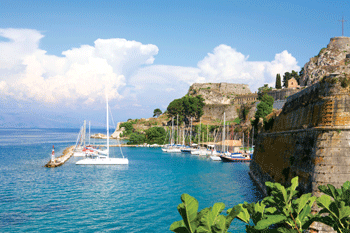

For several centuries Corfu was one of the chief suppliers of esrogim to Jews all over the world. Corfu’s esrogim are mentioned as early as 1646 by Italian scholar and botanist Giovanni Battista Ferrari in a book he published in Rome. Ferrari wrote that rich Jews in Corfu spent considerable amounts of money on very smooth esrogim with no flaws which they packed into small boxes and sent abroad as gifts to their friends.
Probably the earliest reference in Torah literature to Corfu esrogim dates to the second half of the eighteenth century in Michtam LeDavid by Rav David Pardo of Sarajevo Bosnia. Another reference can be found in the writings of Rav Daniel Terni rabbi of Florence a younger contemporary of Rav Pardo.
The Corfu esrogim were very beautiful and therefore very popular in Jewish communities. Ironically the very beauty of Corfu esrogim caused Eastern European rabbis to doubt their kashrus early in the nineteenth century. They suspected that the growers in Corfu were grafting the esrogim with other citrus fruits to enhance their appearance thus rendering them unfit for use in the mitzvah of arba’ah minim.
Rav Ephraim Zalman Margulies one of the leading rabbis of Galicia defended the kashrus of the Corfu esrogim. In a lengthy responsum discussing grafting in the growing of esrogim he states that a trustworthy person who had visited the island and seen the groves had told him that these esrogim were not products of grafting.
Create a free account to keep reading.