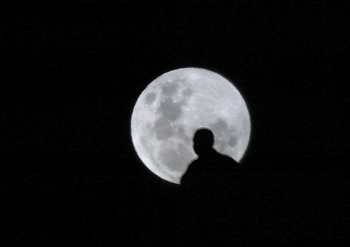
On the night of Hoshana Rabba, people would go out into the moonlight and look at their shadows. If a person’s shadow was whole, it was taken as a good omen; if not, it was taken as a sign that a difficult decree had been issued against him. Why is this custom, which is discussed by the Zohar and many Rishonim, no longer in practice?
The first allusion to shadows acting as harbingers of future events is in the Talmud (Horayos 12a): “One who wants to set out on a journey and wants to know whether he will return home or not should stand in a darkened room. If he sees a shadow of his shadow he will know that he will return home. It is improper to do so however lest his courage fail him and cause him to meet with misfortune.”
A more direct source for this custom is found in the writings of an early Rishon the Rokeiach (221): “That which is decreed on Rosh HaShanah and sealed on Yom Kippur is visible in a shadow on Hoshana Rabbah.”
He explains the reason for this esoteric omen: The night of Hoshana Rabbah is the time when the allotment of water and livelihood for the year is decreed. The angels look at people’s shadows and say “So-and-so will not live so he doesn’t need water for livelihood.”
The Rokeiach also finds an allusion to this concept in the Torah. The verse “Sar tzilam mei’aleihem — Their [protective] shadow is removed from over them” (Bamidbar 14:9) has the same numerical value as “Sar shanah” signifying that that when one’s shadow is removed he will not live out that year.
Create a free account to keep reading.