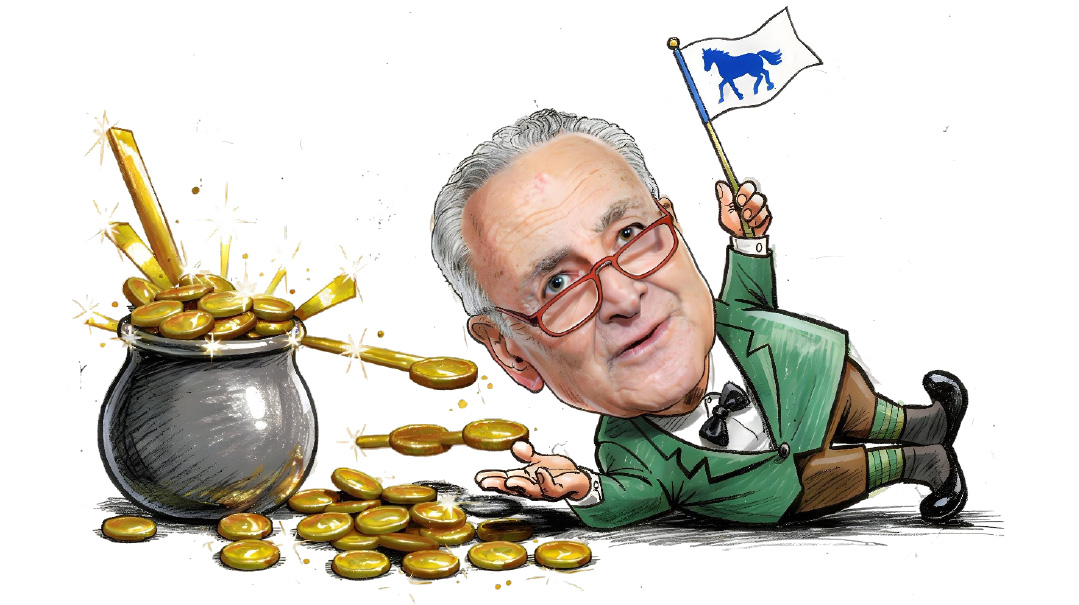
“We are going to crush the Republicans in November — guaranteed!” exclaimed a Democratic strategist.
His optimism didn’t surprise me. Democrats have a viable path to winning big this November. But the word “guaranteed” is deadly. In politics, you learn fast that glittering moments are often fool’s gold. So what would a prudent political prospector make of the terrain ahead?
Hopeful Nuggets
What caused my Democratic friend to leap with joy? The news that Virginia voters approved his party’s effort to gerrymander the state. For those not up-to-date on this battle, you may recall the 2025 effort by Texas Republicans to engage in an unprecedented mid-decade redrawing of districts in their deep-red state.
It was such a great idea, the Democrats stole it. Soon blue states were outpacing red states in redistricting, with Virginia becoming the latest treasure. But this is just one hopeful nugget that the Democratic Party can point to. They can quickly scoop up a number of other gleaming objects that would spell disaster for Republicans.
One, in the House, more Republicans are retiring than Democrats — 37 to 27, according to the Associated Press. That means Republicans have more empty seats that have to be defended.
Two, Dems are keeping pace with the GOP in campaign fundraising. The latest numbers put the House Republican haul at $47 million, while the House Democrats racked up $45 million.
Three, history is on the opposition party’s side. Midterms punish the party holding the White House. Republicans are up against a historic pattern that is decades old.
The sparkle on all those nuggets is blinding for a party that is out of power and hungry for a win. But is there substance at the core?
Fool’s Gold
On Chol Hamoed, my family and I went spelunking. We got to the cave and the staff insisted that we wear helmets with lights and that we bring walking sticks to navigate tough terrain. I was skeptical this was necessary, so at one point, I turned off my light, put my stick aside, and explored on my own. I was lost within seconds and couldn’t tell the difference between a stalagmite and a regular rock.
Democrats have been feeling their way in the dark since getting drubbed at the ballot box less than 18 months ago. The party still doesn’t have a national leader, hasn’t figured out its internal problems, nor has it confronted a number of still unpopular policies. Recent events in Michigan and California are evidence that the party is still tripping over the same obstacles, mistaking old formations for a new path forward while wandering deeper into the dark.
Michigan Dems just held their spring party convention in Detroit. This gathering drew 7,000 party faithful, and it offered a critical chance for activists and supporters to organize and coalesce… but complete chaos broke out. It started over an open Senate seat that attracted multiple office seekers. The pro-Israel candidates were booed and heckled throughout the proceedings.
The confab garnered universally negative media attention, because it highlighted a real problem: There are deep divisions within the Democratic base. This was anything but a “large tent” meeting and it underscored potential problems for the party in the fall. What if the primary process elects radical candidates? What if moderate Democrats flee the party or don’t feel motivated to turn out because of this internal fighting?
Everything should be going well in deep-blue California, yet the situation is even more chaotic. Democrats in the Golden State should be sitting pretty, having netted a projected five new House seats through redistricting…. but internal fighting in the gubernatorial race is causing mayhem.
Granted, part of that mayhem was caused by California’s unique primary system, in which the top two vote-getters, regardless of party, go to a runoff. But California Dems haven’t helped themselves very much in this governor’s race. No Democratic candidate has moved to the fore. The party is divided by ideology and lacks a figure of national stature who can coronate a standard-bearer.
Multiple polls have shown the top two vote-getters are Republicans, with the Democratic candidates splitting the base. What if Republicans head to the polls in massive numbers in California because they can elect one of their own, and the Democrats underperform? This is a recipe for confusion that could wreck Democratic chances of picking up those freshly minted redistricted seats.
The dysfunctional politics in Michigan and California highlight larger problems that can result in a party finding fool’s gold in November instead of the real thing.
This Prospector’s Prediction:
I believe the Democratic Party takes the House in this current climate. The environment is so bad for Republicans that I have heard from multiple GOP insiders that they are now working on the Senate races instead.
But what should give Republicans hope is that what should be a 15- to 20-seat Democratic pickup in this environment could only be more like three to five due to party infighting. The margin of error for both parties is closer than what many predict, and with over 180 days left until the midterms, anything could swing this balance of power decisively.
Echoes of Presidents Past
An April 2026 AP-NORC poll found that only 33% of Americans approve of President Donald Trump’s overall job performance. This is objectively low. It seems prudent to look at other presidents’ approval ratings before their last midterm elections to see how the opposition party fared.
George W. Bush
Polling:
A March 2006 Pew Survey had him at Trump levels — only 33% approval rating.
November Midterm:
The Democratic Party gained 31 seats, took control of the House, and made Nancy Pelosi the Speaker.
Ronald Reagan
Polling:
An April 1986 Gallup Poll had Reagan at 62% and a May poll would have him at 68%.
November Midterm:
Despite Reagan’s outstanding popularity, the Democratic Party still gained five seats and held the House.
Harry Truman
Polling:
A leader in low polling. Truman had a June 1950 Gallup approval rating of 37% approval.
November Midterm:
Republicans gained 28 seats in this midterm rebuke to Truman.