Tamar Taback illuminates a new path to Jewish femininity
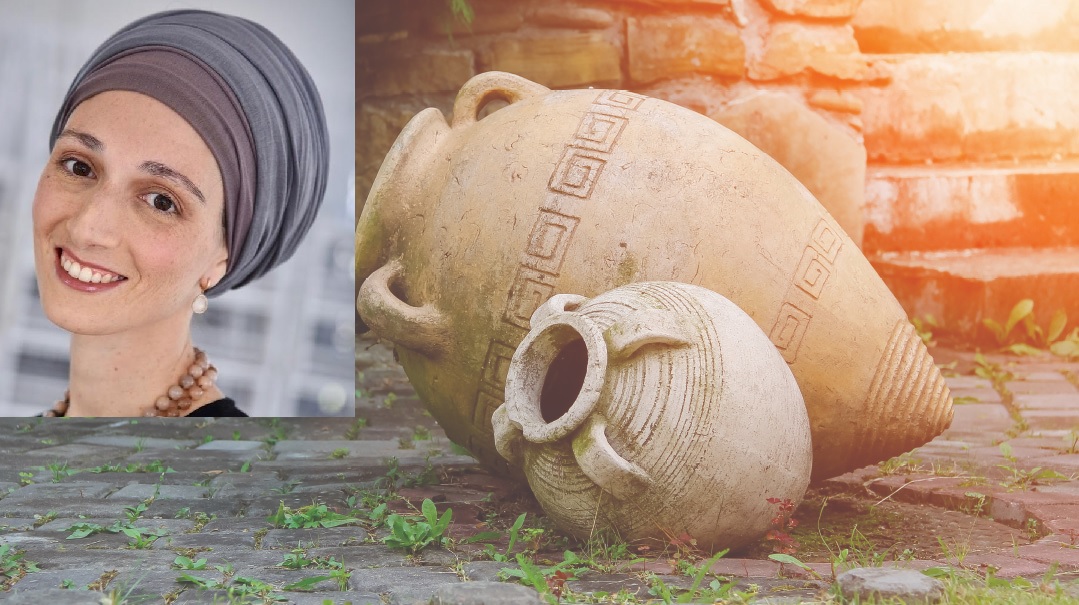
Born on Purim in South Africa, Tamar’s family soon moved to St. Louis, where she grew up. When she was 14, her parents, both baalei teshuvah, took a brief sabbatical in Israel. When her parents returned to America, Tamar stayed in the home of Rabbi Akiva Tatz — who’d been in medical school together with her father — to finish the school year in Israel, after which she returned to Bais Yaakov St. Louis.
She later attended BJJ seminary in Eretz Yisrael, and lived there a few years after her marriage to Ari Taback. Then the couple moved to South Africa, where Rabbi Taback took a position in rabbanus and Tamar taught in high schools and seminaries. During this period, she was learning and translating Ohel Rachel, a sefer describing the traditional feminine role, written by Rav Refael Menachem Schlanger, a student of Rav Moshe Shapira ztz”l.
As she studied, though, she was troubled by an issue that had bothered her since she was a teenager — although then she’d had a hard time articulating it. “If it’s good if a woman loves Torah and wants to learn it,” Tamar asked, “Why, then, are there so many descriptions that seemed to assume that women aren’t personally studying Torah?”
As Tamar continued to learn, she began to notice a pattern: The entire world is composed of masculine and feminine — Heaven and Earth, mitzvos aseh and mitzvos lo saaseh, Kudsha Berich Hu and Shechinah (Hashem’s transcendent Essence and His imminent Presence).
“I had learned so much about femininity, I was determined to get it right, to be the perfect akeres habayis, the woman whose ruchniyus was only what she was mekabel from her husband, who thrived in the traditional role,” Tamar shares. “But doing so strained me emotionally and left me feeling depressed. For example, the mashpia-mekabel model [in which the male is the giver and the woman the receiver] doesn’t mean that a woman should receive her happiness solely from her husband — this misapplication leads to enmeshment and worse.”
As Tamar continued to learn, she discovered the higher feminine archetype. “I realized that a woman cannot expect to get her spiritual needs met by only her husband but if motivated, needs to and can go higher — to Hashem.
“I also had to learn that archetypes are not people,” she adds. “Both men and women have the energy of both archetypes in them, though the feminine is expressed by women as a whole and the masculine by men.”
Many of the sources Tamar had learned from, and struggled with, had been describing the lower feminine archetype accurately. But as she learned more about the higher feminine archetype — the woman capable of abstract thinking, who experiences spiritual taanug through Torah and tefillah, who is connected to her superconscious — she realized that this archetype was starting to emerge in the world and affecting many women, herself included.
“What was also very clear from the sources,” Tamar notes, “is that while the lower feminine archetype is lower than the masculine archetype, it is not of lesser importance. One of the gorgeous secrets about femininity is that hierarchy is not a feminine value. Think of femininity arranged like a circle — lower and higher are somewhat misleading terms.
“The lower archetype receives influence from the masculine above her, while the higher feminine influences the masculine below her. The genius of the lower feminine archetype lies in receiving from her husband and meeting the complex needs of the family while emotionally integrating Torah ideas.”
The goal, Tamar explains, is that the lower feminine archetype unite with the higher feminine archetype. “You cannot reach the higher without have first refined yourself in the school of the lower. But the vessels we create through self-sacrifice, humility, and acceptance as we care for the needs of our husbands and children become large and strong enough to hold vast spiritual light.”
Building these vessels is hard work, Tamar admits, but it’s where much of our avodah lies, and recognizing and embracing our growth is liberating.
This rings so true to me. As a teenager I’d tried so hard to plug into that spiritual high, to tap into dveikus. Although it would seem that the very physical process of marriage, running a home, bearing and raising children would have made connecting to Hashem through Torah and tefillah harder, my experience has been just the opposite. Although I have much less time, because my ego is constantly being refined in the grueling, selfless work of constant giving, I’m able to tap into ruchniyus much more easily — experience the serenity of Shabbos, the kedushah of Yom Tov, a moment of closeness to Hashem.
“Many women already know this, they just don’t have the words to describe it,” Tamar explains.
“But for those who like to understand things, having the framework laid out for them is helpful. Also, if our yearning isn’t met in the Torah world, women will get their input and validation from the secular world, and won’t know how to channel their light and talents toward kedushah and Klal Yisrael.
There was something else pushing Tamar. “I also have a strong pull to psychology, to holistic healing, of curing the body, mind and soul as one. And as I learned the deeper sources, I realized that the power of deep healing lies in Torah — everything else out there is merely fragments. It became my dream to help frum women heal through Torah, not secular wisdom; to bring them to realize that there’s nothing more healing than teshuvah, coming close to Hashem through growing into our spiritual wholeness and rectifying our middos.”
Tamar’s first platform was Torah Anytime, where she’s posted over one hundred shiurim on various topics, mostly relating to femininity in the Torah. But Tamar realized that she wanted to craft an environment for her students, who shared her commitment and focus. She created an online learning platform that she called “Nexus — Where Light Meets Vessel.”
It can be healing to simply learn the texts that explain Torah femininity today, Tamar says. But most women also want to learn how to grow practically and build better marriages using their new knowledge.
“I don’t want to be the teacher; I see my role as facilitator. Everyone has a pure and beautiful neshamah that’s connected to Hashem. But sometimes we need someone else to let us know that we are already holding the key to our own healing.”
Tamar’s feature series “Rise! Into Your Feminine,” organized around the women in the Torah, forms the meat of what she’s trying to transmit on Nexus. Our Imahos serve as our role models in our quest to grow to our full stature, as they rectify femininity, which had been damaged through the sin of Chavah.
“The rise of the feminine means we don’t just discover our brilliance, we recover it,” Tamar explains.
When I listened to this series, I found parts that described, almost eerily, the growth process I’d painstakingly embarked upon years earlier. Tamar explained why women who have “too much light” tend to be rejected and how they should ignore those who consider them weird for being so spiritually intense — the story of my teens and early twenties.
So many wonderful and well-meaning people wanted to make sure that I knew that intense, lengthy davening had no place in the life of a woman, nor did serious Torah learning. They were so oblivious to who I was that they couldn’t understand the intensity of the pain they were inflicting on me.
This rejection is typical and dates back to the earliest moments of creation, Tamar says, “but we don’t have to break down in the face of dismissal. The key is to create vessels for your light.”
As I matured, that’s exactly what I did. And the very same people who had rejected me when I was younger excitedly embraced my writings as I found a way to offer the light inside me in a vessel people could appreciate.
“The shame of being too big — I don’t fit the mold of the traditional woman of the home, I want to do more, to be more, to learn — is a unique type of shame,” Tamar says. “Many women feel very validated when I verbalize it for them.”
“The validation that it is common, Jewish, and historically in line for a girl to wish she can learn on a deep and advanced level was amazing,” shares Chedva, a student of Tamar’s. “Suddenly, I realized, if I’m looking for wisdom, why not learn the wisdom of the Creator? Tamar gave me permission to learn Torah, balancing out my self-taught knowledge of physics and literature.”
Torah feminism is not the movement we associate with the women’s lib movement of the ’60s. “It’s interesting,” Tamar notes, “many women come out of my classes relieved of the pressure feminism put upon them. When they learn how valuable and critical our development of the ‘lower’ feminine archetype is, they’re able to endorse themselves in that role.
“They don’t need to have a career in order to have value, the traditional feminine role creates vessels for light. And even the women who have already acquired the higher feminine archetype understand that most of our work is still in the lower realms. Feeding the part of ourselves that needs pleasure from Torah and tefillah enables us to do the rest of our work with joy. In Torah, feminism means being the most amazing females we can be.”
Create a free account to keep reading.