Harlem’s Jewish population peaked at 175,000 in 1917, making it the world’s third-largest Jewish community after the Lower East Side and Warsaw
In the last decades of the 19th century, Harlem emerged as an alternative to Jews crowded into Lower East Side tenement buildings who were seeking a higher quality of life uptown. Harlem’s Jewish population peaked at 175,000 in 1917, making it the world’s third-largest Jewish community after the Lower East Side and Warsaw.
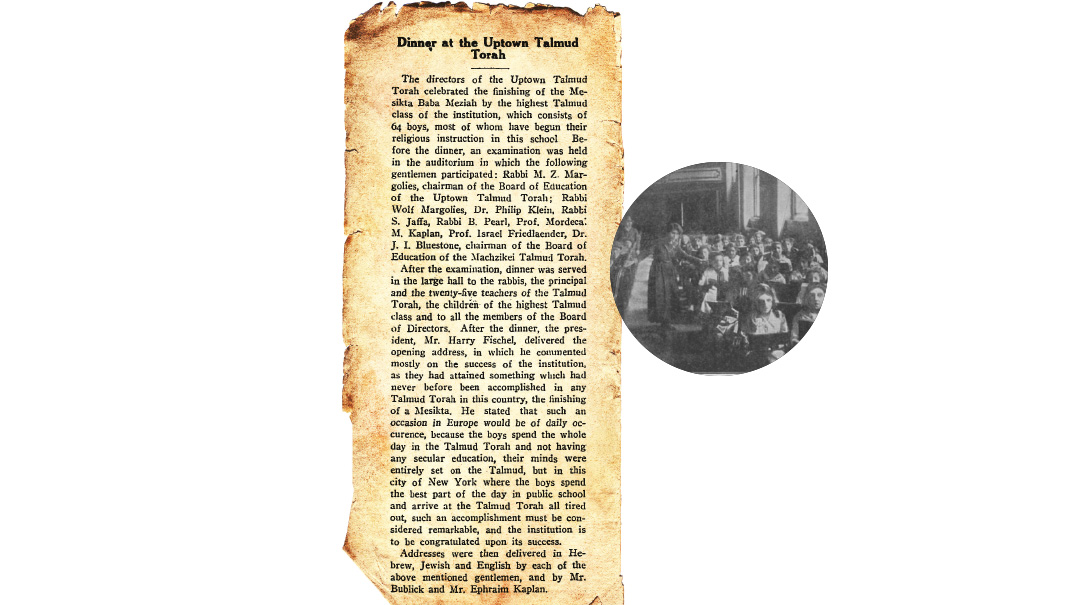
By 1910, Harlem’s Jewish landscape had exploded, with shtiblach and landsmanshaft on every street corner. In 1912, Ohab Zedek Synagogue on West 116th street hired Yossele Rosenblatt as the chazzan, and he performed to large crowds. While some Harlem shuls hosted afternoon Talmud Torahs, a more institutional solution was sought, and the Uptown Talmud Torah was officially incorporated in 1905.
The leadership of dedicated klal leader Harry Fischel was essential to UTT’s development. He engaged influential wealthy German Jews such as Jacob Schiff and his son in law Felix Warburg to help build a state-of-the-art facility. The German Jews hoped this would facilitate the Americanization of the Russian Jews, though Fischel remained in charge of the curriculum.
By 1913, UTT had grown into the world’s largest Jewish educational institution, with an enrollment of more than 2,100 students. Harry Fischel then undertook more fundraising to add much needed space. Foreshadowing the matching campaigns of a century later, Schiff offered to match donors’ gifts. Rabbinical leaders stepped in as well, with Rav Moshe Zevulun Margolies (Ramaz) and New York’s charismatic maggid Rev. Zvi Hirsch Masliansky endorsing the effort.
Create a free account to keep reading.