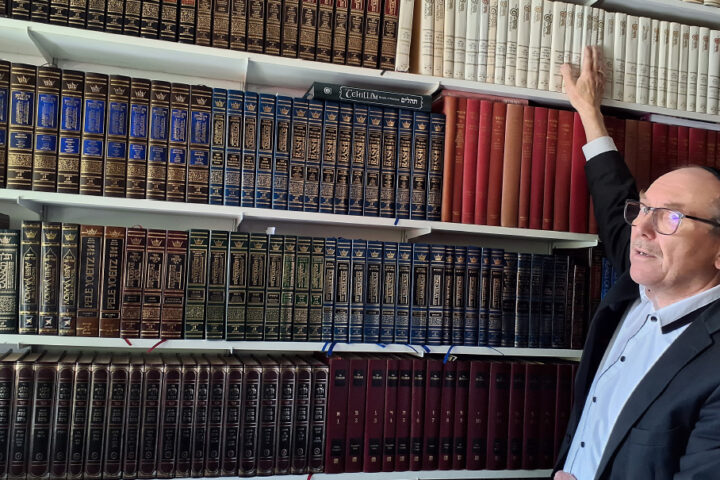
Rebbetzin Rochel Rakow faced tragedy with a siddur in her hands and song on her lips
“Az men hot a siddur, hot men alles — if you have a siddur, you have everything,” she often said. Even in Auschwitz, she had somehow managed to complete one Shemoneh Esreh a day. In her later years, she moved into an assisted living facility, where she took part happily in activities, but only after she’d completed her davening and daily Tehillim.
“Mummy and her siddur were inseparable,” says her youngest daughter, Noami Levy, who cared for the rebbetzin as she aged. “A few years ago, we had a Chanukah party for the Rakow daughters, granddaughters, and great granddaughters. We played a game where each player had two pieces of paper, each with a name or item written on it, and with each round of the game, had to pass on the one that was least important to them. Mummy was left with two papers. One said ‘SIDDUR’ and the other said ‘NOAMI’(me!). She looked at the papers, then at me, said ‘Sorry!’ and pushed the paper with ‘NOAMI’ written on it to the center pile. Then she hugged the paper that said ‘SIDDUR’ to her chest.”
She would plead with the Ribbono shel Olam to help all of His children — “and meiner kinder avadde — and my children among them, of course,” — and never tired of bentshing them all.
The Rakow daughters, today all rebbetzins themselves, laugh as they recall their teen years, when the Rebbetzin took them sales shopping at London’s department stores. Mrs. Suri Cohen recalls: “Mummy had to daven Shacharis first, of course. We tiptoed over and peeped into her siddur to check where she was up to, because Mummy’s davening went on and on. And then when we finally did board the Underground, Mummy had her Tehillim or her siddur and would continue davening. I was once a little embarrassed of her, and I said ‘Oh, Mummy, in front of everyone?’ She replied ‘They can go with all their crazy colored hair and funny clothes and I should be embarrassed of my siddur?’” Her erlichkeit and connection to Hashem were so real and unpretentious, drawing others to her. The last time Noami took her mother to Eretz Yisrael, she spent a long time at Kever Rochel, as she always did. When Noami started to push Rebbetzin Rakow’s wheelchair to the exit, one woman came over to ask for a brachah, then another, and more and more. As they left the building, men approached her too, and she blessed each one. Even after they entered their taxi, people were knocking on the window for her brachah. “What was all that about?” Noami asked her mother after the car pulled out. “Ich veis nisht, mistamah veil ich bin ein alteh Yidene — I don’t know, probably because I’m an old woman,” was her simple answer.
Rochel was the eighth child of Reb Yisroel Leib and Soroh Braunstein, relatives of the Spinka and Zidichoiver chassidic dynasties. Her father was a businessman and philanthropist who had moved westward during World War I into a village on the Hungarian-Romanian border. It was just 40 miles away from the Vizhnitzer Rebbe, the Ahavas Yisrael, in Grossvardein, and Reb Yisroel Leib became a devoted chassid and supporter of his. Soroh rose at 5 a.m. to prepare food for people in need, and Rochel often delivered these parcels. One grateful recipient used to bentsh her regularly, “An alteh babitchkeh zolst du veren — May you become a very old grandmother,” a brachah that the rebbetzin eventually passed on to her own young helpers.
With no Bais Yaakov in their village, the girls all attended public school, but learned to read the siddur from an older woman. “As a little girl, Rochel was called ‘the davener’ by her siblings — she loved davening and singing,” says Mrs. Chani Zahn, Rebbetzin Rakow’s eldest daughter. “She remembered once sitting under the table, singing to herself, when her brothers told her to be quiet — the Vizhnitzer Rebbe had just entered the room!”
In the 1940s, Hitler’s forces stormed through Europe, aiming to render it Judenrein. The Braunstein family tried various avenues of escape, but to no avail. Rochel’s two sisters tried to smuggle themselves over the border into Romania, but were caught and sent back. Mrs. Braunstein faced an agonizing dilemma — should she attempt escape with her unmarried children, which meant abandoning her daughter Blimi, and five small grandchildren who had moved in with her?
Tragically, the trap closed on the entire family. The Nazis acted swiftly and brutally, rounding up the Jews of the village all on one day in Sivan of 1944. First, though, the men were ordered to bring all their families’ silver, jewelry, and valuables to a central depot, so they could be recorded for safe return after the war, the Nazis claimed.
The cattle car to Auschwitz, Rebbetzin Rakow later told her children, initially resounded with bitter sobs But as the days passed with no food or water, the children fell silent. Those who were still alive had no energy left to weep.
Herded off the trains by shouts and barking dogs, the dazed Yidden stood on the selektion ramp. Rochel was sent to the right with her sister Hindu, while her mother, married sisters, and 11 small nieces and nephews were directed left. The stench of burning was terrible, and the trembling women who were left were told “Do you see that smoke? That is your fathers and mothers.”
The 17- and 18-year-old Brausntein girls miraculously stayed together through the remaining year of war. From behind the barbed wire, the skeletal, shaven prisoners at Auschwitz could see trainloads of new arrivals stagger out of the cattle cars. “Varf ariber — throw over [your possessions]!” they used to call in Yiddish, knowing that the SS would seize everything from the Jews upon entry. Once, Rochel was standing at the fence and a Jew threw her a piece of meat. Near her, a girl had picked up a siddur. The choice was clear to her, and a minute later, they had traded their treasures. “The davener” somehow kept that siddur with her, using it until the prisoners left Auschwitz on the death march.
When the Germans forced the inmates to march away from the oncoming Allied armies, anyone whose steps faltered was shot. At one point, Hindu felt she couldn’t move anymore and wanted to sit down. Rochel sang Shabbos zemiros to encourage her to keep going.
The sisters reached Bergen Belsen, where they found themselves in “ de toiter lager — the death camp” where the fleeing Germans had left the sick inmates just barely alive, with no food or water, too ill to move, and ridden with lice. Rochel caught typhus, and Hindu kept her alive by scraping water from puddles on the ground into a cup.
And then the liberators were there. Rochel could hardly believe it when she caught sight of American soldiers davening Minchah. Along with other survivors, Hindu and Rochel traveled to Sweden. Rochel was so weak that she had to be carried onto the boat. Besides the girls, only two Braunstein brothers survived the Holocaust. Rochel went to Lidingo Seminary, where Rabbi Yakovson and Rav Shlome Wolbe did their best to rehabilitate survivors and help them reconnect to Yiddishkeit.
Rebbetzin Rakow’s second daughter, Mrs. Suri Cohen, takes up the tale. “In Lidingo, Rabbi Yakovson’s wife noticed that my mother was always the first one to arrive when it was time for davening or shiurim. She saw the bikush my mother had, and she sat down with her and taught her the peirush hamilim (meaning of the words of tefillah). For the rest of her life, my mother mentioned often how grateful she was to ‘Frau Rabbiner Yakovson’ for giving her this gift.”
Rochel Braunstein’s marriage to Rav Bentzion Rakow was a fascinating shidduch: A young girl from a very chassidish home marrying the son of a litvishe rav. But as Rochel’s father-in-law, Rav Yomtov Lipman Rakow, was known to say: An erliche chassid and an erliche litvak are the same thing,” and the couple indeed shared the same spiritual aspirations.
The Rakows began their married life in Stamford Hill, London, where Rav Bentzion learned in the kollel of Rav Moshe Schneider’s yeshivah.
In 1954, he became the rav of Heichal HaTorah, a beis medrash that was a focal point for the small group of yeshivaleit in the city.
Rav Bentzion eventually became rosh yeshivah of the new Chayei Olam yeshiva in Golders Green, the responsibility to his talmidim joining his prior commitments to give shiurim and serve as rav. For eight years, the beis medrash of Heichal HaTorah was housed in the Rakow home, and the Rebbetzin thrived on hearing the sound of Torah and tefillah — it was food for her soul. She attended tefillos on Shabbos and Yom Tov from beginning to end, a custom she would maintain into her nineties.
Rebbetzin Rakow raised her children in a spirit of Torah idealism, at a time when this was far from the norm. Rav Rakow was a loving father and charismatic educator whose sincerity deeply influenced his children.
“We didn’t have much money,” says Mrs. Suri Cohen. “We had older brothers, and their shirts became our school uniform blouses, although they were nylon, had different collars, and were buttoned the wrong way, but Tatty always said ‘mir zenen azoiy reich veil mir hoben de Torah — we are so rich, we have Torah,’ and we really felt it.”
Their home was a happy one, with the Rebbetzin always ready with hot food or peeled fruit, and a good word. Their father’s maxim that their simple home was “di shenster und di bester — the nicest and the best” rang true in the children’s ears.
Hindu Braunstein had married a Gerrer chassid and war survivor, Yidel Stobiecki, and lived just two doors away. The two sisters remained extremely close; one of their brothers, Rav Chaim Shimon, settled in London too. “There was a refrain that we often heard from Mummy,” says Mrs. Cohen. “Once I told her that I needed new shoes. Mummy’s response was, as it was to everything and anything, ‘Ask Tatty.’ I didn’t feel comfortable disturbing him, though, so Mummy asked him for the money. Tatty told her he didn’t have any, to which Mummy replied seriously ‘Der Ribbono Shel Olam hot doch azoi fil gelt — but the Ribbono shel Olam has so much money! You give me, and He’ll give it to you.’”
In 1985, after 35 years of marriage, Rav Benztion became ill. The Rebbetzin nursed him day and night, cooking nutritious food and hoping it would sustain him. The Rosh Yeshivah grew steadily weaker and his eyesight was failing, but his single minded attachment to Torah never left him — how could it, when Torah was his lifeblood?
He spent hours davening Shacharis, word for word. When he was too weak to learn in depth, he recited Mishnayos. Until his last minutes, he thirsted for Torah. When visiting children entered, they would continue Torah discussions near him, as the Rosh Yeshivah nodded, with closed eyes.
Tragically, Rav Bentzion passed away on Erev Tishah B’Av, at the very end of the yeshivah zeman, at just 60 years old. His remarkable personality is captured in Chani Zahn’s book My Father, My Rebbe, published by Targum/Feldheim.
For the next 35 years, Rebbetzin Rakow was alone. Her prince, her ben Torah, was gone — but she bravely continued to serve the King above.
“Mummy loved hearing the kol Torah, and missed it so much after Tatty ztz”l was niftar,” says Mrs. Levy. “When she moved to the nursing home in Manchester, my sons, who were around 12 or 13, went there daily to learn in the evening with their chavrusas. They learned in the salon while Bobby sat in her bedroom listening.”
The Rebbetzin grieved, but her davening and emunah brought her solace, with a unique brand of tranquillity that stemmed from her reliance on the Ribbono shel Olam. She had no complaints against Him, but focused on His kindness. The Rebbetzin was full of friendly acceptance and appreciated every person as they were. She was a beloved matriarch who enjoyed hosting and treating her children and grandchildren. She never tired of attending shiurim and learning, even when the teachers were much younger than she was, and she steadfastly attended shul up until the outdoor COVID-compliant minyan on her last Yom Kippur.
Create a free account to keep reading.