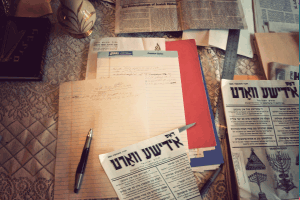
The Yiddishe-Yapanishe Verterbuch (Yiddish-Japanese Dictionary), now on sale for the princely sum of 60,000 yen (about $770), is hardly a bestseller, yet the Japanese seem to be fascinated with the mama loshen they’ve never even heard spoken. What prompted a scholar to devote his life to such a project? Japan’s former chief rabbi Marvin Tokayer, who wrote twenty books on Judaism in Japanese for the locals – some of which became best sellers — says it’s all part of the Jewish mystique
When Rabbi Marvin Tokayer was tapped to serve as the rabbi of Japan’s Jewish community in 1968 he was certain that he would have to master the Japanese language in order to communicate with the local residents. Indeed if someone would have suggested that Japanese people would prefer to communicate with him in Yiddish he would have thought that person was a meshuganeh. Until the day he picked up the phone and was addressed in Japanese-accented Yiddish.
The caller was Kazuo Ueda a Japanese master’s degree student at the University of Tokyo. “It was very difficult for me to understand him” Rabbi Tokayer recalls. “I asked him what languages he spoke. He told me that he spoke German but not English. And then he named another language —Yiddish.”
After Rabbi Tokayer recovered from his surprise he replied “Shulem aleichem. Kum aher (come here)” inviting the mysterious caller to continue the conversation in his home.
“The man who appeared on my doorstep had taught himself Yiddish but had never heard a word of Yiddish spoken in his life. This was before the days of CD players. We took out a made-in-Japan tape recorder and I began singing songs such as Oif’n Pripitchuk and other Yiddish songs simply so that he could hear the language. And of course we spoke in Yiddish.”
Create a free account to keep reading.