As a massive wave of protests overtakes the United States, can the nation repair its badly frayed fabric?
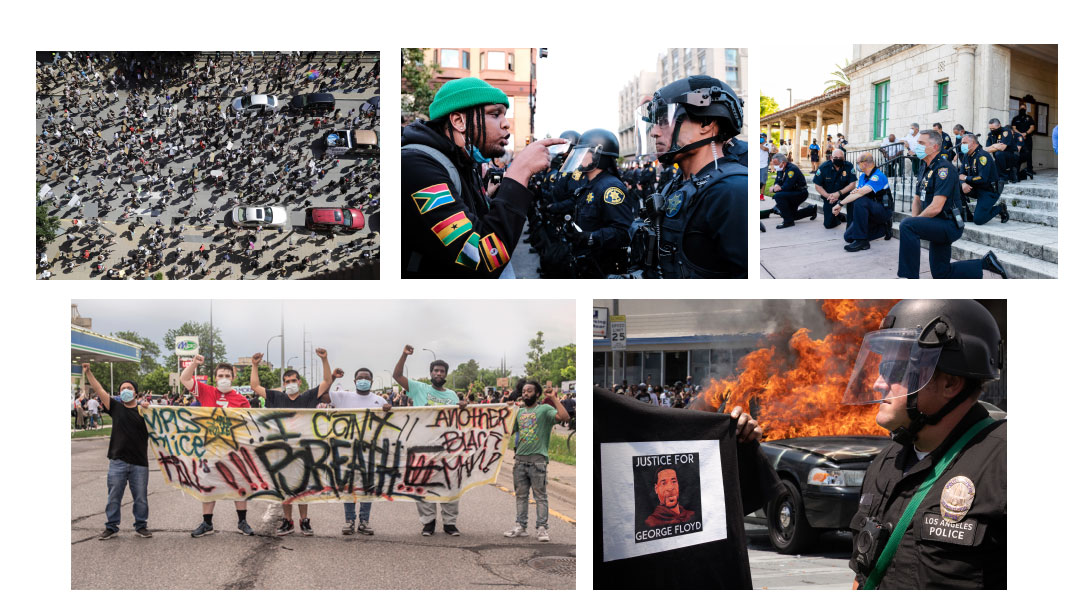

Photos: AP images
What began as an example of horrific police abuse of a helpless man is ending with calls for sweeping societal reforms. America is asking itself many questions in these fraught times, among them: Do police officers disproportionately harass and discriminate against black Americans? Should be police departments be defunded altogether, or completely restructured? What place, if any, does violent rioting have in our body politic? How do these events compare to some of the infamous riots in America’s history?
For the Orthodox Jewish community in America, the unrest has also left us to consider our place in the wider social fabric. The Torah demands justice and compassion for the downtrodden, and we, as Jews who reflect those values are outraged and sickened by the societal prejudice manifest in the murder of George Floyd. However, as among the smallest of minorities, American Jews depend on the protection of the police against anti-Semites. As we have seen just in the last year and a half in Jersey City, New Jersey, and Monsey, New York, that protection is often the difference between life and death.
Prof. Haberfeld: I have been studying, researching, and publishing on the topic of policing in the United States and around the world for over 25 years. From the moment I started looking at the American policing system, it was clear to me that it was profoundly broken. Actually the first words I ever uttered, when I first arrived in this country over 35 years ago to serve in the Office of the Israel Police Representative in the United States, and found out that there are over 18,000 police forces in the country, were: “It is a paradise for criminals.” Later on, I added to my perception that it is also a source of unprofessional service and a dangerous approach to this most noble of professions.
I am convinced that policing — effective, fair, and professional policing — is the pillar of any democracy. Likewise, and the opposite of these qualities, an ineffective, unfair, and unprofessional police force will be the source of its demise. Police is a visible arm of a local, state, or federal government. Not only is it its visible arm, it is also its most tangible arm. It is hard to put your hands, figuratively and physically, on a given politician. And the higher up they are, the harder it becomes. But it’s so easy to reach out for a brick or a bottle of urine and toss it, together with your individual frustration, at the visible and tangible representative of the politicians.
Create a free account to keep reading.