They’ve lived through the worst imaginable tragedies, seeing their loved ones murdered by terrorists, yet they’ve dedicated their lives to bringing solace to others. Who can understand the heart of a mourner more than someone who’s lost so much, yet refuses to sink?
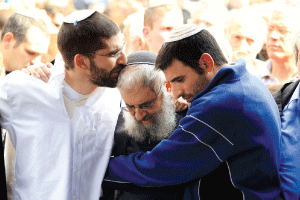
Neve Tzuf March 2011. The air in this Samarian community is heavy with mourning as delegations of public figures friends and anonymous Jews who feel the searing pain of their brothers walk toward the home of Chaim and Tzila Fogel. We all stream in to pay heartrending condolences to the parents of Ehud Fogel Hy”d who had been murdered three days earlier along with his wife and three of his children in the horrifying Friday night massacre in Itamar.
Inside the house the masses of people and the piercing agony of their loss makes it difficult to focus on the latest contingent of visitors. But suddenly excited whispers ripple through the room. The Dasbergs — the parents of Efrat Ungar Hy”d murdered along with her husband Yaron in a 1996 terror attack — have arrived from Alon Shvut. Efrat and Yaron also left two toddler orphans being raised by their grandparents. [Rabbi Uri Dasberg an editor of Encyclopedia Talmudit and co-director of the Tzomet Institute which finds halachic solutions for technological issues was killed in a car crash two months later in May 2011.] They would surely understand the overwhelming pain and blackness.
Neve Tzuf July 2012. A week and five months later that crowded house of mourning is quiet as a summer breeze filters through the living room. Today the elder Fogels have harnessed their suffering to uncover hidden strengths which they have since enlisted to come to the aid of others in their time of need. They are among the heroes who travel around the country arriving at shivah houses without ever having known the people they come to console. They seek to give comfort and encouragement and to spend time with people whose pain can never be fully understood by anyone who has not experienced such a loss.
Reb Chaim Fogel remembers how meaningful the Dasbergs’ visit was for them and in the past year he and his wife have used it as their own role model — “although their experience was different from ours. They were left with very young grandchildren who went on to grow up in their home while our remaining grandchildren are growing up in Jerusalemwith my mechutanim the Ben Yishais. But the mere fact that they came and the things they told us gave us an injection of encouragement and hope whose value cannot be measured in gold.”
Create a free account to keep reading.