In the 1920s, a novel proposal known as the International Fixed Calendar threatened to upend Jewish tradition
Jewish observance has always revolved around the calendar. Though the Jewish year follows a combined lunar-solar calendar, the Gregorian calendar, which tracks the solar year on a seven-day week, is significant in Jewish life as well.
In the 1920s, a novel proposal known as the International Fixed Calendar threatened to upend Jewish tradition. A British accountant named Moses Cotworth found that monthly accounting was greatly complicated by the fact that months did not divide evenly into weeks, and he devised a solar calendar of 364 days, divided into 13 months of 28 days each. Each month would be exactly four weeks. Each date of the month would fall on the same weekday every month, and every year would have exactly 52 weeks.
In addition to the simplicity this would create for scheduling, this new calendar would be of great benefit to the business world, which would now have four equal-length quarters of 91 days, 13 weeks, or 3.25 months long. The proposal had benefits for general society as well. Because this was a perennial calendar, movable holidays such as Thanksgiving Day could now have a fixed date while keeping their traditional weekday.
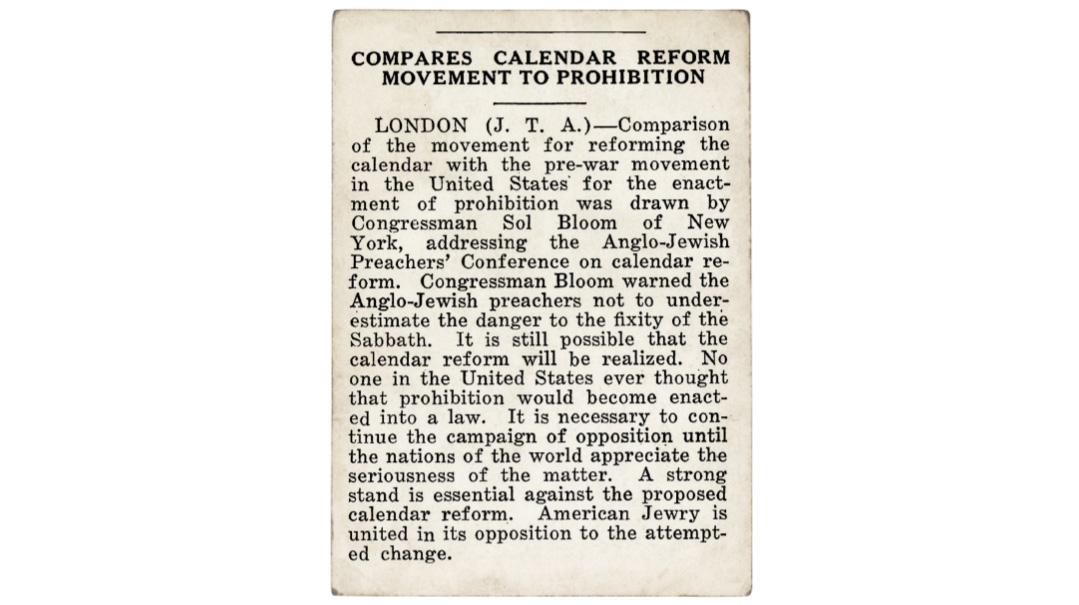
The calendar proposal gained traction in 1924, due to the advocacy of George Eastman, founder of the Eastman Kodak Company. For observant Jews across the world, this proposal caused alarm. The new calendar’s structure of 13 months of 28 days each resulted in 364 days. The solar year lasts 365 days; to bring the calendar into balance, an extra day, dubbed “Year Day,” would be added. This holiday would not be assigned to a specific day of the week. If the day preceding Year Day was Saturday, Year Day would not itself be called Sunday, but rather would be followed the next day by Sunday. For Jews, this would necessitate that Shabbos be observed on a different weekday every year.
Create a free account to keep reading.