I spoke with many people in the street. Elderly people, born and bred in Washington. All said exactly the same thing: “I’ve never seen anything like this”
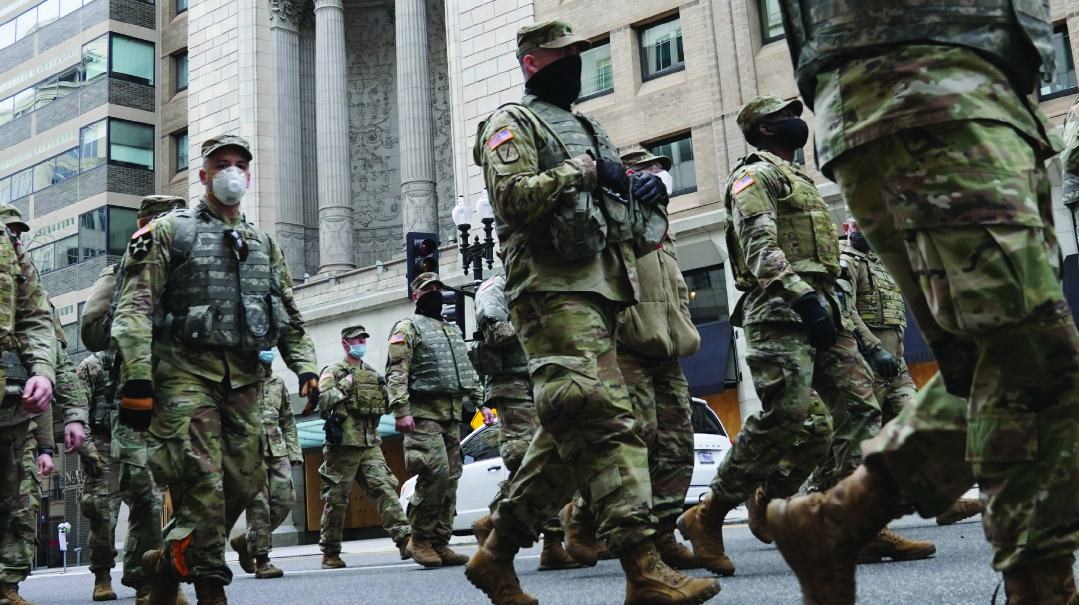
It has created a few surreal situations. A colleague of mine from a different publication called to ask how she could reach her hotel after getting off the train at United Nations, since all the streets were closed and it was too far to walk. The solution? Get off one station earlier, in Maryland, and take a taxi to the hotel, a 45-minute drive.
When I returned on Sunday, I couldn’t even get close to most of the places I had toured on Wednesday. Ring after ring of barbed wire. Streets in the center of the city, miles from the Capitol, were completely closed. The cop at the intersection of I Street and 14th Street demanded my identification, and only when I showed him my press credentials would he let me walk one more block. But I might as well not have bothered. Because only journalists and residents could pass the roadblock, a situation was created where some 15 journalists were standing around looking for residents, visitors, or tourists to speak to — but there was not one to be found. At this stage we couldn’t advance further to Pennsylvania Avenue; it was closed off.
As it was cold, I thought to step into the InterContinental Hotel to order a coffee, but the guard made clear that you could only enter the building if your name appeared on the guest list — a precautionary measure. The cost of hotel tickets also soared dramatically, in another attempt to keep people away from the center of the city.
“I never saw anything like this since Bush’s inauguration in 2001,” the guard said.
I continued wandering around in streets open to pedestrians. All the stores, office buildings, banks, and hotels had boarded up their windows. The atmosphere in the city center was apocalyptic, not like a time of celebration.
Not far from the White House, in BLM Plaza, a few curious residents came to see what was happening in the city center.
Matt McGrath, a DC attorney, told Mishpacha that he decided to come to the plaza to get the sense of what is happening a few blocks away from his home.
“It’s a shame that we have to live through this, but it’s that kind of a place that we live in,” he said. “We understand that by living [in Washington] we have to accept a lot of political activity, and people come here on both sides, and on multiple sides, all the time.”
He told Mishpacha that he would leave the city for inauguration day. “I have a daughter living nearby, and I’m expecting to get out of town before something bad happens. I have no idea what’s going to happen. She lives nearby in the suburbs, so I’m just going to probably go stay with her for a while.”
Although the situation in D.C. was tense, McGrath told Mishpacha he believes that healing is possible. “I hope it’s possible to recover from that. I think it is. I know people I work with on both sides of most issues and they understand that we have to come together. So, I’m hopeful.”
“I remember being here in Obama’s first inauguration and you really felt the excitement, just streams of people walking down, and sure there was security, but it was nothing like what we’re seeing here today,” said Susan Bender, a retired D.C. resident.
She said the amount of law enforcement that is present in the nation’s capital is a reaction to the January 6 riots. “I guess if there was a fraction of this a week and a half ago, we wouldn’t need this today.”
She went on to say that she still feels safe in Washington. “You feel like you’re living in a green zone and yet it’s kind of nice. You can walk around the streets that are closed. So it’s not really a war, I don’t feel personally that my safety is in danger.”
Do you believe that the nation can come together?
“I’ve got to believe it’s possible. It’s not going to be easy, it is going to take a long time, but I have to believe it is possible.”
Will Roberts, a data analyst who toured the plaza with his wife, said, “Usually this area is an awesome place to take a weekend walk because you see so many people walking around and looking at the buildings. It’s honestly just kind of sad to see it like this.
“I’ve never seen it like this. It’s just eerie. The city’s so quiet and tense,” he added. “I’m glad they’ve taken an abundance of precautions to prevent something like that from happening again. But I feel the safest in this city when I’m able to enjoy every aspect of this city, not when we’re covered with military, who I’m grateful are here, but, the safest I feel in this city is when I can walk around here and enjoy the all the cultural aspects, all the political aspects, the protest for various things that people care about happening right here. That’s when the city feels the most alive and the most at home for me.
“I think that there can 100 percent be unity,” he said. “I was reading an article that was saying at times when the US really struggled, like the Great Depression, or the Civil War, the onus was on the next president to really take on that mantle. And I think Joe Biden can do it, but I also think that the country as a whole really wants him to, so that will empower him to be able to unify. It would be really scary if it didn’t happen.”
Rabbi Levi Shemtov of Chabad told Mishpacha that he does not remember ever seeing such a security posture, “and that includes previous inaugurations, 9/11, and the period following the Oklahoma City bombing.
“Some would call it an abundance of caution, and I think that it just hasn’t been enough time [since January 6] to sort out what is necessary and appropriate, so the decision must have been made to go with the maximum.”
How does it feels to see all the barricades in the streets?
“This is definitely unsettling,” Rabbi Shemtov said. “I prefer not to be afraid, but I am concerned, and I hope that the only event would be the inauguration. It’s a very tough balance between openness and access by people to the house of the people. And security gaps. I remember as a child, we were able to pull up to the Capitol. And the other day you couldn’t get within a quarter-mile.
“As someone who has spent literally thousands of hours walking those halls that were desecrated during the riots, I want to feel safe when I’m in that building. So I’m happy to lose some of the access and freedom in order for everyone who works there, and those who have to visit there, to feel secure.”
I ask him if he believes the nation will heal.
“I think it’s possible if both sides are willing to yield some,” he said. “There’s going to be all types of recrimination and that’s understandable. But at some point, both of the sides are going to have to realize that we’re one nation under G-d, indivisible, even by something as horrible and unsettling as the January 6 riots. We’re a country of 300 million people. We can’t let a few hundred wild people undo what took hundreds of years to build. This isn’t the first time it’s been a very painful schism in America. But somehow or other, we’ve always overcome our crises and we are strong and resilient even if right now feels like everything might be falling apart. There’s a famous phrase that says things tend to fall apart before they come together.”
(Originally featured in Mishpacha, Issue 845)
Create a free account to keep reading.