Veteran Degel HaTorah chairMoshe Gafni talks tough on High Court reforms
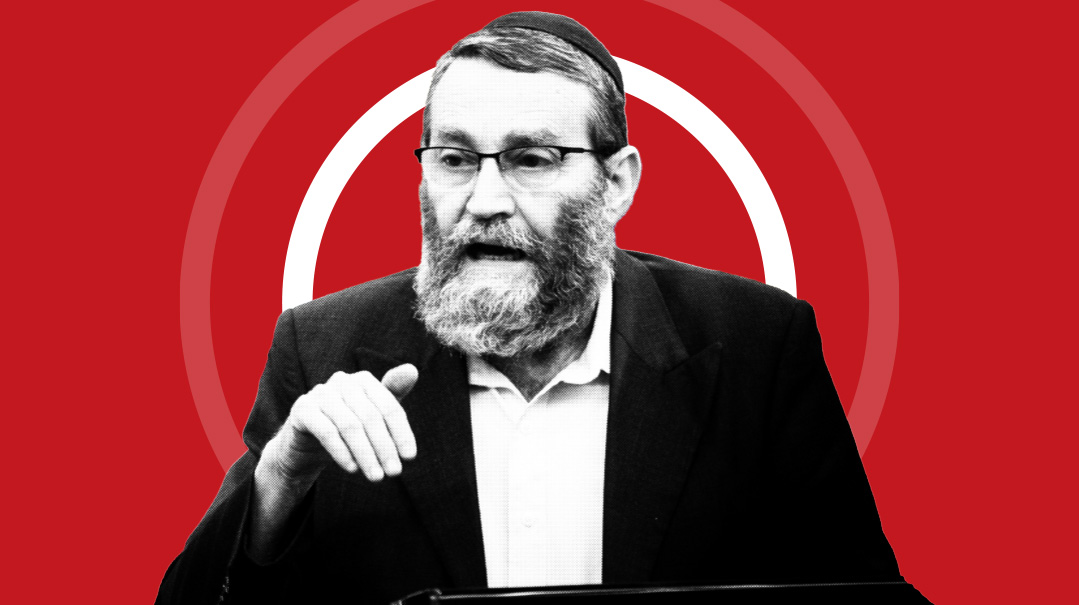
IN the midst of the chaos enveloping Israel’s justice system, with mass protests from the opposition and international condemnation of the Netanyahu government’s proposed reforms, the chareidi representatives in the Knesset are staying silent. After years of bearing the brunt of the High Court’s rulings, chareidim find themselves in the position of having others do the dirty work for them.
Degel HaTorah chair Moshe Gafni, currently the longest-serving member of the Israeli Knesset, has a unique perspective on the threats to the country’s economy that the left wing warn about from his vantage point as chair of the Knesset Finance Committee, responsible for supervising the state budget. This is Gafni’s fourth term as chair, which has gained added significance due to the economic angle of the judicial crisis.
Gafni has long been considered the most moderate member of the right-wing bloc, and now he finds himself serving in a government anchored by parties far to the right of the Likud’s normal coalition partners. In a lengthy interview spanning everything from the judicial reform to Rav Shach’s instructions to ally with the right, Gafni’s tone was notably combative, clarifying why, for the right-wing-religious bloc that’s in power, judicial reform is the call of the hour.
The judicial reform legislation is going through the Constitution, Law, and Justice Committee, not mine, but I do want to say something about this issue. Look, there are two branches in the Israeli government. There’s the elected branch, which is the Knesset and cabinet, and there’s the judiciary, specifically the High Court.
Now, how have the two branches conducted themselves in recent years? Let’s take, for example, the proposed “chometz law,” which would have enabled hospital directors to prevent the introduction of chometz into their facilities on Pesach. There had been a status quo since the founding of the state letting hospital directors manage these problems vis-à-vis the patients. The High Court unilaterally struck down this arrangement, just as it tears down everything relating to Yiddishkeit.
You think we’re going to advance legislation unrestrained? It’s important for me to clarify this, especially for readers abroad: Don’t be impressed by fake news. The ones ramming through changes to the status quo are the High Court justices. And they did it in countless cases where the Knesset wanted to preserve the Jewish character of the state, in areas where the status quo has reigned since the state’s founding.
So, what, the legal advisors and justices should decide? How are they different from us? We’re elected by the people and they’re elected by their friends. Why do they say that the people’s representatives need to be counterbalanced? How can they say that carrying out the will of the voters makes Israel a dictatorship? What’s going on now isn’t a dictatorship?

You tell me how I should describe a state of affairs in which a group of unelected officials co-opted by one another sit around and determine what’s the norm in every subject and area. Why is the left defending this? Well, the reason is that the Court always rules in their favor. If we just look at issues of religion and state, you won’t find a single instance where the Court ruled in our favor.
Don’t wave that at me, because the fact is very simple: Practically and substantively, the High Court has always been against us, in every ruling. So to think they’ll look after us is unbelievably naive.
Stop being naive! In the High Court’s ruling about day care, the argument was that Lieberman’s bill discriminated against families in which the husband learns and the wife works, and the court rejected that argument. It said that it’s okay to discriminate against chareidim and Torah learners, but you can’t start in the middle of the school year, you have to start in the next school year.
It was the same with the zero percent VAT law. The High Court didn’t strike it down on substantive grounds, but sent it back to the Knesset because of procedural errors. On substance, the Court ruled against us, and if we hadn’t brought down both governments, b’siyata d’Shmaya, the policies you mentioned would ultimately have been implemented, with the High Court’s approval. Make no mistake about that.
Are we short on examples? The entire interview wouldn’t suffice to list all the times they ruled against us. And not just against us, but against everything that’s holy and precious, even when the entire Knesset was behind us!
I’ll give you an example that any reader with a Jewish spark wouldn’t believe happened in Israel. There was a debate in the Finance Committee about Clause 46 [of the Income Tax Ordinance] — which provides tax exemptions to charitable institutions — with regards to two missionary organizations operating in Israel.
Everyone without exception voted against giving tax exemptions to missionary groups — even Yair Lapid showed up at the meeting to back my position. The two groups appealed to the High Court, and then Attorney General Avichai Mandelblit — now a vocal critic of the judicial reform — came out in their favor, against the opinion of every faction in the Knesset.
And what happened? The court ruled that the authorities have to give them the tax exemptions — as if we didn’t exist. It wasn’t just a majority — every Knesset faction, without exception, voted against the missionaries, and the High Court took their side. Can someone please explain to me why what the Court says is justice and what we say isn’t justice? And the answer is that those in favor of the Court always get the rulings that they want, and we don’t. That’s it, in a nutshell.
I’ll tell you exactly what their concern is. What it comes down to is they want to preserve their sector’s majority of self-selecting justices on the High Court — that sector being, of course, secular Ashkenazi. And then we come along and say there needs to be a balance between the Knesset, which is elected by the public, and the judges, who are elected by each other. And of course, they support the Court, because they don’t want the will of the people to be realized by their elected representatives.
What they want is for everything to be dictated by the justice from their camp who was chosen by the other justice’s wife — because there, everything is on the basis of friend brings friend. And now tell me which of the two systems is a dictatorship. It’s the exact opposite of how the media is portraying it. The real dictators are sitting in the High Court, and we’re the ones restoring power to the people.
I’m not in favor of fighting for the sake of fighting, but for the sake of achieving a certain outcome in the smartest way possible. By the way, I demanded the override clause in coalition talks with the Likud 20 years ago, and Bibi never allowed it.

This is also the work of the protest movement. They’re the ones who conjured up this threat, even though it’s harming the country. The talk about investors pulling out because of the reform is nonsense, but economics is all about atmosphere and psychology, so when an investor reads the fear-mongering reports from Israel, he could be genuinely spooked. The protesters are out to destroy.
If we stay strong, we’ll pull through this and finally reach something resembling a normal situation, because in the current situation you can talk until tomorrow — there’s no point in going to elections, they call the shots. And that’s why we need change. I’m not afraid, I put my trust in G-d, and I hope that after the legislation is passed, everyone will see that this is just posturing.
That’s nothing new, they’ve always said that. Over the years, we’ve heard what they have to say about the right wing and religious camp. They’ve always felt that they’re the elite, the country belongs to them, and no one else is worth thinking about. What’s happening now is that the right has finally found the courage to say: We want to change this equation, you can’t control all the systems of government while we, the majority, are left out. And now an existential struggle has broken out about whether the state stays in their hands or passes into the hands of the majority.
If you weigh that against what we’ve suffered from the High Court over the years, you’ll understand the answer by yourself. So that threat doesn’t work on me either. Through the years, the beating has always come from the High Court. In the Knesset we have the ability to express our opinion, we can cope; in the Court, we’re powerless.
We have nothing to lose, and we have to do everything to remove them from power. The people’s decision was that they should be removed from power, let that decision be carried out.
I was instructed by Rav Shach and Degel HaTorah’s gedolei haTorah to go with the right. If I have to choose between Lapid on the left and Ben Gvir on the right, I’ll go with Ben Gvir. What can I do? I disagree with Smotrich and Ben Gvir on a lot of issues. But as Rav Shach told me back in the day, we have to go with the right, because the traditional public is with the right. I’m genuinely uncomfortable with some things. For example, they proposed the death penalty for terrorists, and we’ll act as instructed by Rav Edelstein and gedolei Torah in the past. We won’t vote for the death penalty for terrorists. And if that’s the question, this is a perfect example.
I’m against it, I speak out against it, I’m saying it’s not okay. I say to them, too, I’m against Ben Gvir’s visits to Har Habayis. I’m against provocations, which can lead to very unfortunate results, as we’ve seen. But if you ask whether I’m with the right or the left, I’m with the right. And when I see the other side’s behavior, the kefirah, I prefer my current allies, in spite of the disagreements. And I express my view of their provocations, as well.
The alternative is worse, everyone knows it. None of the members of this coalition has an alternative, there’s no better government. I sat with Netanyahu — and his talent in this area speaks for itself. He seems to be making every effort to bridge the divides between the various parties, and I hope he’ll succeed. We have no other government.
I think that’s inaccurate, and I’m opposed to an alternative government with Gantz at the expense of dismantling the right-wing bloc. We have 64 seats for the right-wing and religious bloc, and that’s something we need to keep. And I tell you this as someone who keeps in touch with everyone.
By the way, I’ll remind you that before the elections and throughout the previous government, I was accused of being a leftist and of angling to join the coalition, and today everyone admits that my policy led to an election campaign relatively free of incitement against the chareidi public. I made it very clear that I would only go with the right, and I wasn’t lying, but at the same time I was able to maintain ties that led to significantly reduced incitement, because I naturally talk to everyone.
And when I make a simchah, I invite almost everyone. I meet the people in my place of work every day, and I try to stay on good terms with them all.

It’s possible, though I’ll say in advance that there are some things we won’t compromise on. But to your question, the answer is yes, there’s a chance agreements will be reached. This is a major reform, and it’s possible to reach agreements on key points. We’re talking about it.
The principle that elected officials are the ones who get to decide, not unelected High Court justices with a very clear agenda. To let them do whatever they want.
No!
I don’t want to elaborate, these are days when you have to choose your words carefully. But I’ll tell you on what basis I answered no without thinking twice. Back in the day, then High Court president Aharon Barak wanted to appoint a famous and respected chareidi personality as the first chareidi High Court justice. I consulted Rav Elyashiv ztz”l, and he told us for reasons he detailed to us that we can’t agree to this under any circumstances. So to answer your question about whether we would seek to appoint a chareidi justice, my answer is that the question has already been asked, and we have our answer.
(Originally featured in Mishpacha, Issue 953)