Many autistic children are trapped within themselves, unable to communicate with the outside world, Family First explores the various therapies that help numerous children learn to open up and reveal their special personalities
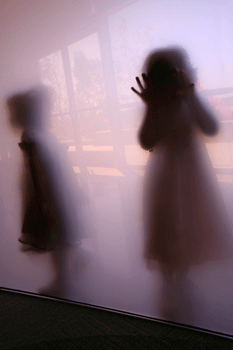

Known as a “complex developmental disability” autism can impact a wide variety of physical emotional and social skills. Affecting roughly one in 100 children — and appearing four times as often in boys — autism is a fast growing disability with almost two million cases in the US today. A new case is diagnosed every twenty minutes.
Autism or more correctly ASD (Autism Spectrum Disorder) is believed to be the result of a neurological disorder that affects the brain’s function and is usually detected during the first three years of life. It’s a “wide-spectrum disorder ” meaning that every person has a different combination of symptoms symptoms that vary from mild to severe. Physical symptoms often include an aversion to physical contact or fear of sudden noises lights or smells etc. Repetitive behaviors and obsessions are also common.
Many autistic children shy away from contact with others whether physical or social. For many parents that means that their child won’t look them in the eye and often won’t even let them hug him. For autistic children who don’t speak the lack of a relationship is even more painful — they feel that they can’t reach out to their parents and their parents can’t connect to them.
In most cases apart from the most severe autistic children don’t have any physical disability that prevents them from speaking or communicating nonverbally — the problem is in the brain. And it has been shown that with the right therapy many autistic children can be helped to open up to bridge the gap with the world around them and become an active — and happy — part of it.
Create a free account to keep reading.