The “Suppose You Were Starving” message resonated strongly with the crowd
When World War I erupted in the summer of 1914, it swiftly became evident that Jewish communities in the principal battle zones would bear a significant brunt of the conflict. Eastern Europe, home to most of the continent’s Jewish population, was frequently traversed by warring armies, which meant that entire communities were uprooted and destroyed. Pogroms and pillaging became tactics commonly employed by both invading and retreating forces. Even those fortunate enough to escape immediate violence still had to face dire conditions such as homelessness, hunger, and disease.
While the US entry into the war in 1917 was a turning point for the Allies, for the Jews of Eastern Europe, it was the relief provided by their brethren in America that would prove crucial. The creation of the Joint Distribution Committee in November 1914 was the impetus for a mass fundraising effort that funneled tens of millions of dollars to Jews suffering overseas.
Key to the effort was the relief committee formed in Chicago led by the banker Bernard Horwich. Others who took leading roles were Rabbi Ephraim Epstein (brother of the Slabodka rosh yeshivah, Rav Moshe Mordechai Epstein) and Samuel J Rosenblatt. In its first full year, the committee raised $220,000, a sum that continued to grow. In 1919, following Horwich’s trip to Poland and the subsequent harrowing reports he returned home with, the group raised $2.2 million. A large portion of that came from Sears, Roebuck and Company owner Julius Rosenwald in the form of a million-dollar donation, a sum so astronomical that it was hailed across the country and cited by President Woodrow Wilson.
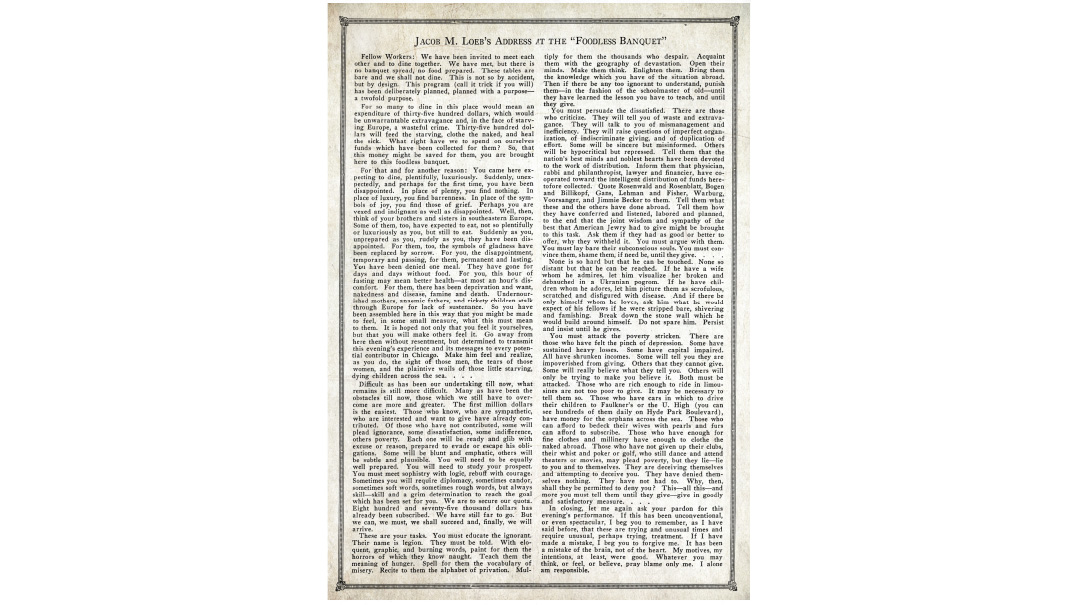
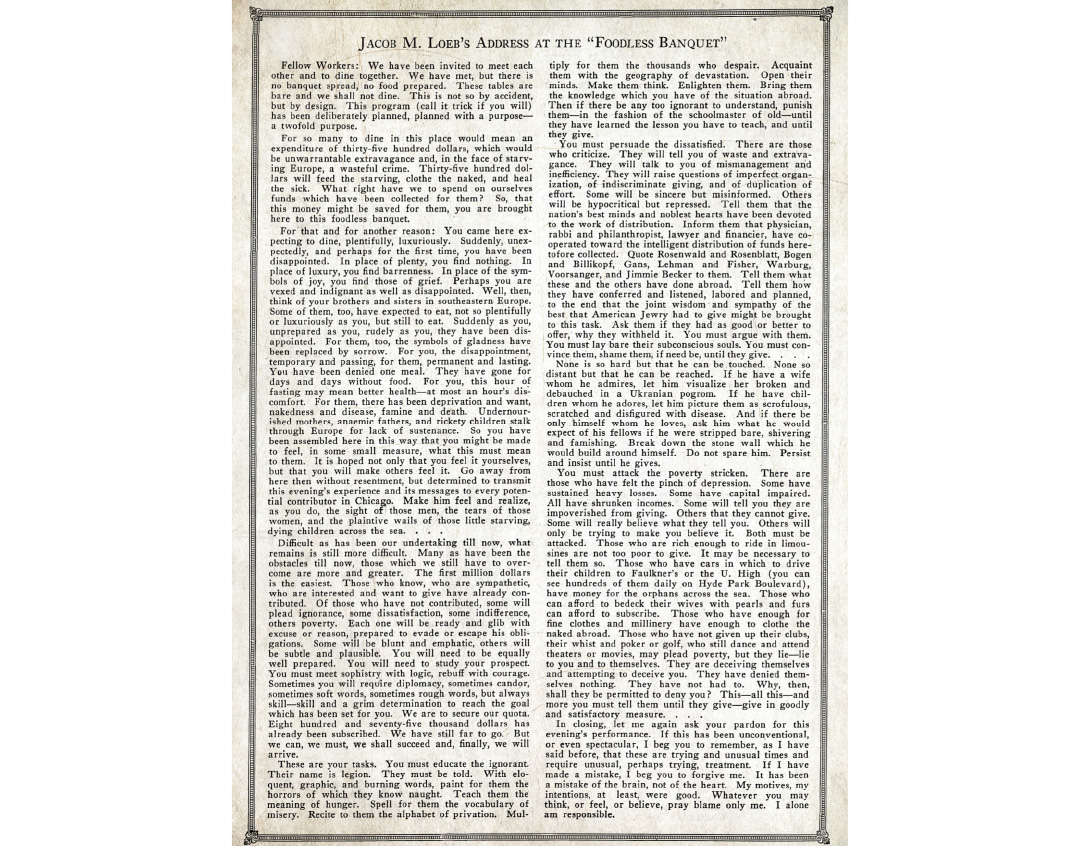
In 1920, the campaign slowed down, as life in much of the war zone resumed a semblance of normalcy. But when news of a deadly famine in Ukraine reached America, JDC activists in Chicago realized that after six years of nonstop fundraising, they needed a fresh idea to meet this urgent new need. Jacob M. Loeb, a banker who had delivered stirring speeches across the country during the previous campaigns, coined a slogan that he promised would soon be on the lips of every Jew in Chicago. “Suppose You Were Starving” was printed in newspaper ads, on flyers hung at every intersection, and worn on buttons by thousands of volunteers who canvassed the city for donations.
Create a free account to keep reading.