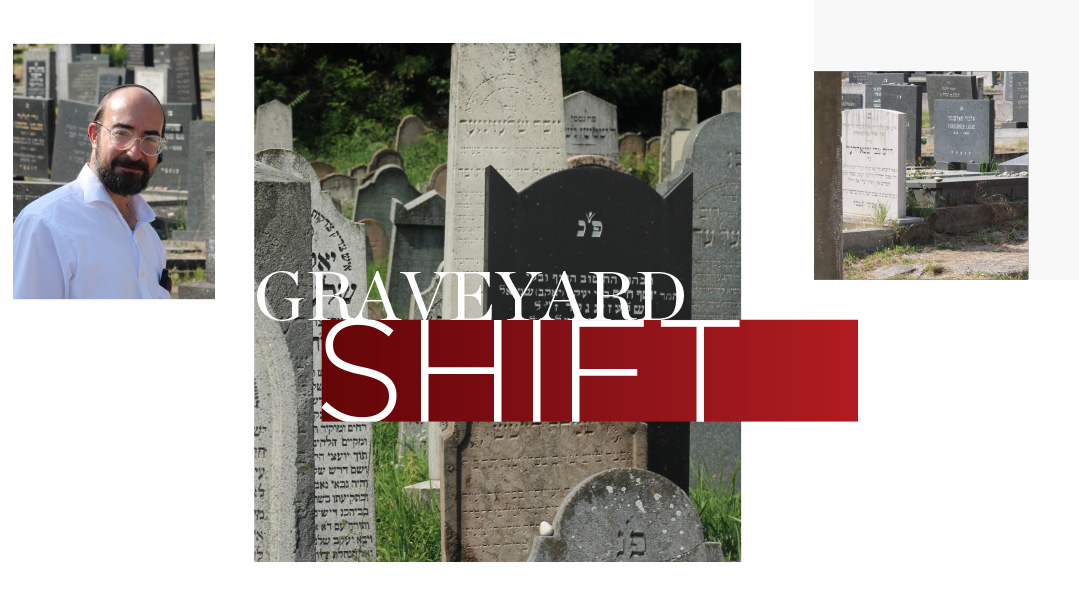
We’re in Bratislava, the Slovakian capital known in European Jewish history as Pressburg, here to visit the kever of the Chasam Sofer — whose yahrtzeit is on 25 Tishrei — and other kevarim in the newer cemetery on an adjoining hillside. We’re lucky to have Mr. Motty Hammer, head of the chevra kaddisha in Vienna and expert on kevarim all over Europe, as our personal guide.
Today, Motty explains, the Chasam Sofer memorial, part of an underground compound, is the sole remaining part of the centuries-old Jewish cemetery that was destroyed when the Nazis overran Slovakia in 1942. The Nazi-backed new Slovakian government ordered the entire cemetery — located on the bank of the Danube River which would invariably flood the nearby main highway — to be cleared in order to elevate the road by 12 feet. The local chevra kaddisha, on threat of being shot, didn’t dare object, and worked quickly to clear all the gravesites, leaving the section of the rabbanim, where the Chasam Sofer is buried, for the last — with the hope against hope that it would somehow be saved. And it was. One brave Jew came to the head of the chevra kaddisha with a massive bag of valuables, and they managed to bribe the Slovakian prime minister to pour a thick layer of concrete on top of the section where the Chasam Sofer is buried (there are an additional 23 graves of rabbanim in the section), and lay train tracks were laid over it instead of having it cleared out. The chevra kaddisha made sure that there would still be access to the tziyun, by quickly constructing a low-ceilinged tunnel under the tracks.
The hillside is immense, with thousands of kevarim stretching back from 1846 to today, as well as two huge matzeivahs memorializing the hundreds of graves from the old cemetery that the Nazis had cleared out and were reburied here in a kever achim, but Motty shows us around with ease. Today is also the yahrtzeit of my husband’s great-great grandmother, buried somewhere on that massive hill, but Motty easily locates her kever among the dozens of rows. “Of course I know where it is,” he says. “When the family replaced the stone, I schlepped it up here.”
Motty, a sociable Boro Park native who was a young yeshivah bochur when he first helped out on the chevra kaddisha doing shemirah, says his work, tending to niftarim and their permanent resting places, is a privilege. “If you do it right,” he says, “it’s not hard.”
Create a free account to keep reading.