“I have already been in this town for 24 hours and still cannot gather my strength to write my report”
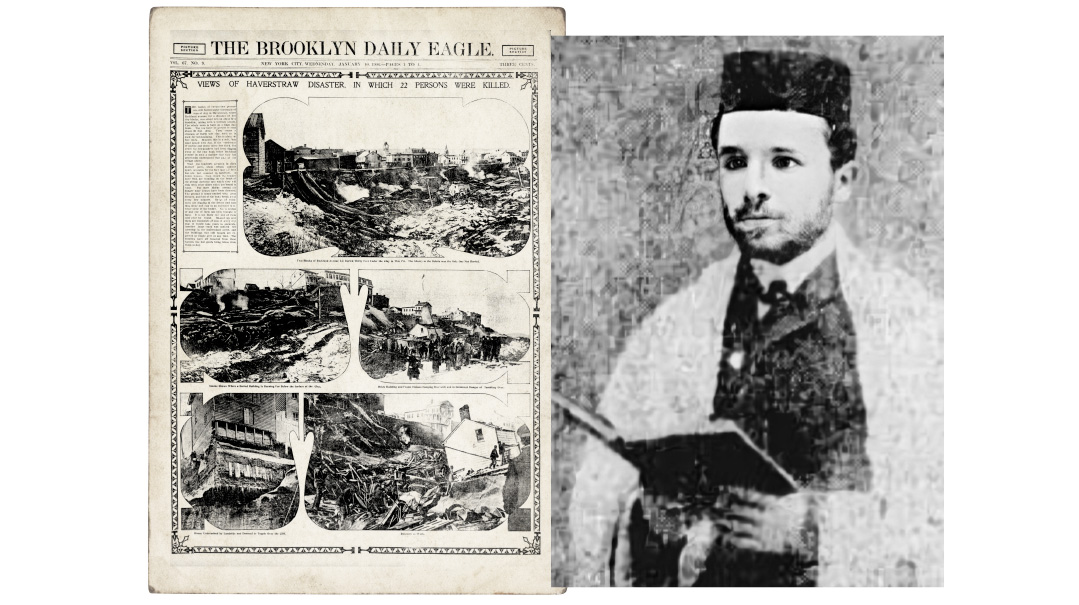
ON January 9, 1906, Nosson “Nathan” Zvirin, a veteran writer and editor for the Yidishes Tageblatt, was sent to Haverstraw, a town 40 miles north of New York City, to report on a breaking story. The Minsk-born Zvirin, who had emigrated from the land of pogroms and chaos several years prior, was shaken to the core by what he found in Haverstraw.
Prior to submitting his article for the evening paper titled “Robbery That Leads to Murder: How the Earth Swallowed Up Jewish Families in Haverstraw,” he filed the following single-line dispatch: “I have already been in this town for 24 hours and still cannot gather my strength to write my report.”
Haverstraw is a town in Rockland County, located 11 miles northeast of central Monsey. While today home to a budding Torah community, Haverstraw was once renowned as the brick-making capital of the world. In the 1880s, 40 brickyards lined the town’s banks on the Hudson. During its dominant age at the turn of the 20th century, more than 3,000 laborers shipped out more than 350 million bricks a year, providing construction materials for many of the large cities of the Northeast. Ultimately it was Haverstraw’s over-industrialization that caused a major industrial disaster in 1906.
The story of how the city came to be called “Bricktown, USA” is told by exhibits in the Haverstraw Brick Museum. During the 18th century, the Hudson River Valley was found to contain a rare variety of yellow and blue clay that was optimal for brickmaking. In order to extract the highest-quality clay, mines were built alongside the factories on the banks of the Hudson River, tunneling underground within the city limits. The Industrial Revolution improved the brickmaking process. In the decades following the great New York City fires of 1835 and 1845, which destroyed hundreds of wooden structures, a large demand for safe and durable bricks emerged, and the industry in Haverstraw boomed. Many of New York City’s original turn-of-the-century brownstones were built with Haverstraw bricks.
Create a free account to keep reading.