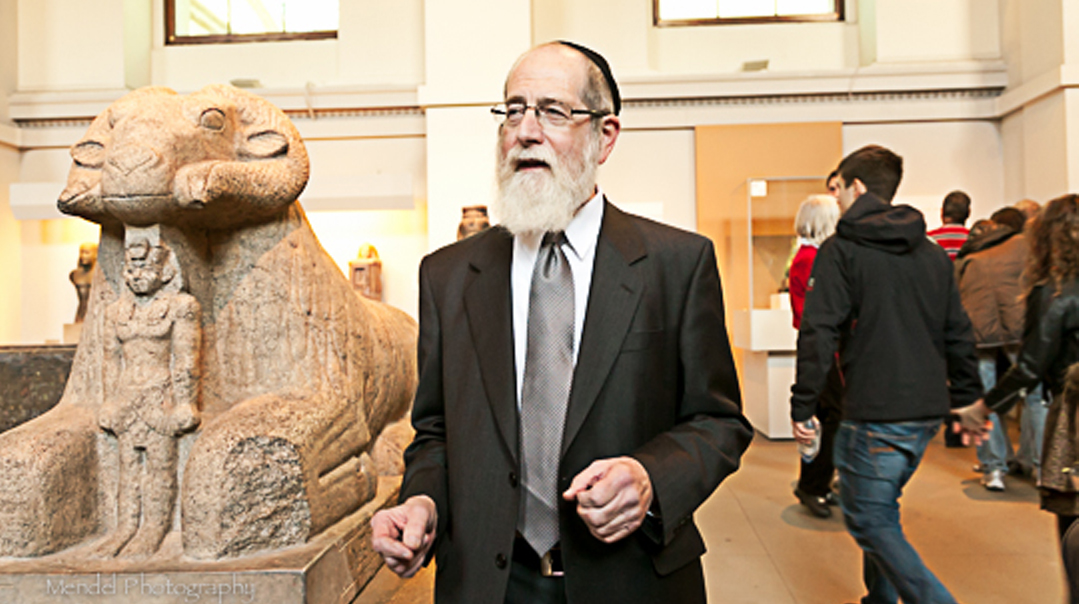
The British Museum’s collection of Egyptian artifacts is second only to the Egyptian Museum in Cairo. With this magnificent display as his background, Rabbi Arye Forta tells the story of our ancestors who lived in Mitzrayim.
M
ishpacha’s Tanach Tour at the Egyptology department in London’s British Museum takes place early on a recent Sunday morning. The labyrinthine quarters are alive with activity; we literally have to elbow our way through the throngs of visitors to keep up with our punctilious tour guide, Rabbi Arye Forta, who forges forward at a breathless pace. We weave our way between ancient mummies, busts, and statues, distracted en route by a blur of fascinating exhibits. We are only halted from time to time by our guide’s constant reminder that we not give in to curiosity and bend down to examine the inscriptions: some of the artifacts may be avodah zarah.
Unsuspecting visitors bearing backpacks and SLRs latch on to our private group, assuming our articulate guide comes with the price of admission. Impeccably mannered, Rabbi Forta doesn’t dismiss the newcomers but seamlessly glides into his tried-and-tested tactic: injecting more Hebrew and Yiddish terminology. It takes less than a minute for the interlopers to edge away, appearing apologetic as they disappear discreetly into the crowd without looking back.
British-born Rabbi Arye Forta has been giving his Tanach Tour for more than seven years and with Pesach approaching, the timing of our tour couldn’t be more appropriate. Of course, we won’t be able to see all the 100,000 objects relating to ancient Egypt, let alone the other seven million objects the museum owns. Only 5 percent of the collection is on display in the public galleries; the remainder is kept under lock and key, with the organic remains under strictly controlled temperature and humidity conditions.
Yet there is still plenty to see during our visit to the museum’s Egyptian galleries, whose prized possession is the Rosetta Stone, a second-century BCE stele that helped the world decipher Egyptian hieroglyphics. And Rabbi Forta — who has taught Biblical Hebrew, Tanach, and ancient Jewish history during a career that spans more than five decades — is a natural storyteller whose enthusiasm for the tour’s topic shows. But how did he make the leap from Tanach and Jewish history to becoming an expert in ancient Egyptian history as well?
Create a free account to keep reading.